
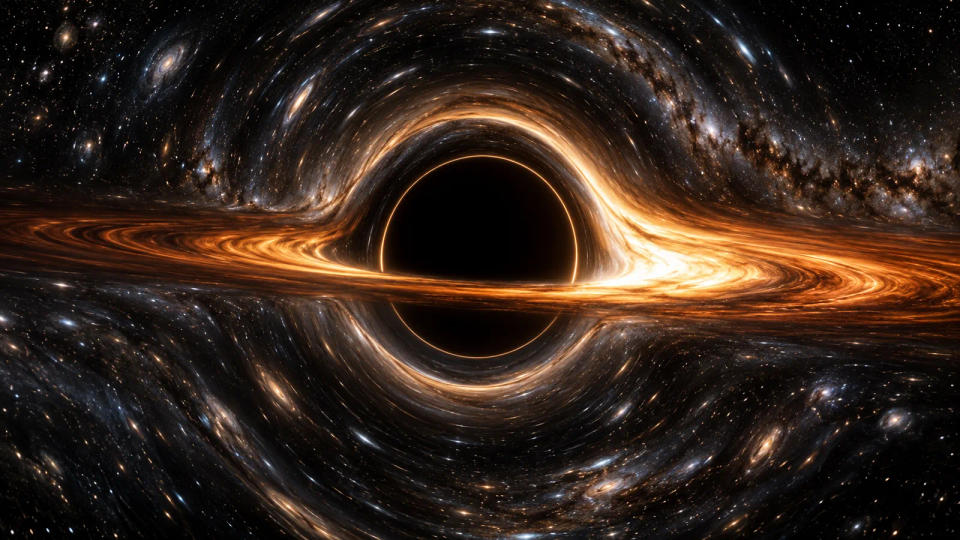
A black hole would not look like a giant cosmic drain waiting to swallow you. If you could survive the trip long enough to watch, the stranger sight would be everything around it: stars bent into arcs, a glowing disk folded into impossible shapes, and multiple images of the same light appearing in different parts of the sky.
The exact view would depend on the black hole, your path, and whether bright gas surrounded it. But general relativity gives us a surprisingly detailed picture of what an observer falling toward a black hole could see. NASA has even used supercomputer ray tracing to simulate the plunge toward a supermassive black hole similar in mass to the one at the center of the Milky Way.
The Black Hole Would Warp the Entire Sky
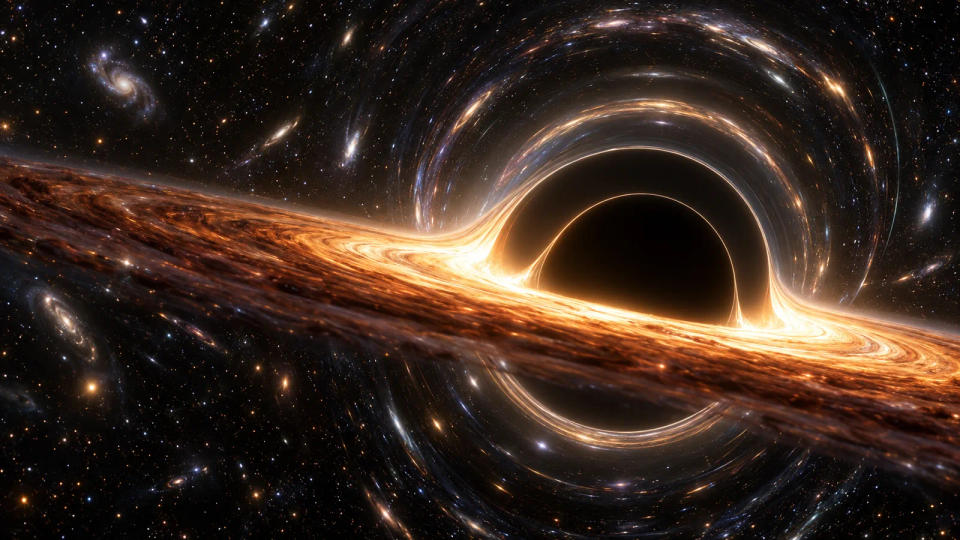
Long before you reached the event horizon, the sky would stop looking normal. A black hole curves spacetime so strongly that light no longer travels along paths that seem straight from far away. Light from stars, gas, and distant galaxies would bend around the black hole before reaching your eyes.
If the black hole had a bright accretion disk, the distortion would be especially dramatic. You could see the far side of the disk even though the black hole should seem to block it. Light from the rear of the disk can curve over the top and under the bottom of the black hole, making the disk appear to wrap around the dark center. Parts of it could seem duplicated.
Closer in, some photons can loop around the black hole one or more times before escaping toward you. These highly bent paths create thin, bright structures often described as photon rings. They are not solid rings floating in space. They are images produced by light taking extreme routes through curved spacetime.
Your own increasing speed would add another effect. Light coming from the direction you were moving could be boosted in energy and brightness, while light from behind would be altered in the opposite direction. The result would be a sky that is not only bent, but unevenly bright and increasingly compressed into distorted patterns.
The Darkness Would Grow, but There Is No Solid Surface
The black region would appear to occupy more and more of your view as you approached. It is tempting to imagine this darkness as the physical surface of the black hole, but an event horizon is not a wall. It is a boundary in spacetime beyond which outward escape becomes impossible.
What we often call a black hole's “shadow” is also larger than the event horizon itself. Light passing too close can be captured, while light passing along other paths can be bent around the hole and reach you. The combination creates a dark apparent region surrounded by strongly lensed light.
Meanwhile, a distant observer watching you fall would tell a very different story. Your signals would become increasingly redshifted and delayed. To them, your image would appear to slow and fade near the horizon rather than cleanly crossing it. Your own clock, however, would keep ticking normally. From your point of view, you would reach and cross the horizon after a finite amount of time.
Crossing the Event Horizon Might Look Surprisingly Ordinary
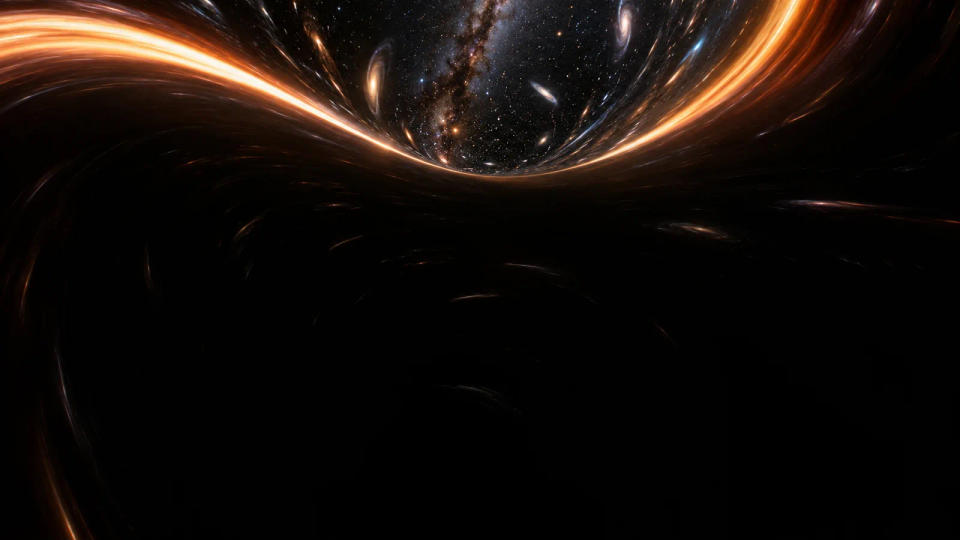
If the black hole were supermassive and you were freely falling, the instant of crossing might not come with a flash, impact, or visible boundary. Locally, there is no glowing line in space announcing that you have passed the point of no return. In classical general relativity, nothing special has to happen exactly at the horizon.
This is one reason a supermassive black hole is the more survivable choice for this thought experiment. Tidal forces depend on how quickly gravity changes from one part of your body to another. At the horizon of a small stellar-mass black hole, that gradient can already be enormous. At the horizon of a much larger black hole, it can be far gentler.
NASA's 2024 plunge visualization used a non-rotating black hole with 4.3 million times the Sun's mass, comparable to Sagittarius A* in our galaxy. Its event horizon was about 25 million kilometers across. In that particular simulated trajectory, the camera crossed the horizon before destructive tidal stretching arrived; the simulation placed its destruction by spaghettification about 12.8 seconds later. That timing is not universal. Change the black hole's mass, spin, or your trajectory, and the experience changes.
Inside, You Could Still See the Outside Universe
Crossing the horizon does not mean all outside light instantly disappears. Light from the universe can still fall inward and reach you, so for a while you could continue seeing stars and the accretion disk behind you. What changes is causality: you can receive light from outside, but no light signal you send can make it back out across the horizon.
As you fall deeper, your view would become more extreme. In NASA's simulated plunge, the accretion disk bends into a thin ribbon while the visible star field is squeezed into a smaller region of the sky and the rest of the view grows dark. Exactly how this looks depends on the observer's motion and the black hole's properties, so there is no single universal “inside view.”
The most important point is not that gravity somehow pulls light downward like a force acting in ordinary space. Inside the horizon, the structure of spacetime itself is such that every future-directed path leads farther inward. Moving toward the center becomes as unavoidable as moving toward tomorrow.
Eventually, the difference in gravity between your nearer and farther sides would become fatal. Your feet, if they were pointing toward the center, would be pulled inward more strongly than your head, while tidal gravity would squeeze you sideways. The combined stretching and compression is what physicists call spaghettification.
For a stellar-mass black hole, this could happen before you ever reached the horizon. For a sufficiently massive supermassive black hole, you might cross first and encounter the strongest tidal forces deeper inside. Either way, the tidal gradient becomes rapidly stronger as you approach the central region described by classical relativity as a singularity.
That last word also marks the limit of the story. General relativity predicts a singularity, but physicists do not yet have a complete quantum theory of gravity that tells us what really happens under such extreme conditions. We can describe the journey through the horizon and into increasingly severe tidal curvature, but the final destination is where our current theories stop giving a complete physical answer.
Conclusion
Falling into a black hole would be less like entering a dark tunnel and more like watching the universe itself become optically rearranged. The sky would bend, duplicate, brighten, and compress around a growing region of darkness. If the black hole were supermassive, you might cross the event horizon without noticing a precise visual boundary at all. Only later would the tidal forces make the journey unmistakably fatal.
The most astonishing part is that this picture is not pure science fiction. It follows from the same general relativity that successfully describes gravitational lensing, black hole shadows, and the motion of matter around compact objects. We cannot send a camera back from inside the horizon, but the mathematics lets us calculate what its final images could look like.
Post a Comment