

If the Sun suddenly turned into a black hole with exactly the same mass, Earth would not be sucked in. Our planet would keep orbiting almost exactly as it does now, because from Earth’s distance the central object would exert essentially the same gravitational pull.
The real disaster would be simpler: the sunlight would disappear. About eight minutes after the change, Earth would go dark, photosynthesis would stop, and the planet would begin a long plunge into cold. This is a hypothetical scenario—the real Sun is far too small to become a black hole.
Would a black hole Sun swallow Earth?
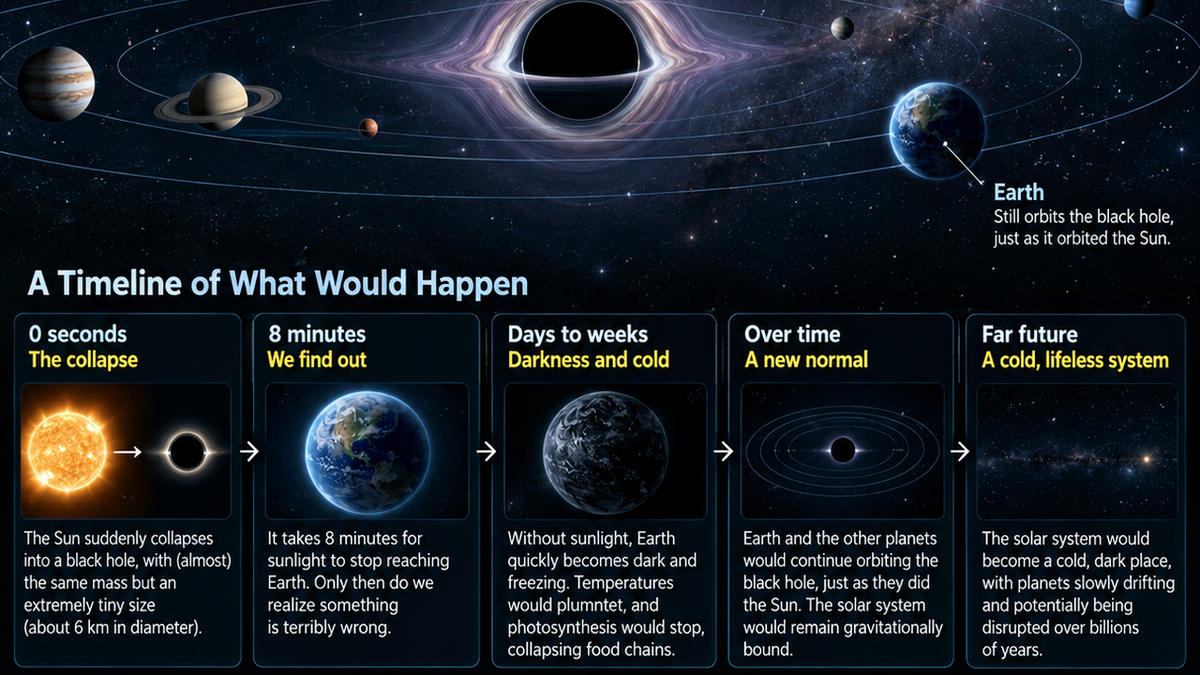
No. A black hole is not a cosmic vacuum cleaner that automatically drags in everything around it. If the Sun were replaced by a black hole of one solar mass, the mass controlling Earth’s orbit would be unchanged, so Earth would continue around it at roughly the same distance and speed.
NASA uses this exact thought experiment to explain black-hole gravity. Far from the event horizon, what matters most for an orbit is the central mass. Changing a large glowing star into an extremely compact object does not magically strengthen its gravity at Earth’s present distance.
How small would the Sun become?
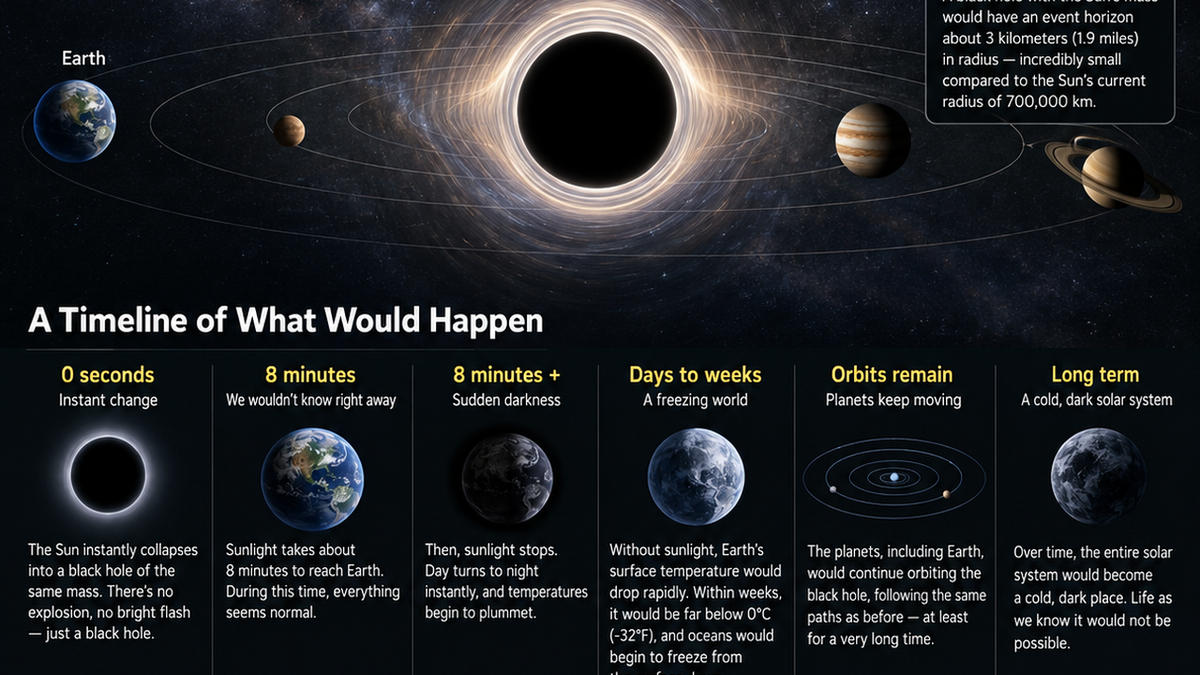
The size change would be astonishing. The Sun’s current radius is about 696,000 kilometers, but a non-rotating black hole with the Sun’s mass would have a Schwarzschild radius of only about 3 kilometers. In other words, the mass of the Sun would have to be compressed inside a region only a few kilometers across.
That boundary is the event horizon: once something crosses it, it cannot send light back out. But Earth sits about 150 million kilometers from the Sun, so it would be nowhere near the tiny event horizon. The frightening part would not be getting spaghettified; it would be losing the star that powers almost every surface ecosystem.
When would Earth notice that the Sun was gone?
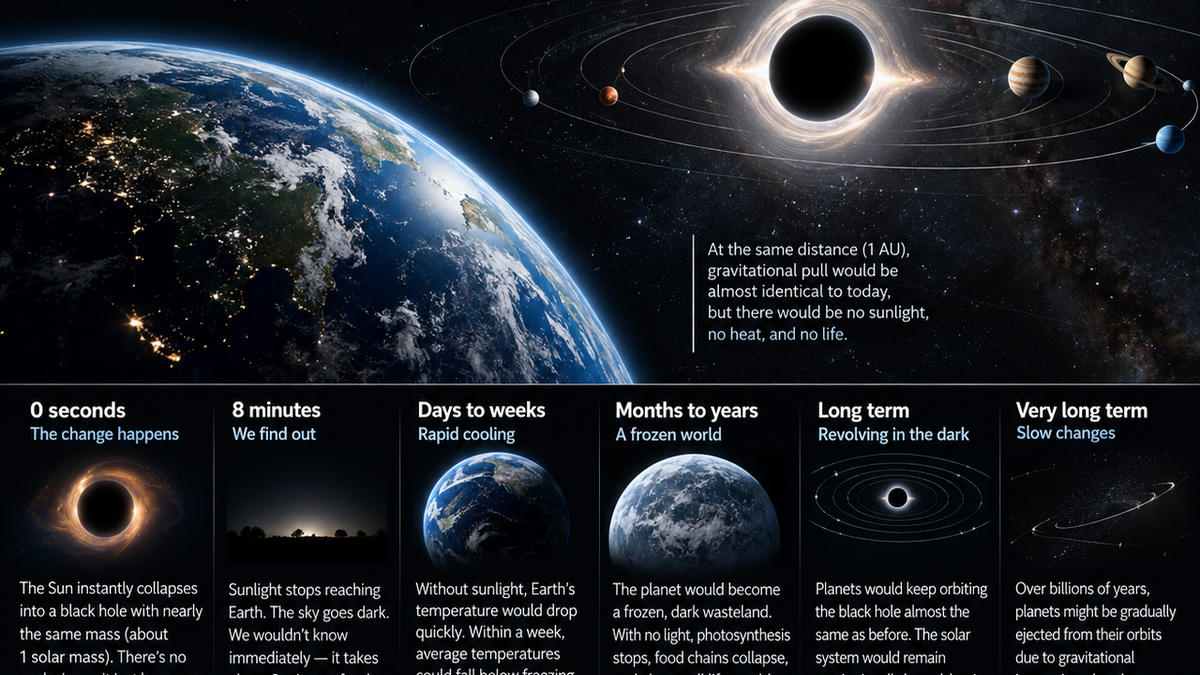
Not instantly. Sunlight takes about 8 minutes 20 seconds to cross the average Sun–Earth distance. In this impossible instant-change scenario, the last normal sunlight already in transit would keep arriving during that interval.
Then daylight would vanish. The Moon and planets would also lose the sunlight that normally makes them bright. Stars would remain visible, and human-made lights could continue while energy supplies lasted, but Earth would no longer receive the enormous continuous flow of solar energy that warms its surface.
How quickly would Earth freeze?

Earth would cool rapidly at first, but it would not become a solid ice ball in a single night. The atmosphere, oceans, rocks, and interior all store heat. Photosynthesis would stop almost immediately after darkness arrived, however, so food webs dependent on sunlight would face a crisis long before the deepest ocean froze.
Over longer periods, the surface would become brutally cold and much of the atmosphere could eventually condense or freeze. The deep ocean would take far longer to freeze completely because ice insulates the water below and geothermal heat continues to leak from Earth’s interior. Some microbial life in protected underground or deep-ocean environments might therefore persist much longer than surface life.
So the strangest answer is also the clearest: a black hole Sun would not destroy the Solar System by swallowing it. The planets could keep orbiting an almost invisible central mass while Earth became dark and increasingly frozen. Fortunately, this is not the Sun’s future—our star lacks the mass required to collapse into a black hole and will ultimately end as a white dwarf.
Post a Comment