


What if the Red Planet had never become the thin-aired desert we know today? Imagine Mars with clouds drifting over a blue northern sea, rivers cutting through rusty valleys, and weather that could keep liquid water on the surface for years instead of minutes.
That version of Mars is not pure fantasy. Ancient river valleys, lakebeds, deltas, and water-formed minerals show that early Mars once had much more surface water than it does now. A thicker atmosphere almost certainly played an important role. If Mars had somehow kept much of that atmosphere, it could be a far wetter and more habitable planet today. But it still would not automatically be a second Earth.
Mars Lost More Than Air — It Lost a Climate System
Modern Mars has an extremely thin atmosphere, dominated by carbon dioxide. With so little air above the surface, heat escapes quickly and liquid water is unstable across most of the planet. Water still exists, especially as ice, but long-lived rivers, lakes, and seas cannot simply sit under the open sky the way they do on Earth.
The ancient planet was different. Geological evidence points to flowing rivers, standing lakes, and repeated episodes when liquid water persisted on the surface. The exact climate remains debated: early Mars may not have been continuously warm everywhere, and some wet periods may have been intermittent. Even so, the rocks make one thing clear—the planet once supported conditions that were much more favorable to liquid water than today's Mars.
Over billions of years, Mars lost a large fraction of its atmosphere. Solar ultraviolet radiation and the solar wind helped drive gases into space, while other carbon and water ended up locked into rocks, ice, and the crust. Mars' smaller gravity made atmospheric escape easier than it is on Earth, and the loss of its global magnetic dynamo changed how the upper atmosphere interacted with the solar environment.
NASA's MAVEN mission spent more than a decade studying that escape. In 2025, researchers reported the mission's first direct observation of sputtering, a process in which energetic particles ultimately knock atmospheric atoms into space. That helped confirm one of the mechanisms scientists had long expected to be important in Mars' transformation.
A Thicker Atmosphere Could Have Kept Water on the Surface
If we change history and simply assume Mars retained a dense atmosphere, the biggest immediate difference would be pressure. Today's low pressure allows exposed liquid water to evaporate, freeze, or boil away rapidly depending on local conditions. A denser atmosphere would make liquid water physically easier to maintain.
It could also provide stronger greenhouse warming. Mars orbits about 1.5 times farther from the Sun than Earth, so it receives much less sunlight. An atmosphere capable of trapping more heat would therefore be essential for keeping large areas above freezing for meaningful periods.
But “thicker” does not automatically mean “warm enough.” Climate models show that carbon dioxide and water vapor alone have difficulty explaining a permanently warm early Mars under the faint young Sun. Other greenhouse gases, clouds, volcanic activity, orbital changes, and episodic warming may all have mattered.
In our alternate Mars, the atmosphere would need the right composition as well as enough mass. If that balance survived, rivers could have continued feeding lakes, groundwater could have remained active near the surface, and low-lying basins might have held long-lived seas. Some studies also suggest early Mars may once have possessed a surprisingly large water inventory, with much of the missing water later lost to space or stored in minerals and the crust.
Would Mars Actually Look Like a Second Earth?
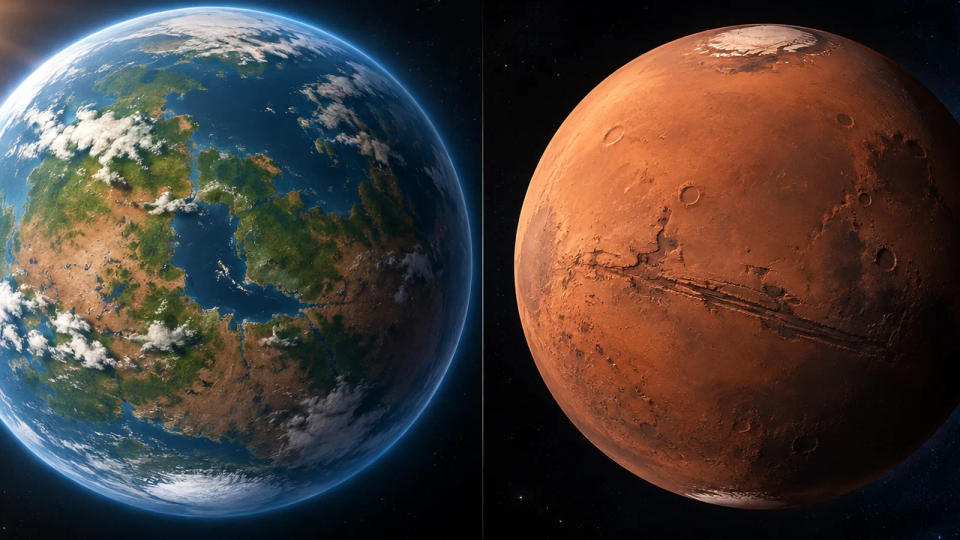
This is a speculative visualization, not a prediction: keeping a thick atmosphere would not by itself make Mars green or oxygen-rich.
From orbit, parts of it might look surprisingly familiar. A wet Mars could show white clouds, bright polar ice, dark water, and rusty continents. Because a Martian day lasts about 24.6 hours and its axial tilt is close to Earth's, the rhythm of daylight and the existence of seasons would also feel oddly familiar.
The resemblance would weaken as soon as we looked closer. Mars is only about half Earth's diameter and has much lower surface gravity. It is also farther from the Sun and follows a more elliptical orbit, giving its seasons a different character. Its geological engine is different too: Earth continually reshapes its surface through plate tectonics, while Mars has spent most of its later history as a stagnant-lid planet. A retained atmosphere would not erase those differences.
The planet's oceans, if they existed, might also be very unlike Earth's. Their extent would depend on how much water Mars kept and where it collected. A large northern ocean is one possibility often discussed, but the ancient shoreline history is still uncertain. Much of the southern highlands could remain dry, cold, and reddish even on a wetter planet.
So the most realistic “second Earth” would probably not be an Earth copy. It could instead be a distinct kind of habitable world: colder, lower-gravity, more seasonal, and dominated by red rock alongside lakes or seas.
The Real Wild Card Is Life
A stable atmosphere and liquid water would make Mars more promising for life, but they would not guarantee forests, animals, or even oxygen-rich air.
Earth's breathable atmosphere is not simply the default outcome for a wet rocky planet. Most of its free oxygen is tied to biology, especially oxygen-producing photosynthesis. For Mars to develop an oxygen-rich atmosphere, life would first have to originate—or arrive—and then evolve metabolisms that release oxygen faster than chemical reactions with rocks and volcanic gases could remove it.
That may never have happened. A wet Mars could have remained a microbial world for billions of years. Its lakes and shallow seas might have supported simple organisms while its land stayed barren. Or life may never have started at all, despite apparently favorable conditions. Earth is still the only planet where we know biology actually emerged.
There is another possibility: if life did begin early on Mars, keeping the atmosphere could have given it vastly more time to spread and evolve. On the real Mars, surface habitability declined as the climate dried and cooled. In the alternate version, long-lived water and a more protective atmosphere could have extended habitable environments across immense spans of geological time.
That is why this thought experiment matters beyond Mars. It shows how planetary habitability can depend on a long chain of physical events. Two rocky worlds can begin with some similar ingredients and still take very different paths.
If Mars had never lost most of its atmosphere, it might be one of the most spectacular worlds in the Solar System today—a cold but much wetter planet with clouds, rivers, lakes, and perhaps seas. It could even have remained habitable for far longer than the Mars we know.
But calling it a second Earth goes too far. An atmosphere could have preserved the stage for habitability. It could not guarantee the same climate, geology, chemistry, or biological history that made Earth what it is.
Post a Comment