

Imagine looking up one night and learning that Jupiter—the largest planet in the Solar System—has simply vanished. No explosion, no debris cloud, no replacement object. It is just gone.
The good news is that Earth would not be thrown out of the Solar System, plunged into darkness, or immediately bombarded by asteroids. The Sun overwhelmingly controls Earth’s orbit. Jupiter’s disappearance would matter, but it would be more like removing a major gravitational traffic controller than cutting the rope that holds Earth in place.
The most interesting changes would unfold gradually. The asteroid belt would lose its strongest planetary sculptor, many comet paths would evolve differently, Jupiter’s Trojan asteroids would lose the gravitational arrangement that keeps them clustered, and its moons would suddenly become independent worlds moving through the Solar System.
Earth Would Not Be Thrown Out of Orbit
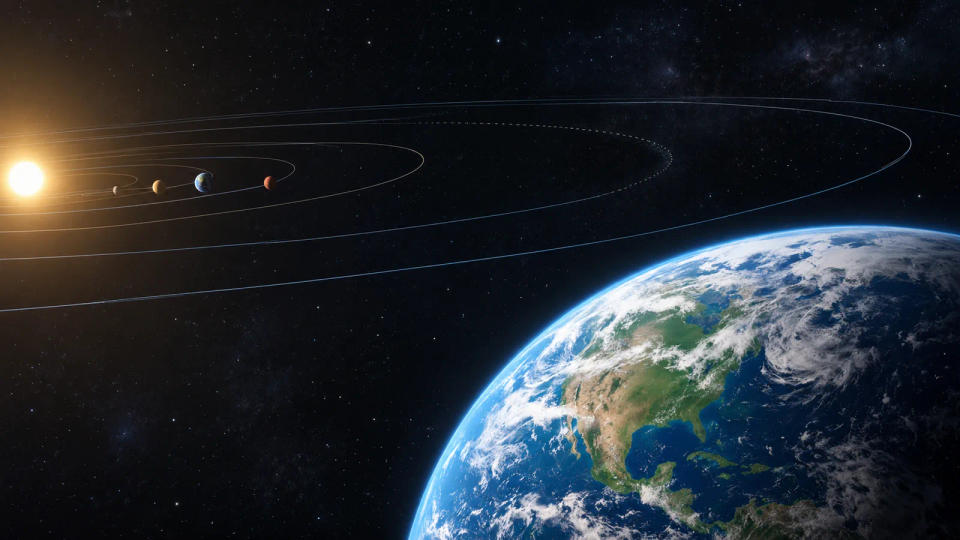
Jupiter is enormous by planetary standards. NASA’s planetary data put its mass at about 318 times Earth’s, and it orbits the Sun at an average distance of about 5.2 astronomical units, or 5.2 times Earth’s average distance from the Sun.
That sounds powerful enough to drag Earth around, but distance matters enormously in gravity. Earth is bound mainly to the Sun, which contains almost all the mass in the Solar System. Jupiter adds small gravitational nudges to Earth’s motion rather than controlling the orbit itself.
If Jupiter vanished in this thought experiment, the change in its gravity would not reach Earth instantaneously. Changes in the gravitational field propagate at the speed of light, so depending on where the two planets were in their orbits, Earth would continue responding to the old gravitational situation for tens of minutes.
Then almost nothing dramatic would happen to us.
Earth would keep moving around the Sun at nearly the same speed and distance. There would be no sudden change in sunlight, seasons, or surface gravity. Over years and centuries, astronomers would measure a slightly different orbit because one source of planetary perturbations had disappeared. Over millions of years, those tiny differences would compound, but “Jupiter vanished” does not mean “Earth leaves its orbit.”
The other planets would also remain bound to the Sun. Saturn, Uranus, and Neptune would begin evolving under a different balance of planetary tugs, especially because Jupiter plays such a large role in the long-term gravitational architecture of the outer Solar System. But they would not immediately scatter into interstellar space.
The Asteroid Belt Would Lose Its Biggest Sculptor
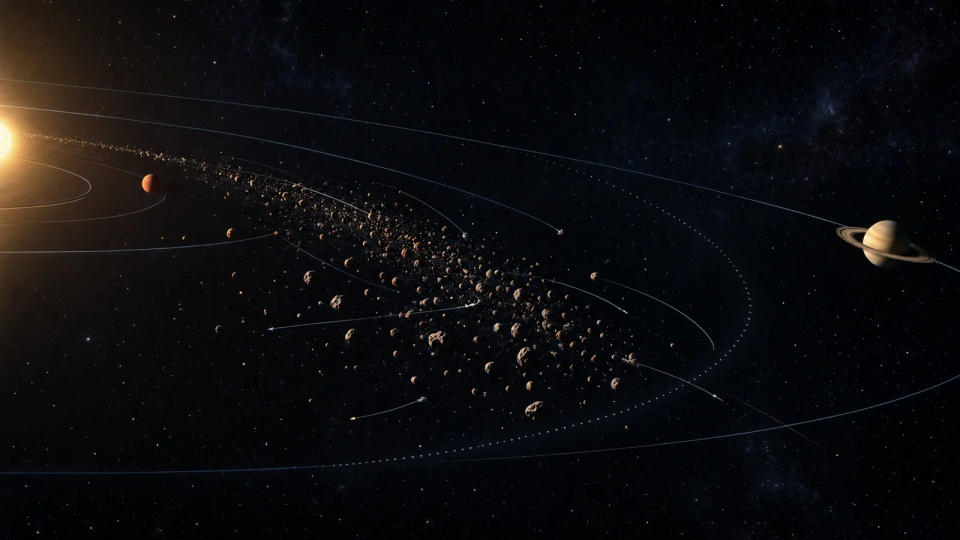
The most obvious long-term disturbance would appear in the small-body population between Mars and Jupiter.
Jupiter’s gravity helps shape the asteroid belt through orbital resonances. A resonance happens when two objects repeatedly line up in a regular rhythm—for example, when an asteroid completes three trips around the Sun for every one orbit of Jupiter. Those repeated tugs can slowly change the asteroid’s orbit.
JPL data show prominent “Kirkwood gaps” in the asteroid belt at several Jupiter resonances. These are regions where relatively few asteroids remain because Jupiter’s repeated gravitational influence has altered their paths over long timescales.
Remove Jupiter, and those Jupiter-driven resonances disappear.
That does not mean the asteroid belt explodes outward or immediately rains rocks on Earth. Every asteroid would keep the position and velocity it had at the moment Jupiter disappeared. From then on, however, its future path would be calculated in a Solar System with a major gravitational influence missing.
Mars and Saturn would still perturb asteroids. Collisions would still happen. Other resonances would remain. But the familiar structure of the belt would gradually evolve into something different.
Jupiter’s Trojan asteroids would face an even more direct change. These objects gather around two regions roughly 60 degrees ahead of and behind Jupiter in its orbit, where the Sun-Jupiter gravitational geometry allows them to remain clustered. Without Jupiter, those special Jupiter-linked regions would vanish. The Trojans would continue around the Sun, but the swarms would begin to disperse and evolve onto new trajectories.
Jupiter Is Not Simply Earth’s Cosmic Shield
A popular description says Jupiter protects Earth by swallowing or flinging away dangerous comets and asteroids. There is some truth in that, but the full story is more complicated.
Jupiter can remove small bodies from the Solar System. Its gravity can also capture or redirect objects, and the 1994 impacts of Comet Shoemaker-Levy 9 showed spectacularly that Jupiter itself can become a target.
But the same gravitational power can send objects inward.
NASA has noted that Jupiter’s gravity can both draw small bodies toward itself and fling others toward the inner Solar System. Dynamical studies have found that the effect on Earth’s impact rate depends on the population being considered. Jupiter is particularly effective at ejecting many long-period comets that arrive from the distant Oort Cloud. For asteroids and short-period comets, however, its presence can also help feed objects onto Earth-crossing orbits.
So if Jupiter disappeared, it would be misleading to say that Earth would simply become less protected and face a guaranteed increase in impacts. The impact environment would change, but not in one direction for every kind of object.
Existing near-Earth asteroids would not vanish, and planetary defense would remain necessary. At the same time, some pathways that Jupiter currently uses to push asteroids or short-period comets inward would weaken or disappear. Other objects that Jupiter now ejects could survive longer.
The final result would depend on long-term orbital evolution. It is a simulation problem, not a simple shield-versus-no-shield calculation.
The Strangest Chaos Would Begin Around Jupiter’s Old Neighborhood
The most dramatic local consequences would happen where Jupiter used to be.
Its moons are gravitationally bound to Jupiter because they are moving around the planet at specific speeds. Remove the planet instantly, and those moons keep moving with the velocities they already have—but suddenly there is no Jupiter to bend their paths into closed orbits around it.
Io, Europa, Ganymede, Callisto, and the smaller moons would become independent objects moving primarily under the Sun’s gravity. Their exact futures would depend on where each moon happened to be in its orbit at the instant Jupiter vanished.
Some could enter very eccentric solar orbits. Some might remain in the outer Solar System for long periods. Others could move onto paths that later bring them near Saturn or other objects. Because a moon’s orbital velocity around Jupiter would be added to Jupiter’s own motion around the Sun, the range of possible new trajectories would be surprisingly wide.
Jupiter’s faint rings would lose their central planet as well. Ring particles would spread onto independent paths instead of remaining organized around Jupiter.
And there would be a much larger change that no one on Earth could miss: the night sky would lose one of its brightest wandering objects. Jupiter has been watched since antiquity, and its four large moons helped Galileo provide decisive evidence that not everything in the heavens circles Earth. A planet that helped change our understanding of the cosmos would simply be missing.
Jupiter’s disappearance would therefore be a major event for the Solar System, but not an instant apocalypse for Earth. Our planet would keep circling the Sun, daily life would continue, and the biggest consequences would emerge through orbital mechanics over long spans of time.
The lasting takeaway is simple: Jupiter is neither a perfect cosmic guardian nor a distant bystander. It is one of the main gravitational architects of the Solar System. Remove it, and Earth survives—but the map of small worlds around us slowly begins to redraw itself.
Post a Comment