


Two suns in Earth's sky would not automatically destroy the planet, but our familiar world could survive only if the stars and Earth's orbit were arranged very carefully. If a second Sun identical to our own were simply added while Earth stayed at roughly its present distance, the planet would receive close to twice as much starlight. That would push Earth's climate far beyond the conditions we know today and would very likely make the surface too hot for long-term oceans.
There is, however, a much more interesting possibility. Earth could orbit both stars from farther away as a circumbinary planet—a planet that travels around a close pair of stars. If the two stars were each about as luminous as the Sun, Earth would need to orbit at roughly 1.41 astronomical units from their shared center of mass to receive about the same total amount of light it receives today. That estimate comes from the inverse-square law: twice the luminosity requires about the square root of two times the distance.
And this is not purely science fiction. Astronomers have already discovered real planets that orbit two stars. NASA's Kepler-16b was the first unambiguous example, proving that worlds with genuine double sunsets can exist. The real question, then, is not whether a two-sun planet is possible. It is whether an Earth-like climate, stable orbit, and biosphere could survive under one.
Would Earth Become Twice as Hot Under Two Suns?
The first surprise is that twice the sunlight does not mean twice the temperature. Temperature and incoming radiation are related in a nonlinear way. If Earth suddenly absorbed about twice its current solar energy while everything else remained the same, its simple radiating equilibrium temperature would rise by about 19 percent, from roughly 255 kelvins to about 303 kelvins.
That number is not a forecast for Earth's actual surface temperature. Our climate includes oceans, clouds, ice, water vapor, carbon dioxide, and many feedbacks. The important point is that doubling the sunlight would move Earth far inside the safe region where liquid surface water can persist. More evaporation would put additional water vapor into the atmosphere, strengthening the greenhouse effect. Melting ice would also expose darker land and ocean that absorb more sunlight.
So an Earth at its present distance from two Sun-like stars would probably not become a pleasantly warmer version of today's planet. It would be at serious risk of evolving toward a moist or runaway greenhouse state, where the oceans become increasingly unstable over geological time.
But the result changes if the stars are dimmer, cooler, or farther away. Two orange dwarf stars, for example, might together provide a similar energy budget to our single Sun. Even a Sun-like star paired with a much fainter red dwarf could produce a climate far less extreme than the simple “two Suns equals twice the heat” picture suggests.
The spectrum matters too. Hotter stars emit a larger fraction of their energy at shorter wavelengths, while cooler stars emit more red and infrared light. Clouds, atmospheric gases, ice, and plants interact differently with those wavelengths. A two-star climate is therefore controlled not just by the total brightness, but by the types of stars producing it.
What Would the Sky Look Like With Two Suns?

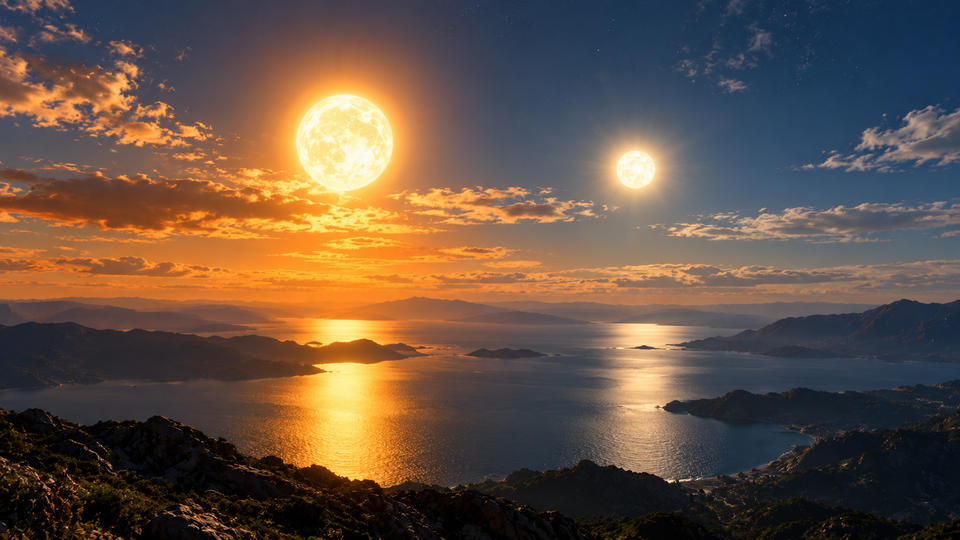
The most obvious change would be visual. At many times of the day, two bright disks could be visible in the sky at once. Their apparent separation would change as the stars orbited each other, so the “double Sun” would not look exactly the same from week to week.
Objects on the ground could cast two shadows, especially when the stars were well separated in the sky. One shadow might be darker and sharper if one star were brighter, while the other could be softer or tinted slightly differently if its star were cooler and redder. At other times, the shadows could overlap and become difficult to distinguish.
Sunrise and sunset would also become more complicated. One star might rise before the other, creating an extended dawn. In the evening, the brighter star could set first while the companion remained above the horizon, producing a second period of daylight or twilight. Nights would still exist because Earth's rotation could carry both stars below the horizon, but the timing of darkness would be less regular than it is now.
There could also be stellar eclipses. Because the two stars orbit their common center of mass, one could occasionally pass in front of the other from Earth's viewpoint. The sky would not become dark like a total solar eclipse on present-day Earth unless the geometry were unusually favorable, but the incoming light could briefly dip.
If the stars had different colors, the sky could change subtly through the day. A yellow-white primary and an orange-red companion would illuminate clouds, landscapes, and oceans with a mixture of color temperatures. Double sunsets could be spectacular, but they would be the visible result of a complicated clockwork of stellar and planetary motion.
Would Days, Years, and Seasons Become Chaotic?

A second Sun would not automatically change the length of a day. A day is mainly determined by how quickly Earth rotates on its axis, so a planet spinning once every 24 hours could still keep something close to our familiar day-night rhythm. What would change is the pattern of illumination during that rotation, because the two stars would not always occupy the same part of the sky.
The larger challenge is the orbit. In a stable circumbinary system, Earth would orbit the shared center of mass of the two stars rather than circling either one individually. The stars themselves would orbit that same center. For long-term stability, the planet generally needs to stay far enough outside the stellar pair that their rapidly changing gravitational pulls average into a more regular central attraction.
If the two stars were too widely separated compared with Earth's orbit, their gravity could destabilize the planet. But compact binary systems can support stable planetary orbits well beyond the stars. Several of the circumbinary planets discovered by Kepler demonstrate that such configurations can persist in nature.
Suppose, as a simple thought experiment, that two stars each had the Sun's mass and luminosity, orbited each other closely, and Earth moved out to about 1.41 AU to keep roughly today's total sunlight. The system would contain about twice the Sun's mass. Using Kepler's law, Earth's year in this simplified case would be about 1.19 present Earth years, or roughly 434 days. The exact number would depend on the stars' separation and the planet's actual orbit.
Seasons would still depend strongly on Earth's axial tilt. A tilted Earth would continue to alternate which hemisphere receives more direct light. But the binary stars would add extra cycles: their changing positions could slightly increase or decrease the total illumination, and any eccentricity in the stellar or planetary orbits could strengthen those variations.
A close, nearly circular binary could therefore produce surprisingly regular seasons. A wider or more eccentric pair could make the climate much less predictable. The two-sun Earth does not have to be chaotic, but it would have more astronomical rhythms layered on top of the familiar daily and yearly ones.
Could Life Survive on Earth With Two Suns?

Yes—in principle. The number of stars is less important than whether a planet receives the right amount of energy, keeps a stable orbit, retains an atmosphere, and maintains liquid water. Those conditions can exist around binary stars.
Researchers have even modeled Earth-size worlds in circumbinary habitable zones. In one NASA-described study of the Kepler-35 system, scientists placed a hypothetical ocean-covered Earth-size planet around two Sun-like stars. Depending on the planet's orbit, the changing starlight produced climate variations that were significant but not necessarily destructive. Near the colder edge of the modeled habitable zone, global average temperatures varied by only about 2 degrees Celsius over the year, while closer regions benefited from water vapor that helped buffer temperature changes.
The same basic limits still apply as in our Solar System. Too far from the stars, a planet could freeze into a global “snowball.” Too close, greenhouse warming could become uncontrollable. Between those extremes, oceans and an atmosphere can act like giant thermal batteries, smoothing some of the short-term changes caused by two moving light sources.
Life itself could adapt to the unusual light cycle. Photosynthetic organisms might evolve pigments that make better use of the combined spectra of both stars. Plants or plant-like life could respond to two moving light directions. Animals might use the relative positions of both suns as biological clocks. These are plausible possibilities, not observations—we have no evidence of life on any circumbinary planet.
What we do have is proof that two-sun worlds are real. Kepler-16b, about 245 light-years away, is a gas giant roughly Saturn-sized that circles both of its stars every 229 days. It is too cold and gaseous to be an Earth twin, but its discovery showed that planets can form and remain in orbit around binary stars. Other circumbinary systems, including Kepler-35, have strengthened that picture.
So what if Earth had two suns instead of one? If a second Sun suddenly appeared in our present Solar System, the abrupt increase in light and gravity would be catastrophic. But if Earth had formed in a carefully arranged binary system, the outcome could be very different. With the right stellar brightness, orbital distance, and climate, our planet could still have oceans, seasons, blue skies, and perhaps life—just under a far more complicated sky.
Post a Comment