

Two objects no bigger than cities can carry more mass than the Sun, circle each other hundreds of times per second, and then disappear into a collision so violent that it shakes space itself. That is what happens when a pair of neutron stars reaches the end of its long gravitational dance.
The result is not just one kind of explosion. A neutron star merger can produce gravitational waves, a brief flash of gamma rays, a glowing kilonova, newly forged heavy elements, and—depending on the total mass—a larger neutron star or a black hole. In 2017, astronomers watched this sequence unfold for the first time in both gravitational waves and light during the event known as GW170817.
Before Impact, the Stars Shake Space-Time

A neutron star is the crushed core left behind after a massive star explodes. Its matter is packed so tightly that a roughly city-sized object can contain more mass than the Sun. Put two of these remnants in orbit around each other and their gravity becomes an extraordinary laboratory for Einstein’s theory of general relativity.
As the pair orbits, it loses energy by emitting gravitational waves: ripples in space-time that travel outward at the speed of light. Losing energy makes the orbit shrink. The neutron stars move faster, the gravitational-wave signal rises in frequency, and the pair spirals inward more quickly. Detectors such as LIGO and Virgo hear this rising pattern as a characteristic “chirp.”
Near the end, the stars are moving at a substantial fraction of the speed of light. Their immense gravity also raises tides in each other. Unlike a collision between rigid balls, the final approach involves nuclear matter being stretched, distorted, and sometimes stripped away before the stellar cores fully merge. The last stage happens in milliseconds.
GW170817 provided the first direct gravitational-wave detection of two neutron stars merging. The signal reached Earth on August 17, 2017, after traveling from a galaxy about 130 million light-years away. It gave astronomers a way to follow the stars before any telescope saw the explosion itself.
The Collision Produces a Kilonova—and Can Launch a Gamma-Ray Burst
When the neutron stars finally meet, enormous amounts of orbital energy are converted into heat, motion, radiation, and turbulence. Magnetic fields can be amplified dramatically, while neutron-rich matter is thrown away from the merger site. Some of that debris can race outward at around a tenth of the speed of light.
Under the right conditions, the remnant and its surrounding disk can also drive narrow jets of particles at nearly the speed of light. If a jet is aimed close enough to our line of sight, we may detect a short gamma-ray burst. These are among the most intense flashes of high-energy radiation known, but they last only briefly.
That does not mean every neutron star merger will look the same from Earth. A gamma-ray jet is narrow, so viewing angle matters. The amount of ejected matter, the masses of the original stars, their spins, and the fate of the remnant can all change what astronomers observe.
In GW170817, NASA’s Fermi spacecraft detected a short gamma-ray burst just 1.7 seconds after the gravitational-wave signal. Hours later, telescopes identified a new source of visible and infrared light in the galaxy NGC 4993. That fading glow was a kilonova: light powered largely by the radioactive decay of freshly created nuclei in the expanding debris.
The Debris Forges Some of the Universe’s Heaviest Elements
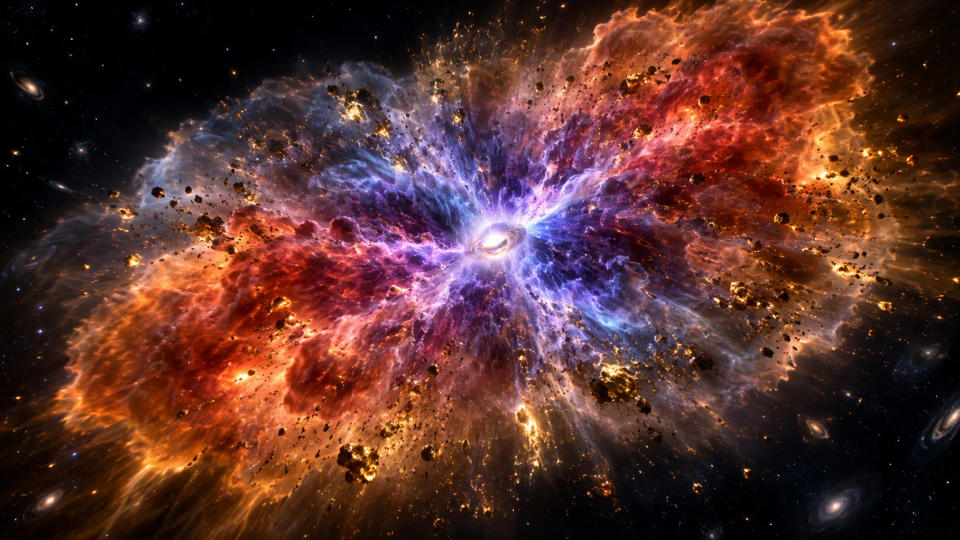
The strange chemistry of a kilonova is one of the most fascinating parts of the collision. The expelled material contains huge numbers of free neutrons. Atomic nuclei can capture those neutrons extremely rapidly in a process called the r-process, short for rapid neutron capture.
This process can build nuclei much heavier than iron. As those unstable nuclei decay toward more stable forms, they release energy that heats the expanding debris and powers the kilonova’s changing glow. The same chain of reactions can produce elements in the region of the periodic table that includes gold, platinum, and other rare heavy species.
Astronomers had suspected for decades that neutron star mergers were important factories for r-process elements. GW170817 gave powerful observational support to that idea because its optical and infrared light evolved in the way expected from radioactive, neutron-rich ejecta.
There is now even more direct evidence. In 2023, the James Webb Space Telescope observed the kilonova associated with GRB 230307A, an event linked to a neutron star merger, and identified tellurium in its spectrum. Tellurium is a heavy element rarer than platinum on Earth. The detection did not mean that every heavy element came from that one event, but it showed that astronomers can now identify individual heavy elements in merger debris rather than infer the chemistry only from the overall color of the explosion.
What Is Left Behind: a Bigger Neutron Star or a Black Hole?
The collision does not have one guaranteed ending. The remnant depends strongly on the total mass of the system and on how matter behaves at densities far beyond anything we can reproduce in laboratories.
If the merged object is too massive to support itself, it may collapse into a black hole almost immediately. In other cases, the merger can first produce an extremely massive, rapidly rotating neutron star. Rotation and thermal pressure may support it for a short time—or, in some scenarios, much longer—before it also collapses. A sufficiently low-mass remnant could remain a neutron star.
This uncertainty is scientifically valuable. The exact dividing line between survival and collapse depends on the neutron-star equation of state, the relationship between pressure and density inside ultradense matter. Gravitational waves from the inspiral, and eventually from the post-merger remnant, can therefore reveal information about matter at densities comparable to an atomic nucleus.
For GW170817, observations did not provide a direct picture of the final compact object. Analyses have favored a short-lived, very massive neutron star that later collapsed into a black hole, but other possibilities have been harder to rule out completely. Future detections with more sensitive gravitational-wave observatories should make that final stage easier to study.
Why Neutron Star Collisions Matter
A neutron star merger is a rare moment when gravity, nuclear physics, high-energy radiation, and the origin of the elements all become visible in the same event. Gravitational waves reveal the motion of the stars, gamma rays can expose relativistic jets, and visible and infrared light trace the radioactive debris.
That combination makes these collisions more than spectacular explosions. They are natural laboratories for matter under extreme pressure and one of the clearest known routes for creating heavy elements. Some of the atoms in jewelry, electronics, and even living organisms may ultimately owe their existence to violent stellar mergers that happened long before the Solar System formed.
Post a Comment