

What happens to Earth when sunspots increase? The short answer is that Earth does not suddenly become much hotter, but the chances of disruptive space weather increase. More sunspots usually mean the Sun's magnetic field is in a more active and tangled state, making solar flares and coronal mass ejections more likely.
Most of that activity is harmless to people on the ground because Earth's atmosphere and magnetic field provide strong protection. The effects are felt most clearly by technology: satellites, radio communication, GPS, power grids, and spacecraft can all be affected when a strong solar eruption is aimed our way.
Why Do More Sunspots Mean a More Active Sun?
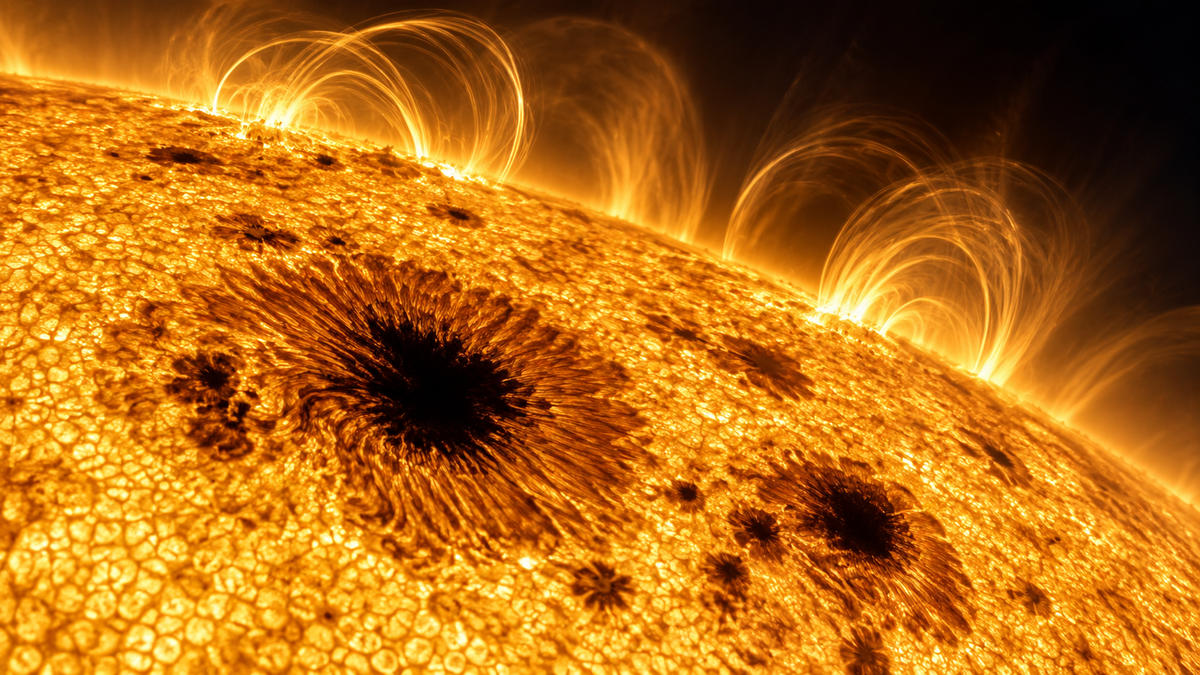
AI-generated scientific visualization.
A sunspot looks dark because it is cooler than the surrounding solar surface, not because it is cold. The Sun's visible surface is roughly 5,500°C, while the darkest parts of large sunspots can be thousands of degrees cooler. They still glow intensely, but against the brighter surroundings they appear almost black.
The reason for that cooling is magnetic. Strong magnetic fields push through the Sun's surface and interfere with the normal upward flow of hot plasma. Less heat reaches the surface in those regions, creating the darker spots we see.
Sunspot numbers rise and fall as part of the Sun's roughly 11-year activity cycle. Near solar maximum, the magnetic field becomes more complicated, more active regions appear, and the Sun is more likely to produce powerful flares, bursts of energetic particles, and coronal mass ejections, or CMEs.
That does not mean every large sunspot will explode. A sunspot count is better thought of as a sign of the Sun's overall magnetic mood: more spots generally mean a busier Sun, but the details of each active region still matter.
Do More Sunspots Make Earth Hotter?
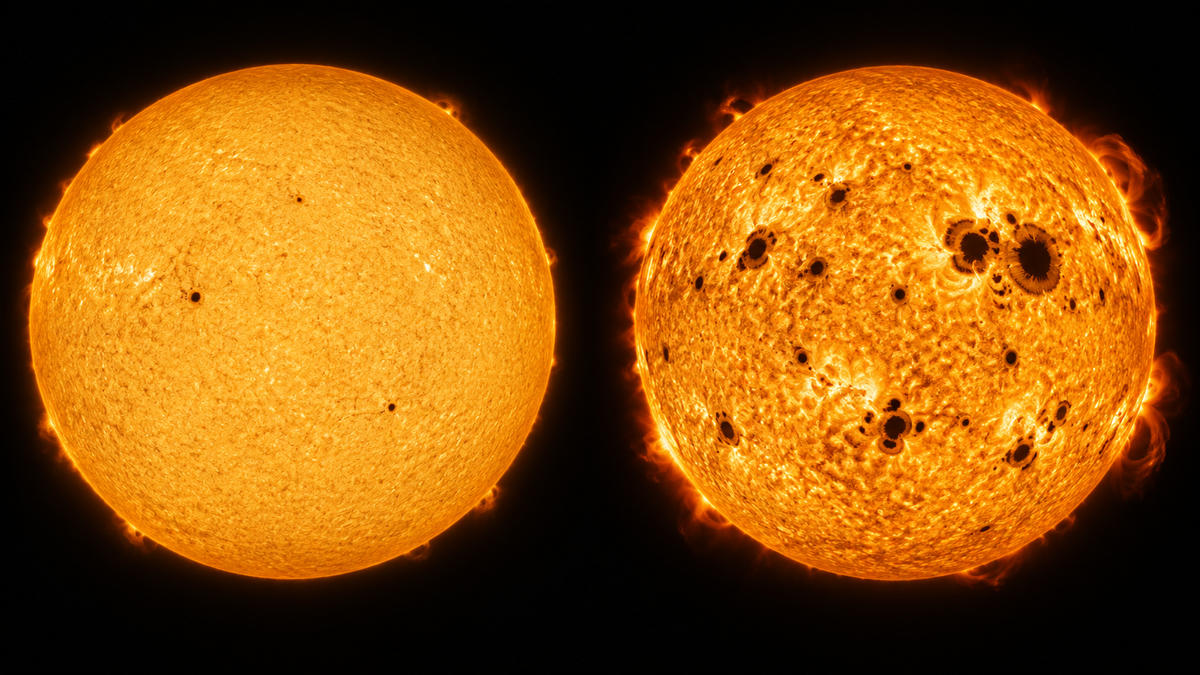
AI-generated scientific visualization.
It sounds logical that more dark spots should make the Sun dimmer. In the short term, a very large sunspot group can slightly reduce the sunlight reaching Earth as it crosses the solar disk. But over an entire solar cycle, the opposite trend wins.
Active regions around sunspots contain bright areas called faculae. Their extra brightness more than compensates for the dark sunspots, so the Sun is usually a little brighter near solar maximum. NASA measurements show that total solar energy reaching Earth changes by only about 0.1 percent across the 11-year cycle.
That small variation can influence the upper atmosphere and contributes a weak natural climate signal, but it does not produce a dramatic temperature jump at Earth's surface. It is also far too small to explain the strong global warming observed in recent decades; long-term measurements show no comparable sustained rise in solar energy while global temperatures have increased.
So if sunspots suddenly become more numerous, the main question is not, "Will Earth overheat?" It is, "Will one of those active regions launch a solar storm toward Earth?"
What Can a Busier Sun Actually Do to Earth?
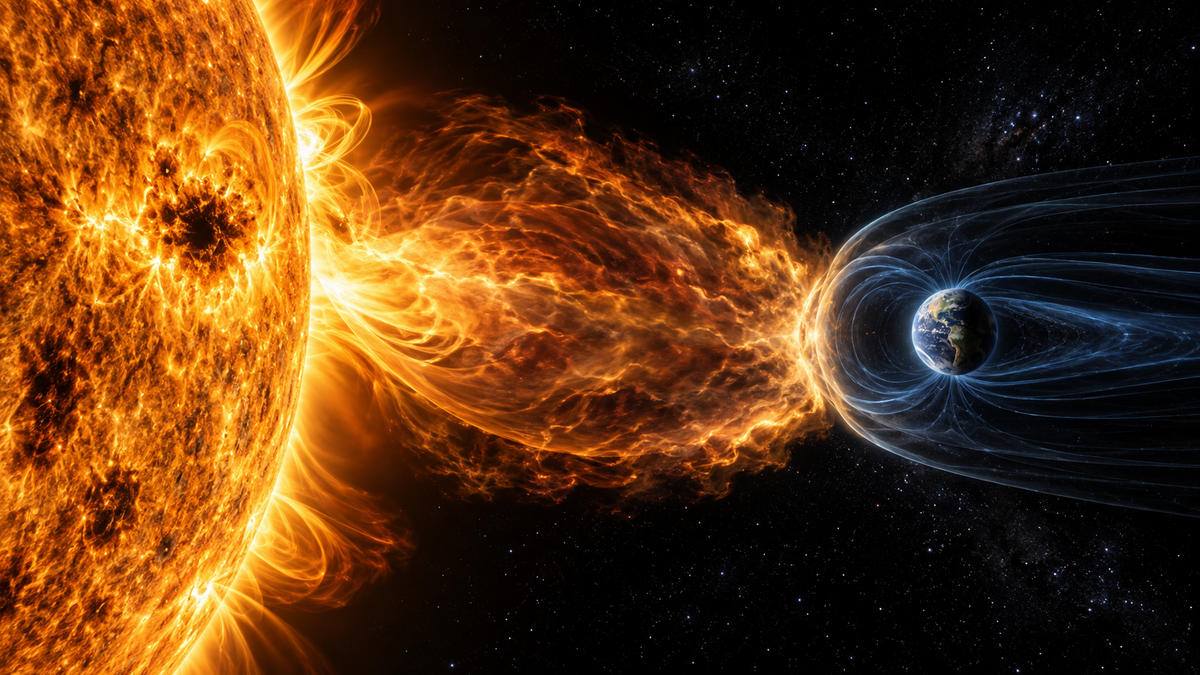
AI-generated scientific visualization.
The effects depend on what the Sun releases. A solar flare is a sudden burst of electromagnetic radiation. Strong X-rays can reach Earth in about eight minutes and disturb the ionosphere on the daylight side of the planet, sometimes causing high-frequency radio blackouts.
Energetic particles can arrive later and create radiation problems for spacecraft electronics and astronauts outside the strongest protection of Earth's atmosphere and magnetic field. They can also disrupt radio communication on polar routes, which is one reason space weather matters to aviation as well as spaceflight.
A coronal mass ejection is slower but can be much more disruptive. It is a huge cloud of plasma carrying its own magnetic field. If a CME is directed toward Earth, it can arrive roughly one to three days later and shake Earth's magnetosphere, producing a geomagnetic storm.
During strong geomagnetic storms, auroras can become brighter and spread to lower latitudes because more charged particles are guided into the upper atmosphere. The same disturbance can change the ionosphere enough to reduce GPS accuracy, increase atmospheric drag on low-Earth-orbit satellites, and induce unwanted electrical currents in long power lines.
There is an important limit, though: more sunspots do not guarantee a major storm at Earth. Flares must occur on the Earth-facing side to affect our ionosphere directly, and a CME must be launched in the right direction for its plasma cloud to hit our planet. A very active Sun can produce many eruptions that miss Earth completely.
That is why scientists watch not only the number of sunspots, but also the magnetic complexity of active regions, the direction of eruptions, the speed of CMEs, and the orientation of their magnetic fields. Sunspots are the warning signs; the actual danger depends on what happens next.
So when sunspot numbers rise, Earth usually does not notice through ordinary weather or a sudden change in temperature. What changes is the probability of stronger space weather. For most people, the most beautiful result may be a wider aurora. For satellites, astronauts, navigation systems, radio operators, and power-grid managers, the same active Sun is something to watch much more carefully.
Post a Comment