

A scrap of metal only a few millimeters wide does not look dangerous on Earth. In orbit, it can hit a satellite at several kilometers per second and turn a tiny impact point into a serious engineering problem in an instant.
The reason is speed. NASA says orbital-debris impacts in low Earth orbit occur at about 10 km/s on average and can reach roughly 15 km/s. At those velocities, a fragment does not simply bounce off a spacecraft. It can crater metal, punch through thin structures, damage electronics or, if the object is large enough, break the satellite apart.
And there is far more debris than the objects we can easily track. ESA statistics updated July 31, 2026 list about 46,950 space objects regularly tracked by surveillance networks. ESA's models estimate another 1.5 million debris objects between 1 and 10 centimeters and about 230 million between 1 millimeter and 1 centimeter. That enormous smaller population is why spacecraft designers worry about objects that may never appear in a collision warning.
Why Space Junk Hits Satellites So Hard
A satellite in low Earth orbit typically travels around Earth at roughly 7 to 8 km/s. Debris is moving too, often in a different orbital plane or direction. What matters during a collision is the relative speed between the two objects, which is why an encounter can be much faster than either object seems by itself.
Impact energy also rises with the square of velocity. Double the impact speed and the kinetic energy becomes four times larger, assuming the mass stays the same. That makes velocity more important than our everyday intuition suggests. A lightweight fragment moving at orbital speed can deliver an impact far beyond what its size would imply on the ground.
At these hypervelocity speeds, the collision becomes an extreme materials event. The shock pressure can exceed the strength of the projectile and the spacecraft surface. Material may fracture, melt or partly vaporize, and fragments can spray away from the impact site. The result is closer to a tiny, violent crater-forming event than to a pebble hitting a car.
Damage Depends on Size — and Where the Debris Hits
Not every strike destroys a satellite. In fact, spacecraft are routinely hit by very small particles with little or no operational effect. NASA has documented thousands of tiny impact pits on spacecraft surfaces that spent years in orbit.
The danger rises quickly as the object gets larger. ESA's hypervelocity-impact guidance describes a progression from small surface pits caused by micrometer-scale particles to penetration by millimeter-scale objects and mission-critical damage from projectiles larger than about a centimeter. A collision with a roughly 10-centimeter cataloged object can be energetic enough to catastrophically break apart a spacecraft.
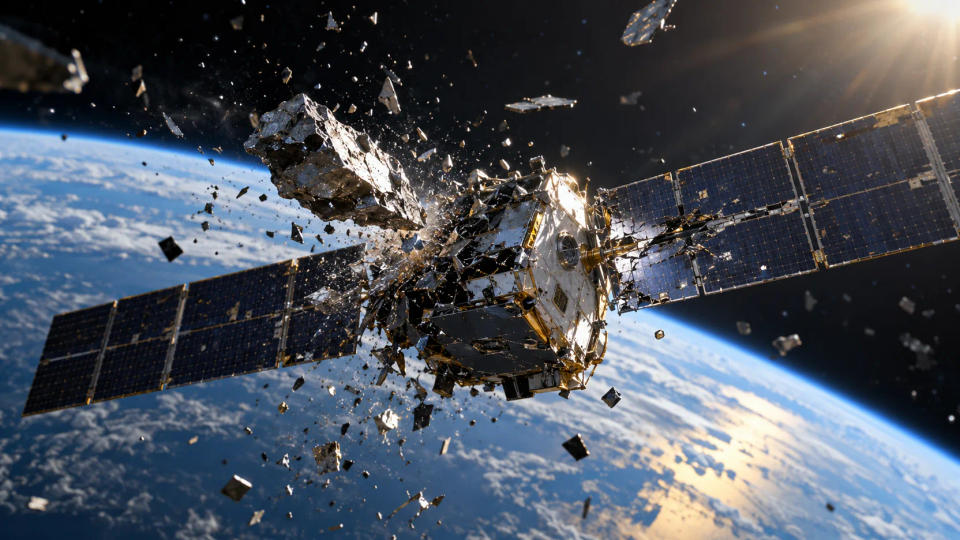
Location matters just as much as size. A fragment that strikes a noncritical outer panel may leave a crater and little else. A similar fragment that penetrates a propellant tank, radiator line, battery, computer, star tracker or power cable could disable a vital system. Solar arrays and antennas are especially difficult to protect because they must remain exposed to work.
What Happens Inside a Satellite After the Impact?
A satellite does not necessarily explode when debris hits it. The most common outcome from small impacts is much less dramatic: a pit, a puncture, chipped material or localized damage. Whether the mission notices the hit depends on what lies behind that spot.
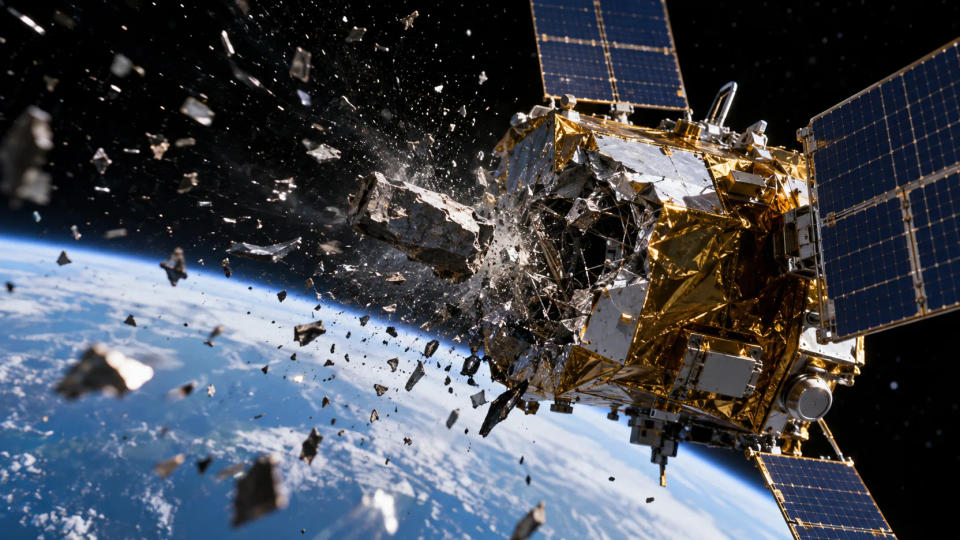
If the fragment reaches a sensitive subsystem, the failure can spread. A severed electrical harness can cut power or communications. A damaged radiator can allow a spacecraft to overheat. A punctured pressure vessel or propellant line can leak. Damage to attitude-control hardware can prevent the satellite from pointing its antennas, cameras or solar arrays correctly.
The impact can also create secondary fragments from the spacecraft itself. Pieces of the outer surface may become ejecta and strike nearby hardware. With a sufficiently energetic collision, the original satellite can fragment into a cloud of new debris, turning one failed spacecraft into a hazard for many others sharing the same orbital region.
Can Satellites Dodge or Block Space Junk?
For larger objects that can be tracked, the best defense is not to be there when they arrive. Ground-based surveillance systems predict close approaches, known as conjunctions. Satellite operators can then refine the predicted trajectories and, when necessary, command a collision-avoidance maneuver. The maneuver may be small, but changing the satellite's position by even a modest amount in advance can create a safe separation later.
This approach has limits. A dead satellite cannot maneuver. Every burn uses propellant or affects mission planning. More importantly, much of the millimeter-to-centimeter debris population is too small to be routinely cataloged and followed as an individual object, so there may be no warning at all.
That is where passive protection matters. Some spacecraft use layered shields in which an outer bumper breaks up an incoming particle before the fragments reach the main wall. The classic example is the Whipple shield, used in different forms on crewed spacecraft and other vulnerable systems. The gap between layers gives the debris cloud room to spread, distributing the impact over a larger area. But shielding adds mass, and large solar panels, sensors and antennas cannot simply be wrapped in armor.
Why One Collision Can Create Thousands of New Hazards
The most important consequence of a major debris strike may come after the original satellite is already lost. On February 10, 2009, the operational Iridium 33 communications satellite collided with the derelict Russian Cosmos 2251 satellite at about 790 kilometers altitude. NASA's analysis put the relative velocity at 11.6 km/s and identified it as the first known unintentional hypervelocity collision between two intact satellites.
The crash produced thousands of fragments, including many pieces too small to track individually. Those fragments did not simply fall straight down. They spread into related orbits, where they could encounter other spacecraft years later. A collision can therefore create the ingredients for future collisions.
This is the feedback process behind the idea often called the Kessler syndrome. It does not mean that one accident instantly fills all of near-Earth space with debris. It means that, in crowded orbital regions, collisions can generate fragments that raise the chance of more collisions. ESA's 2026 Space Environment Report warns that debris can continue to grow through this collision-driven cycle and says active debris removal is needed alongside better prevention and end-of-life disposal.
Space junk therefore threatens satellites on two scales at once. A tiny unseen fragment can damage one spacecraft in a fraction of a second, while a catastrophic collision between large objects can reshape the risk environment for years or decades.
The takeaway: space junk does not need to be large to be dangerous. In orbit, speed turns even small fragments into high-energy projectiles. Satellites survive by combining tracking, avoidance, shielding and careful design—but every major collision that is prevented also helps protect the orbital environment itself.
Post a Comment