
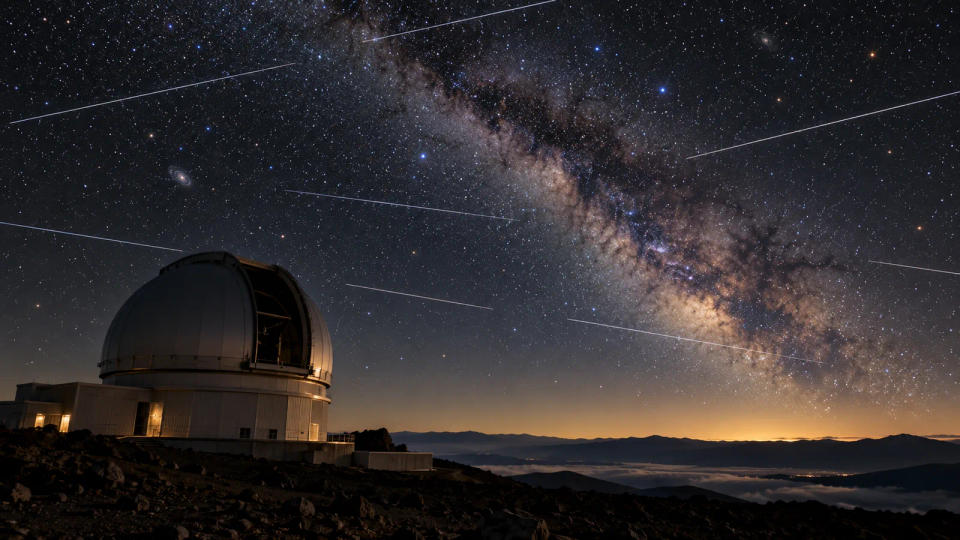
Look up from a dark place just after sunset and you may see a bright point sliding steadily across the stars. Sometimes you may see several in a row. Many of those moving lights are Starlink satellites, part of SpaceX’s low-Earth-orbit internet network.
So is Starlink ruining our view of the Universe? Not in the simple sense that astronomy is becoming impossible. But the concern is real. Large satellite constellations can leave bright trails in telescope images, complicate sensitive measurements, and even produce radio interference that matters to observatories listening to the cosmos. The effect is especially important for modern surveys designed to photograph huge areas of sky quickly and repeatedly.
Why Starlink satellites appear in astronomical images
Starlink satellites do not shine by themselves in visible light. What telescopes see is sunlight reflected from their surfaces. A satellite can already be in darkness from your point of view while still catching sunlight hundreds of kilometers above Earth, which is why these objects are often most noticeable after sunset and before sunrise.
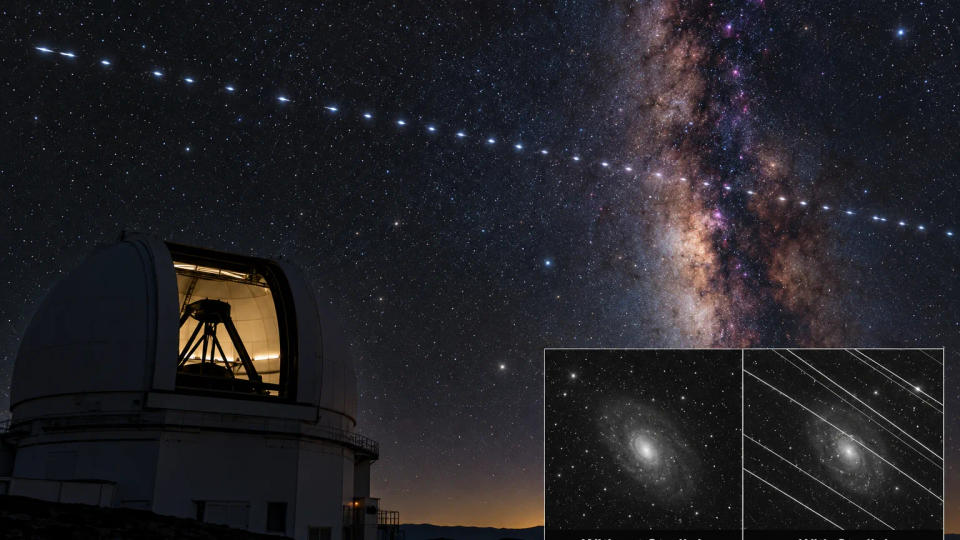
For casual stargazing, a satellite may be a brief distraction. For a long telescope exposure, the same moving point can become a line stretching across the image. A sensitive scientific camera can record satellites that are too faint for the human eye to notice.
The problem is not that one streak destroys an entire night of observing. Astronomers can often identify the affected pixels and mask them during data processing. The difficulty grows when many satellites repeatedly cross wide fields of view, because masking removes useful data and bright trails can create extra artifacts that are harder to correct.
Why Rubin Observatory is especially vulnerable
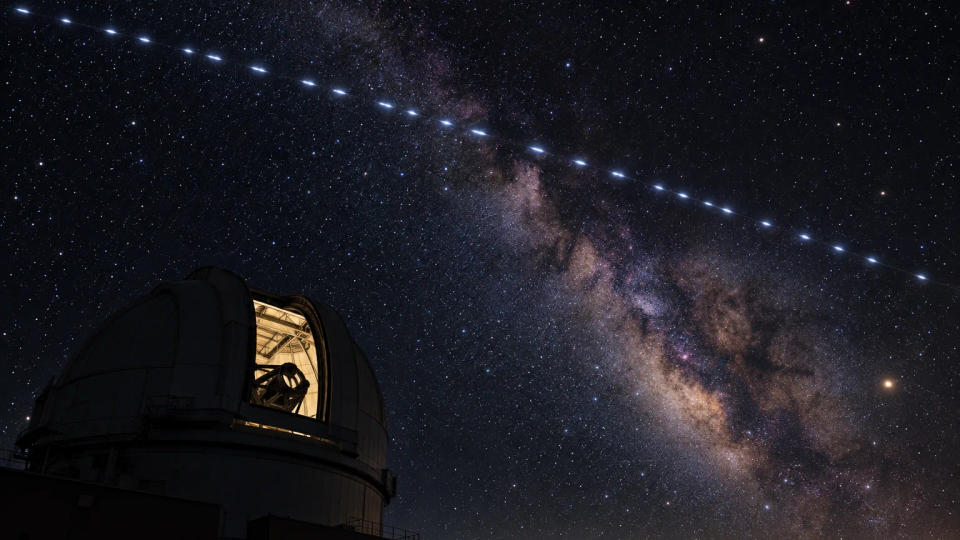
The timing of this debate matters because the Vera C. Rubin Observatory in Chile began its 10-year Legacy Survey of Space and Time in June 2026. Rubin is built to scan enormous areas of the southern sky again and again, looking for everything from near-Earth asteroids to exploding stars and subtle signatures of dark matter.
That makes it unusually sensitive to satellite contamination. Rubin says that during a roughly 30-second visit, a low-Earth-orbit satellite can move about 15 degrees across the sky, easily cutting through the observatory’s 3.5-degree field of view. Simulations using a population of 40,000 low-Earth-orbit satellites suggest that about 10% of Rubin images could contain at least one satellite trail, with the majority of twilight images affected.
Twilight is scientifically valuable. It is one of the best times to search near the direction of the Sun for asteroids that spend much of their orbits hidden in the daytime sky. That means simply avoiding the first and last hours of darkness is not always a good solution.
Rubin’s software is designed to detect streaks, flag suspicious regions, and keep contaminated pixels out of some combined images. Those tools reduce the damage, but they cannot recover photons that were never measured cleanly in the first place. Very bright trails can also influence more of a detector than the narrow line you see in the final image.
The radio astronomy problem is different
Visible streaks are only half the story. Radio telescopes do not care whether a satellite looks bright to your eyes. They care about electromagnetic signals reaching extremely sensitive receivers.
Starlink satellites intentionally transmit radio signals for communications, but researchers have also detected unintended electromagnetic radiation from onboard electronics. In a 2024 peer-reviewed study using the LOFAR radio telescope, scientists detected broadband radiation from second-generation Starlink satellites across parts of the 40–70 MHz and 110–188 MHz ranges.
After correcting for distance, the researchers found that some second-generation satellites produced unintended radio emission up to 32 times stronger than the earlier generation they compared them with. Importantly, this is not the same thing as saying Starlink deliberately transmits in every affected astronomy band. The study focused on radiation apparently produced unintentionally by satellite electronics.
Radio observatories can be built far from cities and protected by radio-quiet zones, but satellites pass overhead. That makes orbital interference a fundamentally different challenge from a nearby cell tower or transmitter that can be kept outside a protected area.
Has SpaceX made Starlink less disruptive?
Yes, there has been measurable progress on optical brightness. SpaceX has tested different surface treatments, orientations, and design changes intended to reflect less sunlight toward the ground. A 2025 study comparing several major constellations found that newer Starlink Generation 2 Mini satellites were dimmer at a standardized distance than older Starlink Generation 1 spacecraft, evidence that brightness mitigation can work.
But “dimmer” does not automatically mean “faint enough for astronomy.” The International Astronomical Union’s Centre for the Protection of the Dark and Quiet Sky recommends that low-Earth-orbit satellites at or below about 550 kilometers should be fainter than visual magnitude 7 for professional research. The same 2025 analysis found that nearly all of the constellation types it studied, including Starlink models, exceeded the recommended research brightness limit on average.
There is also an important distinction between Starlink and the larger issue. Starlink is the most prominent example because it operates thousands of satellites, but it is not the only constellation. OneWeb, Amazon’s Kuiper system, China’s large planned constellations, and other commercial networks mean the astronomy community is dealing with a new orbital environment rather than a problem caused by a single spacecraft design.
So, is Starlink ruining our view of the Universe?
For most people looking up at the night sky, the stars, planets, Milky Way, meteor showers, and deep-sky objects are still there. Professional astronomy is also continuing to produce extraordinary science. It would be misleading to say that Starlink has made the Universe unobservable.
But it would be equally misleading to dismiss the concern as cosmetic. Satellite trails can remove data, create false signals, complicate precision measurements, and disproportionately affect certain observing programs. Radio interference adds a second problem that cannot be solved by simply painting a satellite darker.
The practical question is therefore not whether humanity must choose between global communications and astronomy. It is whether satellite operators, astronomers, regulators, and observatories can reduce brightness and radio emissions enough that both can coexist as orbital traffic keeps growing. Better spacecraft design, predictable orbital data, smarter scheduling, improved image processing, and meaningful technical standards can all help.
Starlink has not ruined our view of the Universe. It has, however, made something clear that astronomers can no longer ignore: the space between our telescopes and the cosmos is becoming part of the observing environment itself.
Sources & Further Reading
- Rubin Observatory — Impacts from artificial satellites and debris
- Rubin Observatory — Legacy Survey of Space and Time begins
- IAU Centre for the Protection of the Dark and Quiet Sky — Consolidated recommendations
- Monthly Notices of the Royal Astronomical Society: Letters — Satellite constellation brightness study (2025)
- Astronomy & Astrophysics — Unintended radio emissions from second-generation Starlink satellites (2024)
Post a Comment