
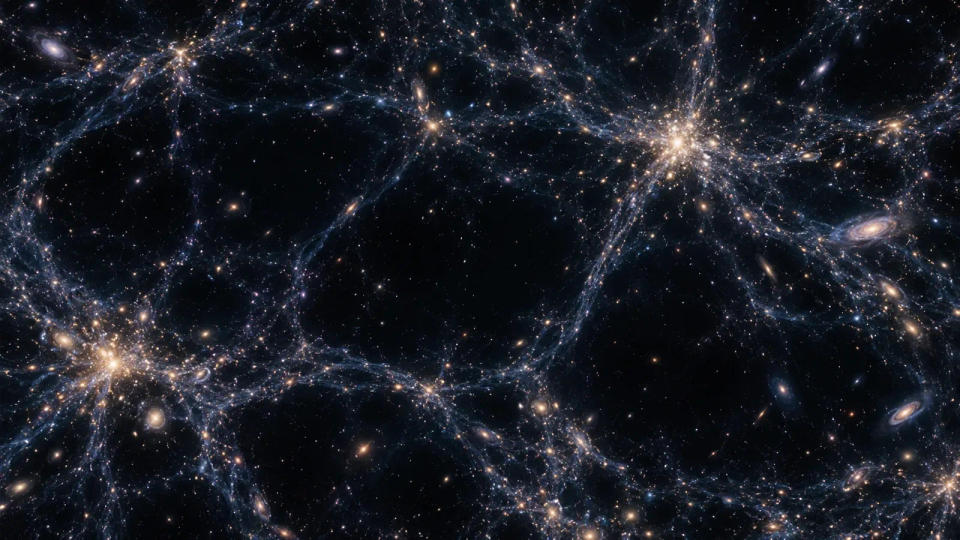
At first glance, the space between galaxies seems like the closest thing the universe has to nothing. Yet those enormous gaps are not truly empty. They contain an extremely thin mixture of gas and plasma, dark matter that helps shape the cosmic web, and radiation that has been traveling through space since the early universe.
The surprising part is that some of this intergalactic material can be millions of degrees hot while still being far more rarefied than even the best laboratory vacuum on Earth. Because there is so little matter in any small volume, it barely glows at all.
Intergalactic Space Is Thin, Not Empty
Astronomers call the ordinary matter between galaxies the intergalactic medium, or IGM. It is mostly hydrogen and helium, the two light elements that dominated the universe after the Big Bang. Over billions of years, stars have also enriched this gas with heavier elements such as oxygen, neon, magnesium, silicon, and sulfur.
The IGM is astonishingly sparse. NASA describes a typical density of roughly one atom per cubic foot in some intergalactic regions, compared with around a thousand atoms per cubic foot in the already thin space between stars. That means a spacecraft could travel through intergalactic space without encountering anything resembling air, fog, or a visible cloud.
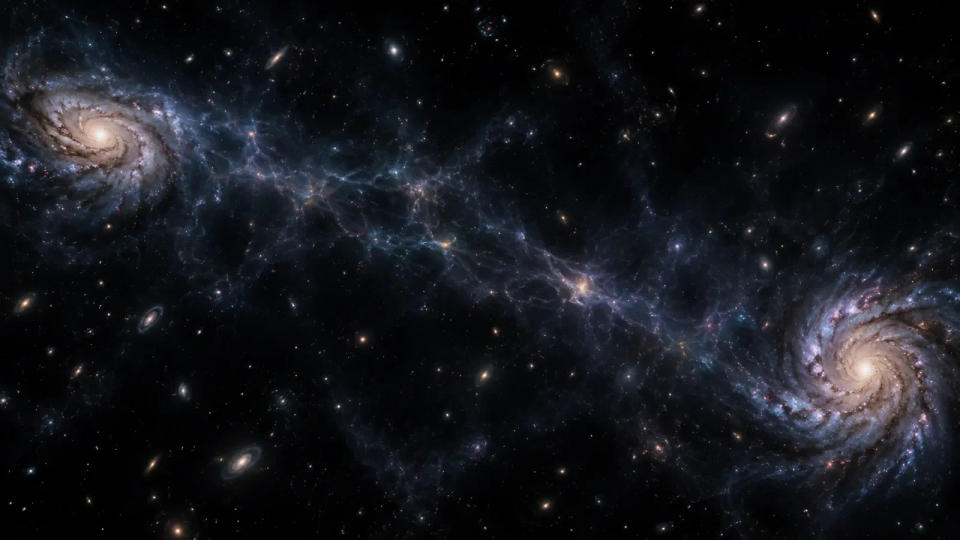
Calling it a “gas” can therefore be misleading if it makes us imagine something dense. A better picture is an almost empty ocean in which single particles are separated by enormous distances. In many regions, atoms are ionized, meaning electrons have been stripped from them. That makes much of the IGM a plasma rather than neutral gas.
Galaxies Sit Inside a Giant Cosmic Web
Galaxies are not sprinkled randomly through space. On the largest scales, matter forms a vast network called the cosmic web. Galaxies and galaxy clusters gather along filaments and sheets, while much emptier regions called cosmic voids lie between them.
Dark matter is a major part of this structure. It does not emit or absorb light in a way telescopes can see directly, but its gravity influences galaxies, clusters, and the bending of background light. In the standard cosmological picture, dark matter provides much of the gravitational framework along which ordinary gas collects.
That means the apparent darkness between galaxies often contains both kinds of matter: invisible dark matter and very faint ordinary matter. The densest knots of the web grow into galaxy clusters. Thinner strands connect those knots across tens of millions of light-years, while the largest voids contain far less material but are not perfectly empty.
This web matters because galaxies are not closed boxes. Gas can move along filaments, fall into groups and clusters, and become part of the material from which future generations of stars may eventually form.
Some of the “Empty” Space Is Extremely Hot
One of the strangest components of intergalactic space is the warm-hot intergalactic medium, usually shortened to WHIM. Models predict that a substantial share of ordinary matter in the nearby universe should be spread through filaments of gas ranging from roughly tens of thousands to millions of kelvins.
This gas can become hot as matter falls into the cosmic web and is compressed or shocked. But high temperature does not mean it would feel like a blazing atmosphere. Temperature measures the energy of individual particles. Because the particles are so widely separated, the gas has extremely little ability to transfer heat to an object passing through it.
A useful example came in 2025, when astronomers using ESA’s XMM-Newton and JAXA’s Suzaku X-ray observatories reported a hot gas filament in the Shapley Supercluster. ESA said the structure stretches about 23 million light-years, exceeds 10 million degrees, and contains roughly ten times the mass of the Milky Way. It connects four galaxy clusters and closely matches expectations from large-scale cosmological simulations.
Findings like this are important because astronomers have long struggled to account for all the ordinary matter predicted from measurements of the early universe. Some of that “missing” matter is not missing in the sense of having vanished; it is simply difficult to detect because it is spread through faint, hot filaments.
How Astronomers Detect Matter They Can Barely See
If the intergalactic medium is so thin, how do astronomers know it is there? One of the most powerful methods is to use a bright, distant object as a backlight. Quasars are especially useful because the regions around their active supermassive black holes can shine across enormous distances.
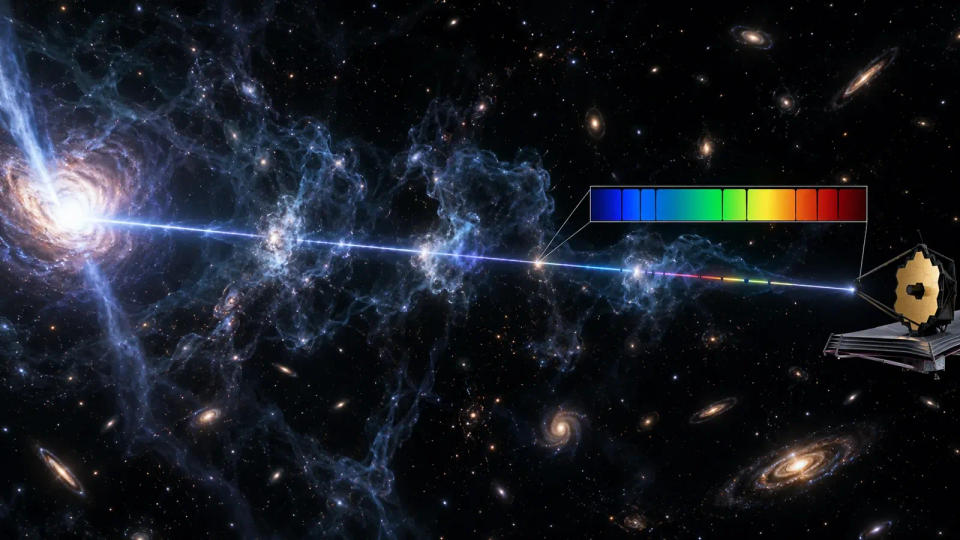
As quasar light travels toward us, it passes through clouds and filaments of gas. Atoms and ions along the way absorb very specific wavelengths. When astronomers spread the arriving light into a spectrum, those missing wavelengths appear as absorption lines. The pattern reveals which elements are present and can also provide clues about temperature, motion, and distance.
Hubble’s ultraviolet spectrographs have used this technique to trace hydrogen and highly ionized oxygen in the cosmic web. X-ray observatories can search for even hotter material. These measurements are difficult because the signals are weak, so researchers often combine long observations with careful modeling and observations at several wavelengths.
There is also radiation between the galaxies
Intergalactic space is filled with light as well as matter. The most famous example is the cosmic microwave background, the cooled afterglow of the early universe. ESA notes that the CMB fills the entire universe and amounts to roughly 400 photons in every cubic centimeter of space. Those photons pass through the same regions we casually call empty.
Starlight, infrared radiation from dust, X-rays from hot gas and black holes, and other forms of electromagnetic radiation also travel between galaxies. So even a region with almost no atoms is still crossed by photons and influenced by gravity.
Conclusion
The vast spaces between galaxies are extraordinarily empty by everyday standards, but they are not nothing. They contain a thin intergalactic medium, hot plasma, traces of heavy elements forged by stars, dark matter that helps organize the cosmic web, and radiation filling the universe.
What looks like darkness is therefore part of the universe’s structure. The gaps between galaxies are not blank scenery; they are where much of the cosmic web lives, where hidden matter can reside, and where light carries information from one side of the universe to the other.
Sources & Further Reading
- NASA Science — Large Scale Structures
- ESA — “The models were right”: astronomers find ‘missing’ matter
- NASA Science — Hubble Spectroscopy
- ESA — Planck and the cosmic microwave background
- Nature — Observations of the missing baryons in the warm-hot intergalactic medium
Post a Comment