

NASA’s Nancy Grace Roman Space Telescope is built to do something unusual for a flagship observatory: look at enormous areas of the universe without giving up sharp detail. That combination has a consequence on Earth. Once its science surveys are underway, Roman is expected to downlink about 1.4 terabytes of science data every day—the highest daily data volume yet for a NASA astrophysics mission.
Roman launched on August 30, 2026, and is now in its commissioning phase. NASA reported on September 25 that ground stations had already demonstrated the communications capacity needed for the mission, including links reaching up to 500 megabits per second. The real story, though, is not simply that Roman produces “big data.” It is why the telescope needs to collect so much information in the first place.
Why Does Roman Produce So Much Data?
Roman’s primary science camera, the Wide Field Instrument, is designed for surveys. Instead of concentrating on a tiny patch of sky for every observation, it can capture a much broader scene while preserving fine detail. NASA says Roman has sensitivity and resolution comparable to Hubble while covering a field of view at least 100 times larger.
The Wide Field Instrument uses an array of 18 detectors and records hundreds of millions of pixels. A single exposure can therefore contain an extraordinary number of stars and galaxies. Repeat those observations across large regions of sky, through different filters and at different times, and the data pile grows quickly.
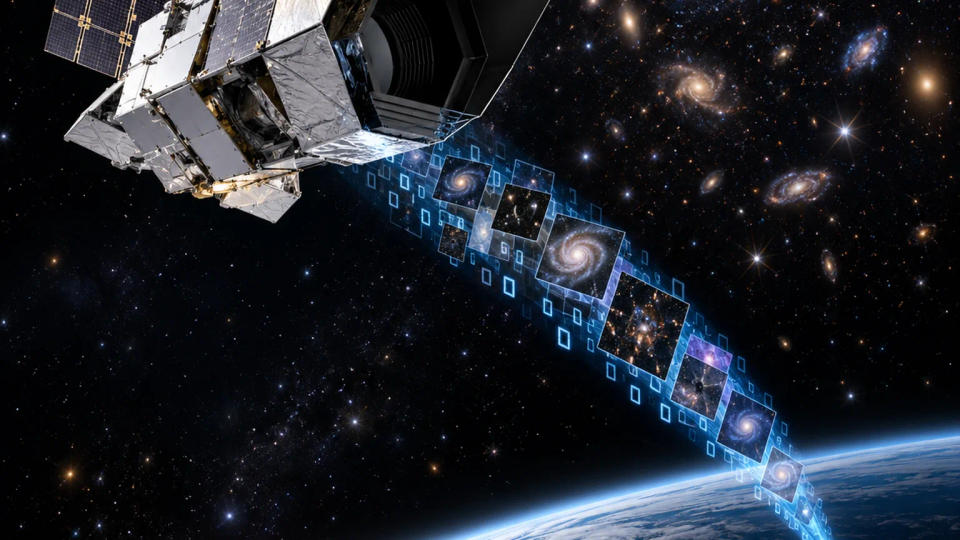
This is central to Roman’s science rather than an engineering side effect. Its surveys are intended to study the large-scale structure of the universe, investigate dark energy, search for planets through gravitational microlensing, and create datasets that astronomers can reuse for many other questions. Roman is essentially combining a powerful space telescope with a panoramic survey machine.
How Does 1.4 Terabytes a Day Reach Earth?
Roman operates around the Sun–Earth L2 region, roughly a million miles from Earth. Sending such a large volume across that distance requires a communications system designed for sustained high-speed downlinks.
NASA’s ground-system documentation says Roman can transmit science data in the Ka band at rates up to 500 megabits per second. It does not need to transmit continuously at that maximum speed all day. Instead, large antennas contact the observatory for hours at a time and pull down stored observations. Roman itself can hold up to four terabytes of science data in its onboard science data recorder while waiting for a suitable connection.
The receiving network is deliberately spread around the planet. Stations in New Mexico, Australia, and Japan provide geographically separated opportunities to communicate with Roman as Earth rotates. In September 2026, NASA confirmed tests involving these stations were successfully receiving operational information as commissioning continued.
Roman Is a Different Kind of Telescope From Hubble and Webb
It is tempting to think that more daily data simply means Roman is “more powerful” than Hubble or the James Webb Space Telescope, but that comparison misses the point. The observatories were designed for different styles of astronomy.
Hubble and Webb can spend substantial time studying carefully selected targets. Roman is optimized to survey large populations and wide areas efficiently. NASA has described it as capable of surveying the universe dramatically faster than Hubble. That survey speed means it can repeatedly measure huge numbers of objects rather than producing only a small number of narrowly framed observations.
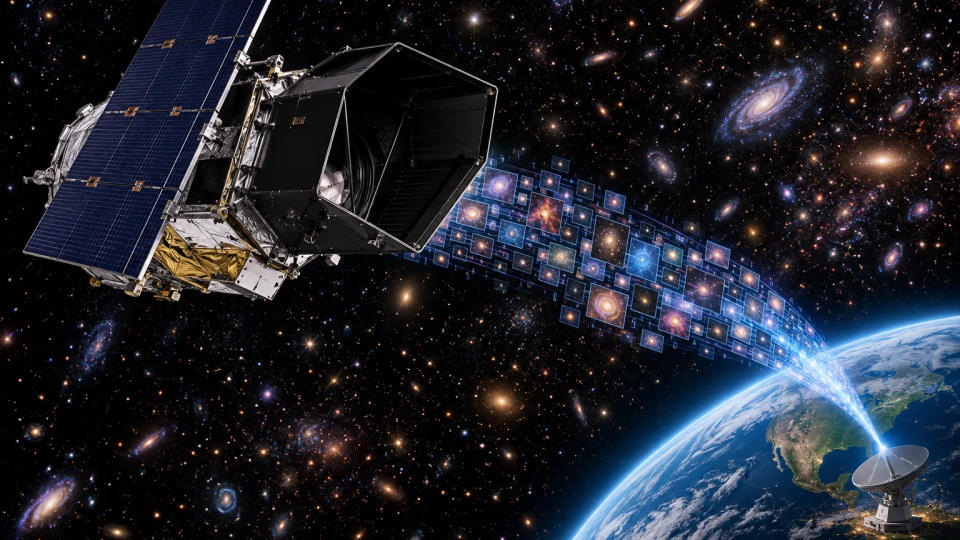
The scale becomes clearer over time. NASA expects Roman’s five-year primary mission to generate an archive of roughly 20 petabytes, or about 20,000 terabytes. The Space Telescope Science Institute notes that the Wide Field Instrument may downlink around 1,375 gigabytes of compressed observation data per day on average. The 1.4-terabyte figure is therefore not a one-day stunt; it reflects the normal scale of the mission.
The Bigger Challenge Starts After the Data Arrives
Receiving the signal is only the first step. Raw detector measurements have to be calibrated, processed into useful science products, archived, searched, compared, and analyzed. At Roman’s scale, the old model of every astronomer downloading every dataset to a personal workstation becomes increasingly awkward.
That is why Roman’s ground system includes automated processing and large-scale archive infrastructure. The Space Telescope Science Institute has also developed the Roman Research Nexus, a cloud-based environment where researchers can work near the data instead of repeatedly moving enormous files across the internet. It includes scientific software, notebooks, collaborative workspaces, and access to Roman datasets.
This shift matters because Roman will not merely create pretty images. Survey observations can contain signals that were not the original reason an exposure was taken: a transient event, an unusual galaxy, a faint moving object, or a statistical pattern visible only after millions of sources are compared. NASA has said machine learning, artificial intelligence, and citizen scientists can help sift through the flood and flag promising discoveries for astronomers to examine.
Why Roman’s Data Flood Could Change Astronomy
A giant archive becomes more valuable when researchers can ask questions that were not imagined when the observations were first collected. Roman’s wide surveys will create a common dataset for studies ranging from cosmology to stellar populations and exoplanets. One team may examine the shapes of distant galaxies, while another uses the same survey to hunt for changing objects or map stars in the Milky Way.
There is also a time-domain advantage. When a telescope repeatedly observes the sky, astronomers can compare one visit with another. Instead of asking only “what is there?”, they can ask “what changed?” That opens the door to finding events that brighten, fade, move, or appear unexpectedly.
Roman’s 1.4 terabytes per day therefore represents something more interesting than a storage problem. It is a measure of how astronomy is changing from observing a limited number of targets toward surveying vast populations with enough detail to discover patterns, rare objects, and surprises hidden among billions of measurements.
Conclusion
Roman’s enormous daily downlink is the natural result of its wide-field design. A telescope that can see a Hubble-like level of detail across much larger patches of sky will inevitably produce a torrent of information. The challenge now is to receive, process, organize, and explore that torrent efficiently. If Roman works as designed, some of its most interesting discoveries may come not from a single spectacular image, but from connections found inside an archive too large for any one astronomer to examine alone.
Sources & Further Reading
- NASA Science — Roman Team Confirms Ground Stations Receiving Data
- NASA Science — Roman Ground Systems
- NASA Science — Wide Field Instrument Technical Information
- STScI — Accessing Roman WFI Data
- NASA Science — Roman Research Nexus
Post a Comment