
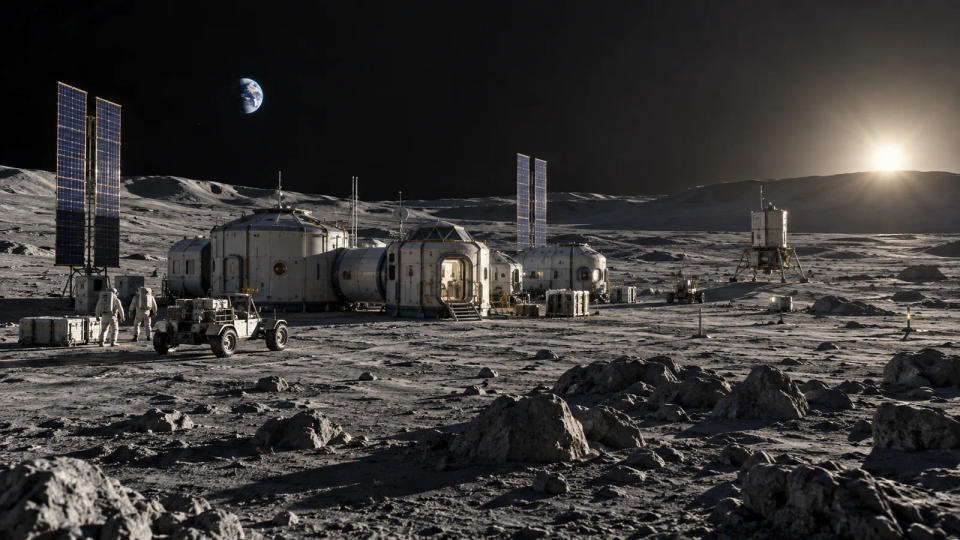
A permanent base on the Moon sounds like science fiction until you break it into ordinary needs: somewhere to sleep, air to breathe, water to drink, electricity, transportation, spare parts, and a way to survive when something fails. None of those problems is impossible by itself. The hard part is making all of them work together, continuously, about 384,000 kilometers from Earth's industrial supply chain.
So could humans really do it? Yes, in principle. We already know how to keep people alive in space for months, recycle much of a crew's water, operate machines remotely, and generate power in hostile environments. A lunar base does not depend on one miraculous invention. It depends on many technologies becoming reliable enough to keep working year after year.
That is why the first real Moon base will probably grow in stages, starting with robotic deliveries and short crew visits before becoming an outpost that remains on the surface between missions.
Why the Lunar South Pole Is the Best Place to Try
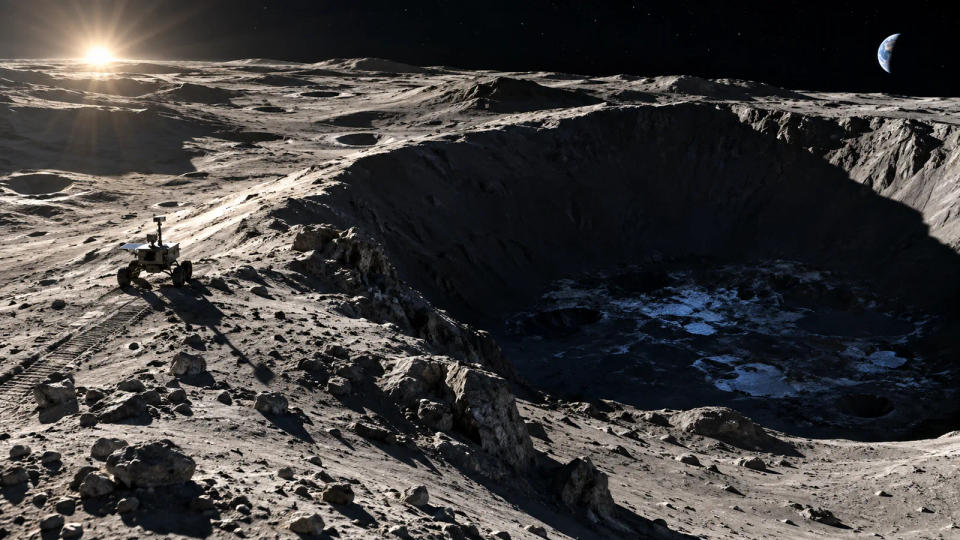
If humans are going to stay on the Moon, location matters. The leading target is the lunar south-polar region, where the Sun stays low in the sky and the landscape mixes illuminated ridges with deep, permanently shadowed craters. Some elevated areas can receive long periods of sunlight, useful for solar power, while nearby shadows can remain extraordinarily cold.
Those dark craters matter because spacecraft observations have found evidence of water ice in the polar regions. Water is expensive to launch from Earth, so an accessible local supply could transform a lunar outpost. Ice could potentially become drinking water, oxygen for breathing, and hydrogen and oxygen for rocket propellant.
But the south pole is not an easy building site. NASA describes steep terrain, long moving shadows, severe temperature differences, and abrasive dust as major challenges. Some permanently shadowed areas can fall to roughly -203°C. A site close to useful ice may therefore also be difficult to illuminate, power, navigate, and maintain.
A Permanent Base Needs Much More Than a Habitat
A pressurized module is only the beginning. A long-lived base would need airlocks, environmental control, water recycling, waste handling, thermal regulation, communications, medical capability, food storage, surface vehicles, repair equipment, and a steady supply of replacement parts. Every critical system would need backups because a failed pump or valve cannot be replaced by a technician arriving the next morning.
Power may be the most important shared resource. Solar arrays can work well in favorable locations, but darkness, terrain, dust, and changing illumination make it risky to rely on sunlight alone. NASA is developing surface power systems that include solar arrays, energy storage, radioisotope power, and fission power. The goal is to keep habitats and equipment running even when solar energy is unavailable.
Mobility matters too. Apollo astronauts worked within a relatively small area around their landers. A permanent outpost would need rovers that can carry people, cargo, tools, and science equipment much farther. NASA is also developing pressurized rover concepts that could act as mobile habitats, allowing crews to live and work away from the main base for extended trips.
The Moon Is Brutal on Machines and People
The Moon has no thick atmosphere and no global magnetic field like Earth's to provide comparable protection at the surface. Astronauts would face more space radiation, including galactic cosmic rays and energetic particles from the Sun. Habitats therefore need shielding, radiation monitoring, and a protected area where crews can shelter during major solar particle events.
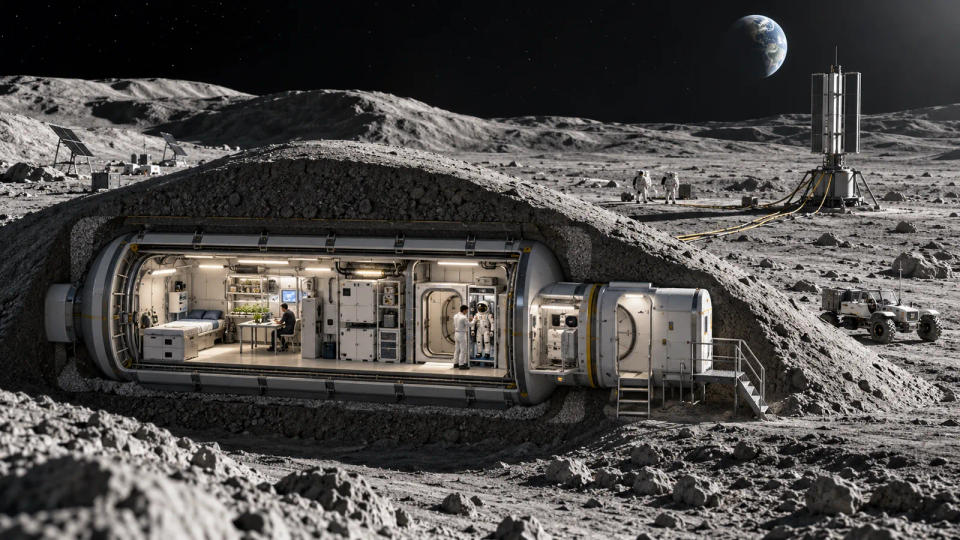
One possible approach is to cover parts of a habitat with lunar soil, or regolith. Extra mass above living areas can reduce radiation exposure and provide additional protection from tiny high-speed impacts. It also avoids launching every kilogram of shielding from Earth. The idea is simple; autonomously excavating and moving large amounts of regolith is not.
Then there is lunar dust. Unlike weathered sand on Earth, lunar grains are sharp, abrasive, and prone to clinging to surfaces. They can interfere with seals, joints, radiators, visors, and moving equipment. NASA successfully demonstrated an electrodynamic dust-removal system on the Moon in 2025, but a permanent base would need dust control built into spacesuits, airlocks, vehicles, solar panels, and maintenance routines.
Low gravity is another unknown. The Moon has about one-sixth of Earth's surface gravity. We have decades of medical experience with near-weightlessness in orbit, but very little evidence about what years in one-sixth gravity would do to bones, muscles, circulation, balance, and other body systems. Exercise and medical countermeasures would be essential, but lunar living would still teach us things the International Space Station cannot.
The Key Is Learning to Use the Moon Itself
A base that depends on Earth for every liter of water, kilogram of oxygen, wall panel, and load of propellant would be extraordinarily expensive. That is why engineers are studying in-situ resource utilization, or ISRU: using materials already present on the Moon.
Polar ice is the obvious prize, but it is not the only resource. Lunar regolith contains oxygen chemically bound inside minerals. In principle, high-temperature or electrochemical processing could release some of it. Regolith could also be compacted, melted, or sintered into hard surfaces for landing pads, roads, berms, or construction components, reducing how much bulk material must come from Earth.
The important word is could. Detecting water ice from orbit is not the same as operating a dependable lunar mine. Engineers still need to learn how concentrated accessible ice is at useful sites, how efficiently it can be excavated in extreme cold, how much energy extraction requires, and whether processing equipment can survive dust and thermal cycling. NASA's September 8, 2026 technology solicitation specifically highlighted power generation, oxygen extraction, and producing construction materials on the Moon as capability gaps still needing work.
When Could Humans Actually Live There for Years?
NASA's current Moon Base plan is deliberately incremental. The first phase, running through 2029, emphasizes robotic missions, reliable surface access, technology demonstrations, and learning how equipment behaves. A second phase from 2029 to 2032 is intended to add early power, cargo, communications, logistics, and initial habitation. From 2032 onward, NASA describes a phase in which larger habitats, transportation, power systems, and other infrastructure could support an enduring human presence near the south pole.
That schedule should not be read as a promise that people will begin living on the Moon continuously in 2032. Spaceflight schedules, funding, test results, and hardware development can all change. In the early years, a “permanent base” is more likely to mean permanent infrastructure: habitats, power equipment, communications, rovers, and supplies that stay on the Moon while crews rotate in and out.
Continuous occupation would be a later milestone. It would require routine cargo transport, dependable power, maintainable life-support systems, radiation protection, medical plans, and enough redundancy that one failed launch or broken machine does not threaten the crew.
The Moon itself is no longer the biggest mystery. We know many of the hazards, and we know the basic systems a base would need. The real challenge is turning spacecraft designed for missions into infrastructure designed for years. If that transition succeeds, the first permanent human settlement beyond Earth may begin not as a gleaming lunar city, but as a few rugged modules that simply refuse to stop working.
Post a Comment