
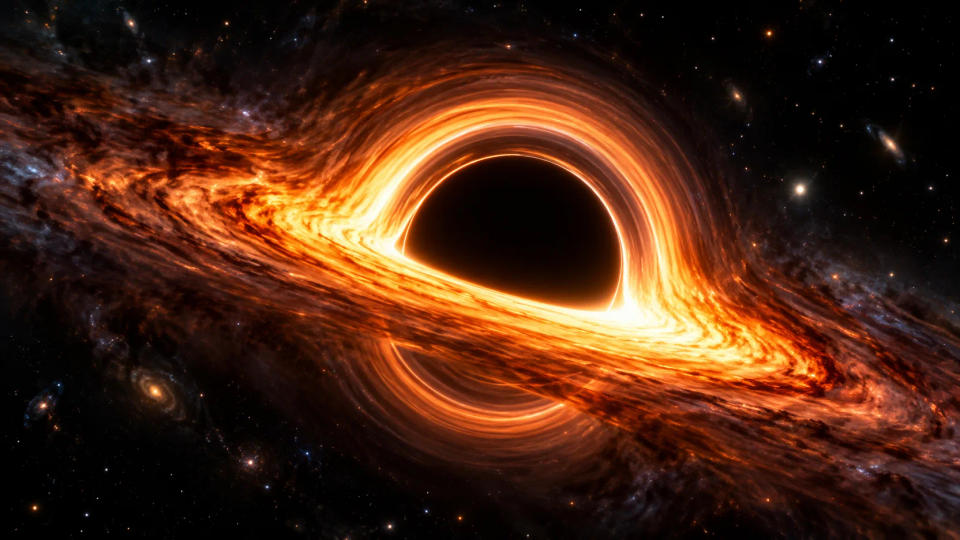
A black hole is defined by something frustratingly simple: once light crosses its event horizon, it cannot come back out. So how can astronomers possibly observe an object that sends us no light of its own?
The answer is that we usually do not observe the black hole itself. We observe what its gravity does to nearby stars, gas, light, and even spacetime. In some cases, those effects are so precise that astronomers can measure a black hole's mass, estimate its spin, map the hot matter around it, or reconstruct the shadow it leaves against glowing material.
We See the Matter a Black Hole Heats Up
Many black holes reveal themselves because matter is falling toward them. Gas does not usually plunge straight in. It carries angular momentum, so it forms a rapidly rotating accretion disk around the black hole. Collisions, magnetic fields, and turbulence in that disk convert orbital energy into heat.
The result can be extraordinarily bright. Gas close to a stellar-mass black hole can become hot enough to shine strongly in X-rays, while supermassive black holes can power luminous galactic nuclei that radiate across much of the electromagnetic spectrum. The light is coming from material outside the event horizon, not from inside the black hole.
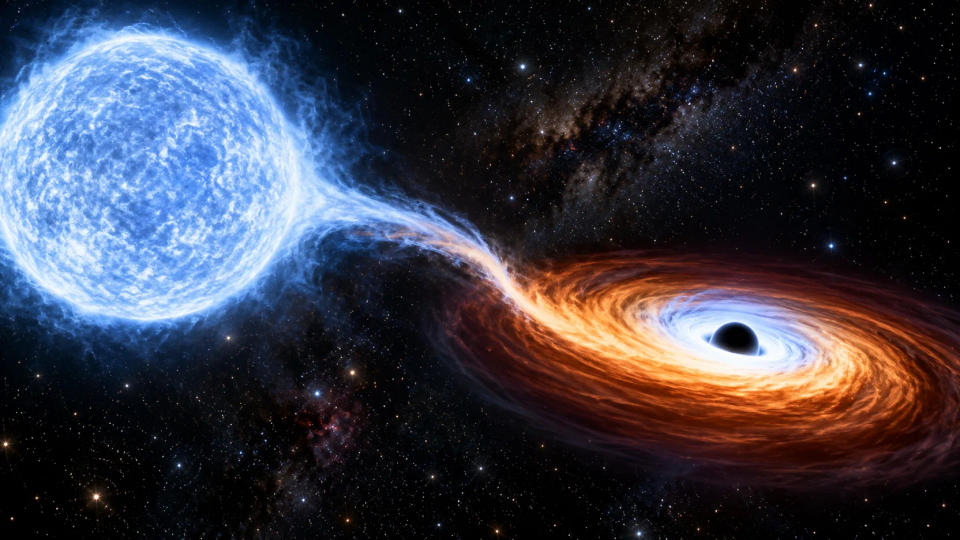
This is especially useful in binary systems. If an ordinary star orbits an unseen compact object and some of its gas is pulled away into a hot disk, astronomers can compare the star's motion with the X-rays from the system. The invisible companion may turn out to be too massive and too compact to be a neutron star, leaving a black hole as the best explanation.
Black holes can also launch narrow particle jets from their surroundings. Those jets are not matter escaping from inside the event horizon. They are produced by energetic processes in the magnetic fields and rotating material outside it.
We Track Objects Orbiting an Invisible Mass
A second method is almost like watching leaves circle a hidden drain. If stars move around a point where no normal object is visible, their orbits reveal the gravity of whatever is there. From orbital speed, distance, and shape, astronomers can calculate how much mass must be packed into the unseen region.
This approach provided some of the strongest evidence for the supermassive black hole at the center of the Milky Way, Sagittarius A*. For decades, astronomers have tracked stars racing around the Galactic Center and found that millions of times the Sun's mass must be concentrated into a remarkably small volume.
The technique is still improving. In August 2026, the European Southern Observatory reported observations of a star called S301, the fastest known star in the Milky Way at the time of the announcement. It reaches about 25,000 kilometers per second while orbiting Sagittarius A* and passes close enough for astronomers to probe effects associated with the black hole's spin. That does not mean we suddenly see the black hole itself. It means the motion of a nearby star becomes a very sensitive probe of the invisible spacetime around it.
We Image the Black Hole's Shadow
The famous orange-ring images from the Event Horizon Telescope can be misleading if we call them ordinary photographs of a black hole. The black hole itself remains dark. What the telescope resolves is radio emission from hot material surrounding it, shaped by extremely strong gravity.
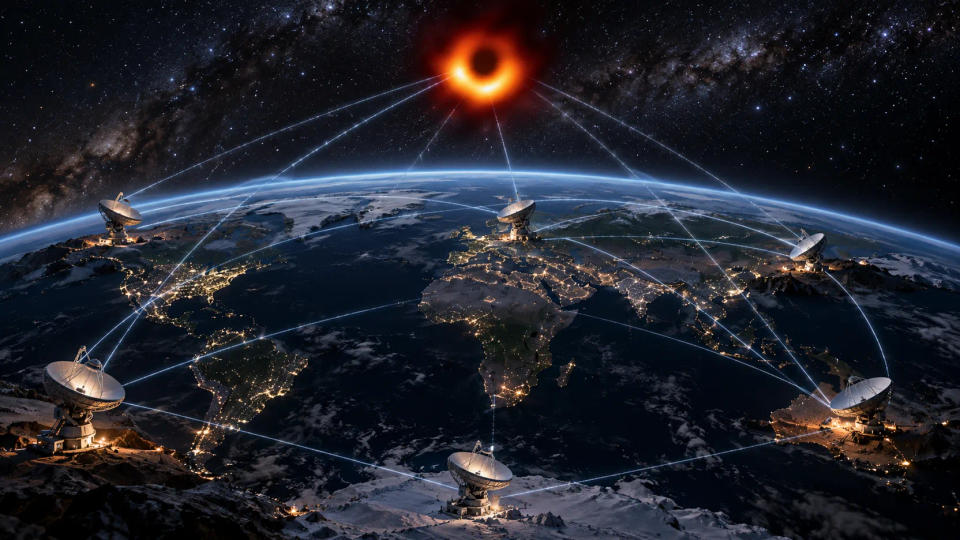
The Event Horizon Telescope, or EHT, links radio observatories separated by enormous distances. Using a technique called very-long-baseline interferometry, the network acts like a virtual telescope roughly the size of Earth. That enormous effective baseline is what gives it the angular resolution needed to study structures around a nearby supermassive black hole.
In 2019, the EHT Collaboration released the first image showing the shadow region around the black hole in galaxy M87. In 2022, it released the first image of Sagittarius A*. In both cases, the bright ring comes from radiation near the black hole, while the central dark region is a shadow-like silhouette produced by captured and strongly bent light.
General relativity predicts how light should curve in such an extreme gravitational field. Measuring the size and shape of the ring and shadow therefore gives astronomers another way to test whether the observed system behaves as a black hole should.
We Detect the Ripples From Black Hole Mergers
There is also a way to observe black holes without relying on light at all: gravitational waves. When two black holes orbit each other and spiral inward, their motion creates ripples in spacetime. As the orbit shrinks, the waves grow stronger and sweep upward in frequency until the black holes merge.
LIGO and related detectors measure these waves by looking for almost unimaginably small changes in the lengths of perpendicular laser interferometer arms. The signal carries information about the masses and spins of the objects that created it.
The first direct detection of gravitational waves, GW150914, was recorded in September 2015 and announced in 2016. Its waveform matched the expected pattern from two stellar-mass black holes merging into a larger black hole. Since then, gravitational-wave astronomy has opened a completely different channel for finding black holes, including systems that may produce little or no detectable electromagnetic light.
The Strongest Picture Comes From Combining Clues
No single observing method is useful for every black hole. A quiet, isolated black hole may have no bright accretion disk. A distant supermassive black hole may be impossible to resolve at event-horizon scales. A black hole that is not merging with another compact object will not produce a merger signal for LIGO to detect.
That is why astronomers combine methods. X-rays can reveal hot infalling gas. Stellar orbits can measure an invisible mass. Radio interferometry can map the shadow region around a supermassive black hole. Gravitational waves can reveal black holes through the motion of spacetime itself. Together, these observations turn an object that emits no light from inside its event horizon into something we can study in remarkable detail.
Conclusion: We do not need light from a black hole to know it is there. We can watch matter heat up, follow stars as they orbit, resolve the silhouette against glowing gas, and detect spacetime rippling during mergers. In astronomy, sometimes the most convincing view of an invisible object comes from everything around it.
Sources & Further Reading
- NASA Science — Black Holes
- NASA Science — Anatomy of a Black Hole
- Event Horizon Telescope — Can We Really Photograph a Black Hole?
- Event Horizon Telescope — First Image of Sagittarius A*
- ESO — Milky Way's Fastest Star Orbits Our Supermassive Black Hole So Closely It Feels Its Spin
- LIGO Scientific Collaboration — Gravitational-Wave Science
Post a Comment