

One rocket, fifteen spacecraft, and almost fifteen different reasons to go to orbit. South Korea’s Nuri rocket is scheduled to make its fifth flight on October 7, 2026, carrying the largest satellite load in Nuri’s history: five NEONSAT Earth-observation satellites and ten CubeSats built for science, technology tests, public services, and commercial experiments.
The mission is especially important because Nuri will not simply drop off a collection of unrelated payloads. Its main job is to begin deploying South Korea’s first domestically launched microsatellite constellation, while the smaller ride-share satellites turn the same flight into a compact laboratory for everything from space radiation to laser communications.
A Record Nuri Mission Built Around a Satellite Constellation
Nuri’s fifth launch is planned from the Naro Space Center in Goheung. The current launch window runs from 12:23 p.m. to 1:23 p.m. Korea Standard Time, with October 8–14 reserved as backup dates if weather or other conditions force a delay.
The 15 satellites are expected to head for a sun-synchronous orbit roughly 570 kilometers above Earth. That kind of orbit is useful for Earth observation because a satellite passes over locations at similar local solar times, making images easier to compare from one pass to the next.
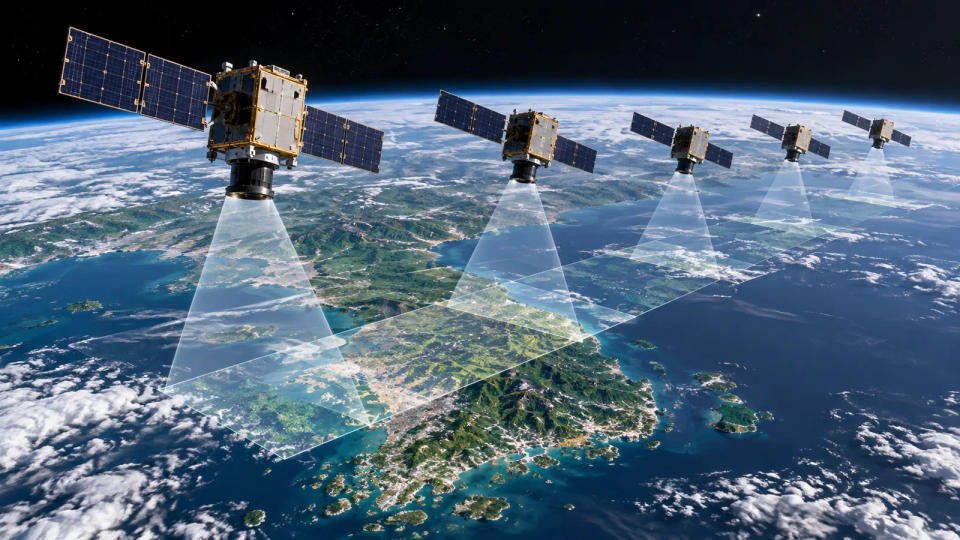
The five primary payloads are NEONSAT-2 through NEONSAT-6. Nuri will release them one after another, about 35 to 40 seconds apart and in different directions. The staggered deployment is designed to reduce the chance that the satellites interfere with or collide with one another immediately after separation.
Satellites 1–5: NEONSAT-2 Through NEONSAT-6 Will Watch Earth Together
The first five spacecraft have the same basic mission. Each NEONSAT satellite weighs less than 100 kilograms and carries an electro-optical camera capable of roughly 1-meter black-and-white imagery and 4-meter color imagery. Their purpose is to collect high-resolution pictures of the Korean Peninsula and surrounding waters for disaster response and national-security applications.
- 1. NEONSAT-2: Earth observation as part of the new constellation, adding another viewing opportunity over Korea and nearby seas.
- 2. NEONSAT-3: The same imaging mission, helping the constellation revisit important locations more frequently.
- 3. NEONSAT-4: High-resolution optical imaging that can support monitoring of events such as wildfires and floods.
- 4. NEONSAT-5: Another coordinated Earth imager, increasing the amount of useful coverage available each day.
- 5. NEONSAT-6: The fifth spacecraft in this launch batch, completing the first group of mass-produced NEONSAT units.
Five more NEONSAT spacecraft are planned for Nuri’s sixth launch in 2027. Once the full ten-satellite system is operating in two orbital planes, the goal is to image the Korean Peninsula more than three times per day and revisit the same location within 24 hours. The advantage is not that one satellite suddenly becomes more powerful. It is that several modest satellites can cooperate to reduce the time between useful observations.
Satellites 6–15: Ten CubeSats With Ten Different Jobs
The next group shows why CubeSats have become so useful. These spacecraft are much smaller than conventional satellites, but each can carry a tightly focused experiment that would be difficult or expensive to justify as a large standalone mission.
- 6. SLEDGE: Developed by ONB Space, it will use GNSS signals to study the ionosphere. Changes in those radio signals can reveal information about the electrically charged upper atmosphere.
- 7. PERSAT02: Quaternion’s satellite will examine ocean currents associated with marine debris around Jeju Island, helping researchers understand how floating waste moves through coastal waters.
- 8. JACK-007: Cosmoworks will collect Earth-observation imagery while also testing Korean-made components in the real space environment.
- 9. SD-1 SAT: Space & Bean will collect radiation data and test materials intended to protect hardware from the space-radiation environment.
- 10. GBSAT: A university team led through KAIST will measure high-energy proton flux associated with Earth’s magnetic-field environment, adding data on conditions that can affect spacecraft electronics.
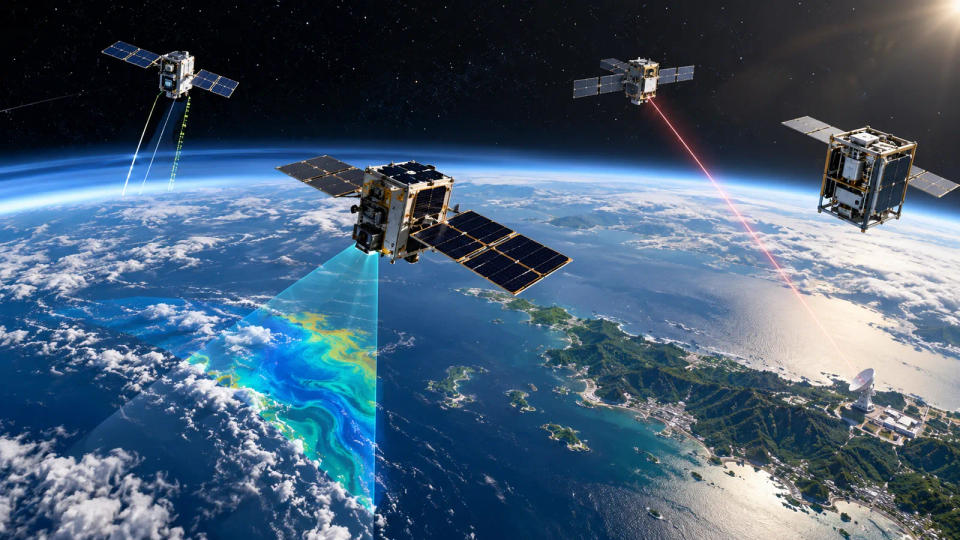
The remaining five CubeSats lean more heavily toward technology demonstration, environmental sensing and in-orbit experimentation.
- 11. UEL-Y-Sys, also called Ulysses: The Unmanned Exploration Laboratory will monitor fine dust while also testing domestically developed space-grade components. It combines an environmental-observation mission with hardware qualification.
- 12. CPSat: Developed by Chosun University and Pusan National University, CPSat will demonstrate optical communications using laser light and will also test multiple radio-frequency communication technologies. Laser links are attractive because future satellites may need to move much larger volumes of data than conventional radio systems comfortably handle.
- 13. BEE-1012: Space LiinTech will run a protein-crystal growth experiment in microgravity. Researchers are interested in space-grown crystals because reduced gravity can change how some molecules organize, potentially revealing structures that are difficult to produce on Earth.
- 14. Domestic Components Space Verification Platform 2: Built by the Korea Aerospace Research Institute, this spacecraft will expose Korean-made electronic devices and space components to the real orbital environment. The payload includes items such as memory devices, attitude-control hardware and other components that need flight experience before customers can trust them on larger missions.
- 15. DaejeonSat-1: This 16U-class CubeSat will observe changes in Daejeon’s urban landscape while testing payload technologies developed by local space companies. It is also a demonstration of how a local government can use a small satellite as a technology-development platform.
Put together, the ten CubeSats cover a striking range of jobs: atmospheric and radiation science, coastal-environment monitoring, Earth imaging, optical communications, pharmaceutical research, and the unglamorous but essential work of proving that new hardware can survive launch and operate in orbit.
Conclusion: The Important Part Is What Happens After Separation
The spectacular moment will be Nuri leaving the launch pad, but the mission’s real value comes later. Five NEONSAT spacecraft must separate safely and begin working as the first half of a coordinated constellation, while ten smaller satellites try to turn focused experiments into useful data and flight-proven technology.
If the mission goes as planned, Nuri’s fifth flight will show something broader than raw launch capability. It will demonstrate that one Korean rocket can serve a national Earth-observation system, universities, startups, research institutes and local industry on the same trip to orbit. Fifteen satellites will leave together, but once they are free-flying, each has a very different job to do.
Sources & Further Reading
- Korea AeroSpace Administration — Nuri’s fifth launch opens South Korea’s first satellite-constellation era
- Korea Aerospace Research Institute — Nuri fifth-launch payload manifest
- Korea AeroSpace Administration — Secondary payload satellites selected for Nuri’s fifth launch
- Yonhap News Agency — Missions of the 15 Korean satellites aboard Nuri
- MoneyToday — Nuri fifth-launch satellite missions and target orbit
Post a Comment