
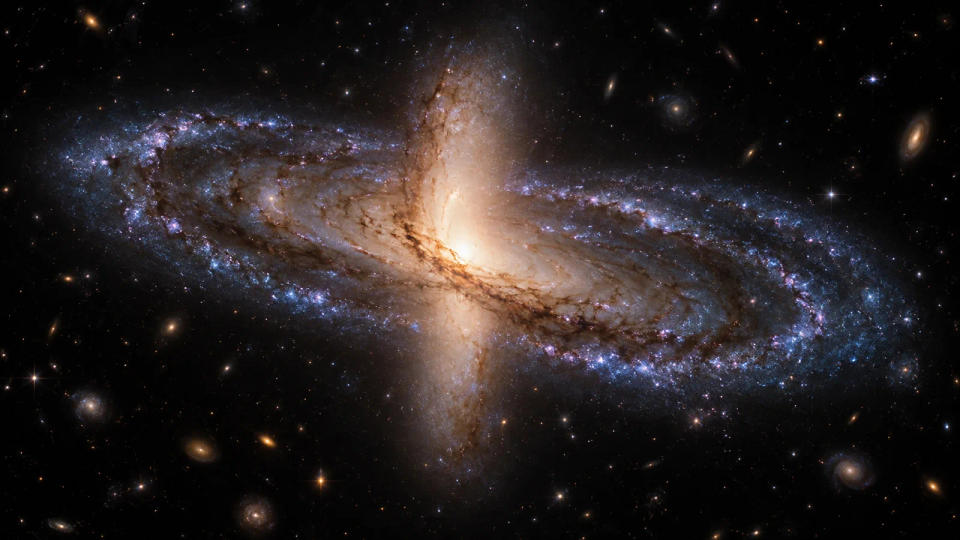
At first glance, NGC 4698 looks like a calm spiral galaxy: a bright central glow, dusty lanes, and faint arms curling through a flattened disk. But the stars and gas nearest its core do something far stranger than the picture suggests. They rotate in a plane that is almost perpendicular to the rest of the galaxy.
That is why saying the center is “rotating the wrong way” is useful shorthand, but not quite literal. It is not simply spinning backward in the same plane. Imagine a dinner plate turning on a table, then place a smaller wheel through its middle so that the wheel turns almost vertically. NGC 4698 contains something surprisingly close to that crossed geometry on a galactic scale.
NASA and ESA/Hubble released a new Hubble image of NGC 4698 on September 18, 2026, bringing fresh attention to this unusual structure. The sideways rotation itself is not a new discovery; astronomers were measuring the galaxy’s decoupled central motion decades ago. What the new image provides is a remarkably detailed view of the galaxy that hosts it.
It Is Not Rotating Backward — It Is Rotating Sideways
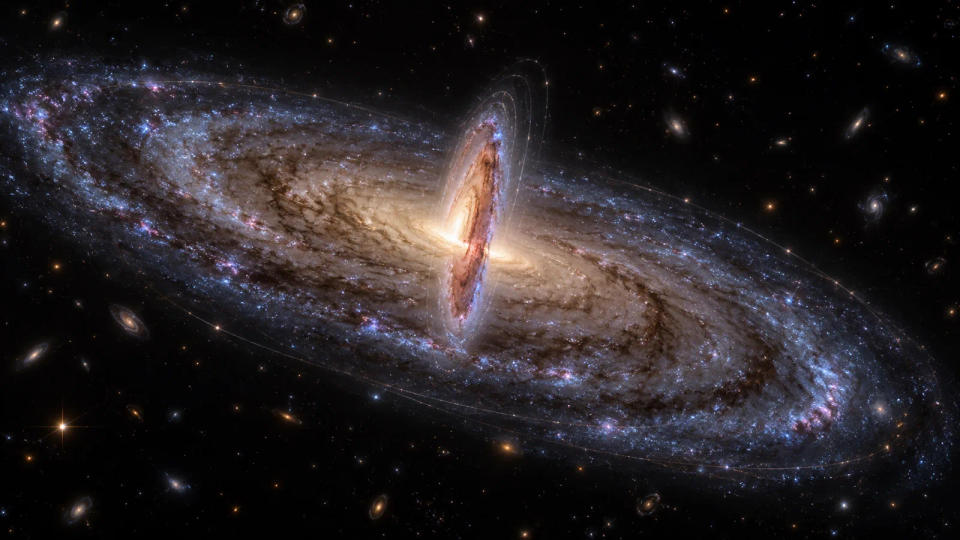
NGC 4698 lies about 55 million light-years away in the constellation Virgo and belongs to the Virgo Cluster, a crowded collection of more than a thousand galaxies. Like the Milky Way, it has a broad disk filled with stars, gas, dust, and spiral structure.
Its center, however, does not line up neatly with that disk.
The galaxy’s central bulge is stretched roughly at a right angle to the main disk. More importantly, measurements of the stars and ionized gas close to the nucleus show that this inner region rotates around an axis that is nearly perpendicular to the rotation of the larger galaxy.
Astronomers call this a kinematically decoupled component. “Decoupled” does not mean the center is detached or floating separately. Gravity still binds the galaxy together. It means that one part of the galaxy has preserved a different pattern of motion from the larger system around it.
That difference is a clue to the galaxy’s history. A disk that forms from one rotating reservoir of material usually develops a common overall direction of angular momentum. NGC 4698 looks as though some of its central material arrived with a very different orientation.
How Astronomers Know Which Way a Galaxy Is Rotating
A Hubble photograph cannot show stars making a full orbit around a galactic center. Those journeys can take millions of years. Instead, astronomers measure motion with spectroscopy.
Light contains fingerprints from atoms and molecules. If a star or cloud of gas is moving toward Earth, those fingerprints shift slightly toward shorter, bluer wavelengths. If it is moving away, they shift toward longer, redder wavelengths. By measuring these Doppler shifts across different parts of a galaxy, astronomers can build a map of line-of-sight velocity.
In a typical rotating disk, one side approaches us while the opposite side recedes, producing a smooth pattern aligned with the disk. NGC 4698 breaks that simple picture near its center. The strongest central change in velocity appears along an axis that does not match the rotation of the galaxy’s large-scale disk.
Researchers reported this geometric and kinematic mismatch in 1999, describing the bulge and disk as nearly orthogonal. Later work identified a compact nuclear disk of stars and gas rotating perpendicular to the main galactic disk.
So Hubble’s 2026 image should not be read as the first detection of the sideways rotation. The motion comes from spectroscopy and earlier dynamical studies. What the new portrait does is show the setting in exquisite detail: dusty lanes, a ring-like spiral pattern, blue star-forming regions, and an elongated central glow all belong to the same unusual galaxy.
A Past Encounter May Have Built a Second Inner Disk
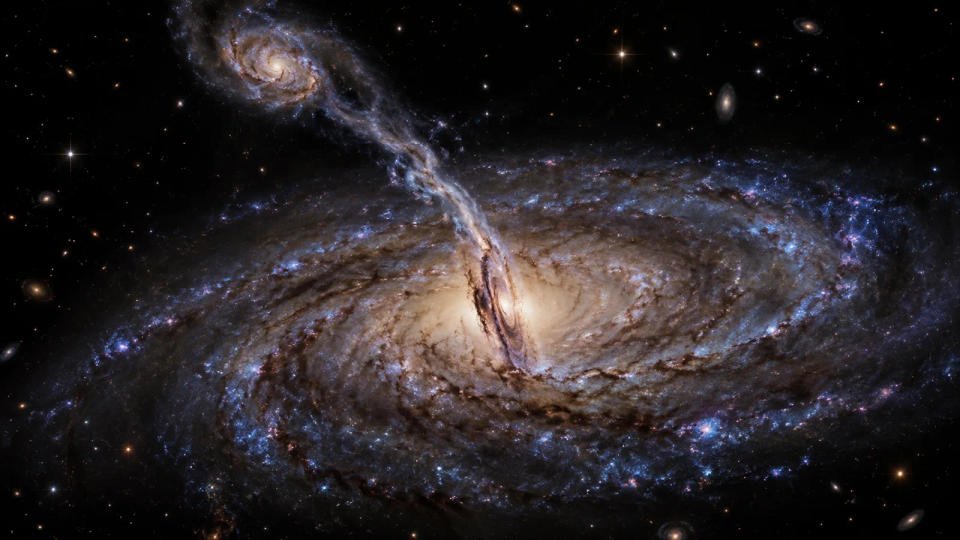
How can one galaxy end up with major structures rotating around different axes?
The most plausible explanations involve material arriving from outside NGC 4698. Gas matters here because it behaves very differently from stars. Gas clouds can collide, shock, radiate away energy, and settle into new orbits. Stars mostly pass one another without direct collisions.
If incoming gas carries angular momentum pointed in a very different direction from the galaxy’s original disk, it does not have to flatten into the same plane. It can settle into a tilted, even nearly polar, configuration near the center. If enough gas collects there, it can form stars. The result is a compact stellar-and-gas disk that keeps the orientation of the material from which it formed.
A detailed 2012 study supported this kind of scenario for NGC 4698. The researchers found that the unusual bulge geometry and polar nuclear disk were consistent with the galaxy acquiring gas from outside. Their analysis also indicated that star formation in that nuclear disk ended more than 5 billion years ago, so the structure is ancient rather than the aftermath of something that happened recently.
NASA and ESA point to another intriguing clue: observations show a short tail of hydrogen extending from one side of NGC 4698. Disturbed gas like this can be consistent with a past minor merger, in which a larger galaxy absorbs a much smaller companion.
That clue does not give astronomers a frame-by-frame replay of the event. A gas tail cannot tell us exactly when a merger happened or reconstruct every stage of it. But the sideways central rotation, unusual bulge, and disturbed hydrogen all fit a history in which NGC 4698 did not evolve as a perfectly isolated spiral.
Why NGC 4698 Matters for Galaxy Evolution
NGC 4698 is useful because it exposes something that is easy to miss in beautiful galaxy images: a galaxy can look orderly today while preserving motions created by events that happened billions of years ago.
Once stars form, they can continue orbiting for immense spans of time. A tilted nuclear disk can therefore act like a piece of galactic archaeology, preserving information about the direction from which material arrived and the gravitational structure into which it settled.
This is why unusual velocity patterns are so valuable. A photograph tells us where the stars, dust, and glowing gas are. Spectroscopy tells us how those components are moving. Two galaxies can look similarly smooth and still have very different internal histories.
The new Hubble image comes from an observing program focused on galaxies in the Virgo Cluster. By resolving structures such as star clusters, nebulae, dust lanes, and central regions, Hubble helps researchers connect the anatomy of individual galaxies with a larger question: how does life inside a dense galaxy cluster change the way galaxies evolve and form stars?
For NGC 4698, the answer is not that its center is violating the rules of physics. It is following the angular momentum it inherited from a complicated past.
A spiral galaxy can spend billions of years smoothing over the visible scars of an encounter. Its motion is harder to erase. In NGC 4698, the center is still turning sideways — a quiet reminder that galaxies remember where their material came from.
Post a Comment