
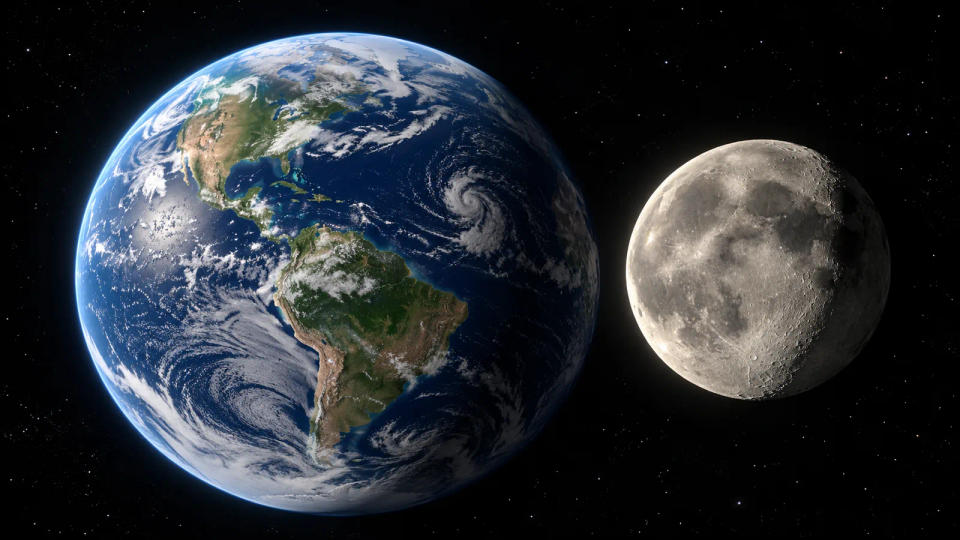
Move the Moon to half its present distance and the first thing you would notice is obvious: it would look enormous. But the bigger change would be happening in the oceans. A Moon only about 192,200 kilometers from Earth would produce far stronger tidal forcing, race around us in roughly 9.7 days, and transform the rhythm of phases and eclipses.
This thought experiment assumes the Moon keeps the same mass and roughly the same kind of orbit, just with its average orbital distance cut in half. It is not an instant teleportation scenario, because suddenly moving the Moon would introduce extra complications. Instead, imagine a stable Earth–Moon system with the Moon already settled into that closer orbit.
The Moon Would Look Twice as Wide—and Move Much Faster
Today, the Moon is about 384,400 kilometers from Earth on average. At half that distance, its physical size would not change, but its apparent diameter in our sky would roughly double. The familiar half-degree-wide Moon would become about one degree across—large enough to look strikingly oversized even without a telescope.
Its total reflected light reaching Earth would also be about four times greater, because the same reflected sunlight would spread over only one quarter as much area by the time it reached us. The Moon’s surface would not become intrinsically brighter, but a full Moon would light the night much more strongly simply because it would occupy about four times the apparent area in the sky.
The orbit would speed up too. According to Kepler’s third law, orbital period scales with orbital distance raised to the three-halves power. Halving the Moon’s orbital radius would reduce its sidereal orbital period from about 27.3 days to roughly 9.7 days. Because Earth is also moving around the Sun, the cycle from one new Moon to the next would be slightly longer—about 9.9 days instead of today’s 29.5 days.
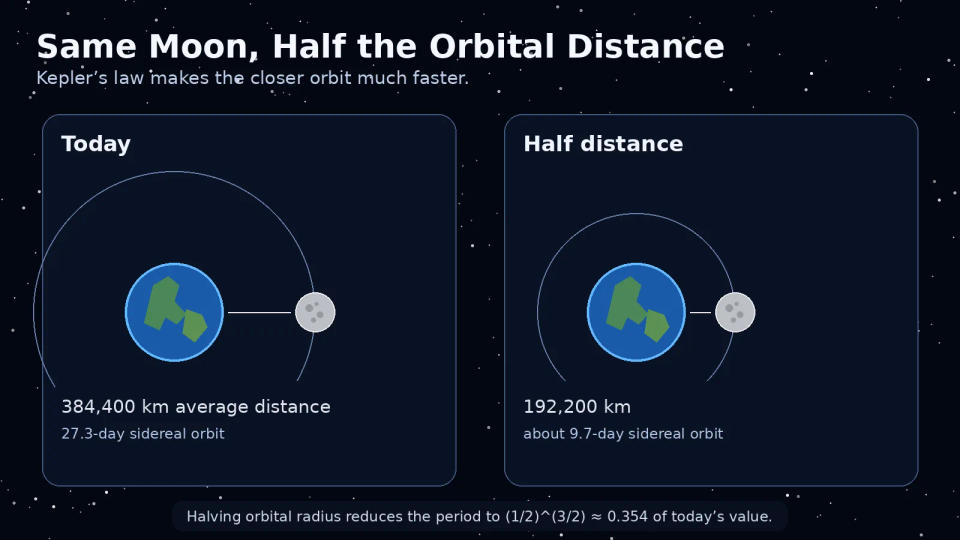
That means the lunar phases would rush by. New Moon to full Moon would take only about five days. The Moon would change position against the stars much faster each night, making the sky feel noticeably more dynamic.
Tidal Forcing Would Be About Eight Times Stronger
This is where the thought experiment becomes much more serious. The tide-generating force of the Moon is not governed by the ordinary inverse-square rule alone. Tides come from the difference in the Moon’s gravitational pull across Earth, and that tidal force varies approximately with the inverse cube of distance.
So if the Moon were half as far away, the lunar tide-generating force would be about eight times stronger: 1 divided by one-half cubed equals eight. That does not mean every high tide would be exactly eight times higher. Real ocean tides depend on coastlines, ocean depth, basin shape, seafloor topography, friction, and resonance. Some places already amplify tides dramatically while others do not.
Even so, an eightfold increase in the forcing would profoundly change coastal environments. Tidal ranges and tidal currents would generally become much more energetic, and many low-lying coasts and estuaries would experience far more extreme flooding and draining. Ports, wetlands, beaches, and shallow seas would have to adapt to a completely different rhythm of water movement.
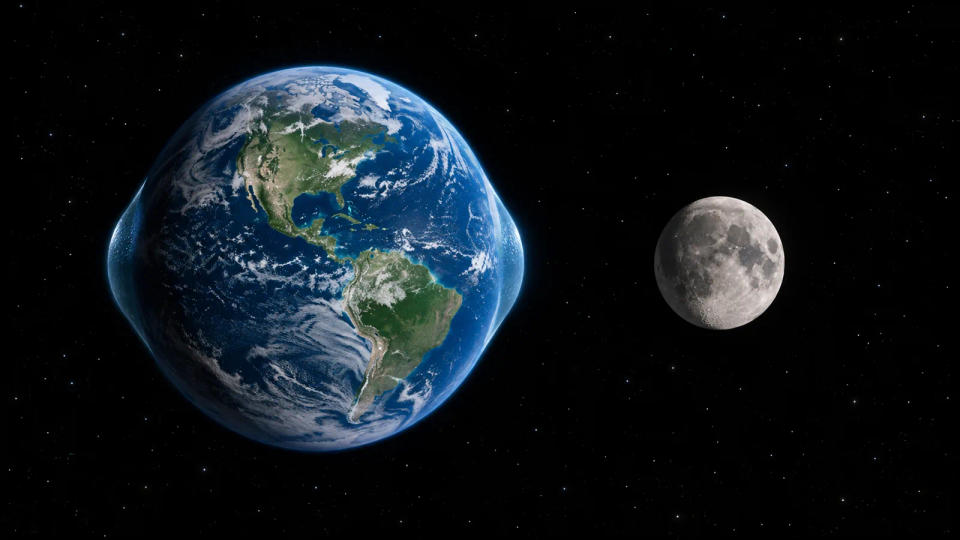
The solid Earth also responds to lunar gravity. Today, the Moon raises small tides in Earth’s crust as well as in the oceans. A much closer Moon would increase those stresses too. That would not justify saying Earth would automatically suffer constant giant earthquakes or volcanic eruptions, but the planet would flex more strongly under the Moon’s changing gravitational pull.
Solar Eclipses Would Look Completely Different
One of the great coincidences of our current sky is that the Sun and Moon appear almost the same size. The Sun is vastly larger, but it is also vastly farther away. That near-match is why the Moon can sometimes cover the solar disk almost perfectly during a total solar eclipse.
At half its present distance, the Moon would appear roughly twice as wide as the Sun. If the orbit kept a similar shape, central solar eclipses would therefore be total rather than annular: the Moon would be much too large in the sky to leave the bright “ring of fire” that appears when today’s Moon is near the farther part of its orbit.
Eclipses still would not happen at every new Moon. The lunar orbit is tilted by about five degrees relative to Earth’s orbital plane, so most new Moons would still pass above or below the Sun from our point of view. But when the alignment was right, the Moon’s larger apparent size would cast a broader central shadow across Earth. A total eclipse would look less like the delicate near-perfect fit we know today and more like a large dark disk sweeping across the Sun.
Earth and Moon Would Trade Spin and Orbital Energy Faster
The modern Earth–Moon system is slowly evolving. Lunar laser ranging shows that the Moon is receding from Earth by about 3.8 centimeters per year. The reason is tidal interaction: Earth rotates faster than the Moon orbits, so our planet’s tidal bulges are carried slightly ahead of the Moon. Their gravity transfers angular momentum from Earth’s rotation to the Moon’s orbit, gradually slowing Earth’s spin while pushing the Moon outward.
With the Moon much closer, tidal coupling would be far stronger. Earth would lose rotational energy to the lunar orbit more rapidly, and the Moon would tend to migrate outward more strongly. The exact rate cannot be obtained by simply multiplying today’s recession rate by eight, because real tidal dissipation depends heavily on ocean geography, resonance, Earth’s rotation rate, and the detailed response of both bodies.
That also means “half as far away” would not be a permanent natural arrangement. Unless some outside mechanism held the Moon there, the stronger tides would continue changing both Earth’s rotation and the Moon’s orbit over geological time. A closer Moon is not just a different picture of the same system—it changes the pace at which the system evolves.
There is one more subtlety. The Moon is tidally locked today, rotating once per orbit so the same hemisphere generally faces Earth. In a long-settled closer orbit, tidal forces would again favor synchronous rotation, but with the shorter orbital period. In other words, the Moon would still tend to show us the same face while completing that cycle much faster.
Conclusion
A Moon at half its current distance would be spectacular, but the giant-looking disk would be the least important consequence. Its orbital cycle would shrink to about ten days, full-Moon nights would be much brighter, solar eclipses would change dramatically, and lunar tidal forcing on Earth would rise by roughly a factor of eight.
The biggest lesson is that distance matters enormously in gravitational systems. Cutting a distance in half does not merely make an object look twice as close—it can change orbital timing, tides, and long-term planetary evolution by much larger factors.
Sources & Further Reading
- NASA Science — Moon Facts
- NASA Space Place — How Far Away Is the Moon?
- NOAA Ocean Service — Tidal Generating Forces and Distance
- NASA JPL — The Apollo Experiment That Keeps on Giving
- NASA Science — Why Do Eclipses Happen?
Post a Comment