
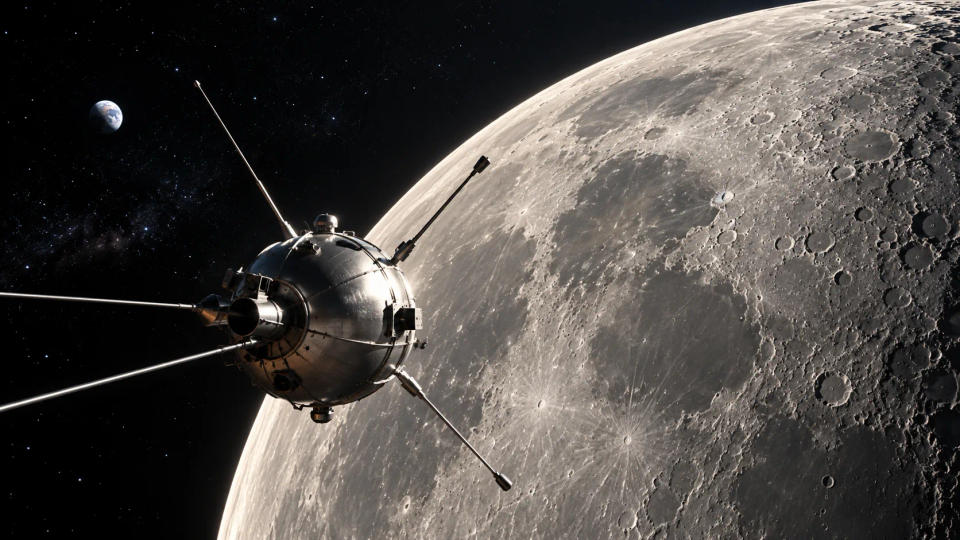
Today, “crashing into the Moon” sounds like a mission failure. In 1959, it was the mission.
The Soviet Union became the first country to deliberately crash a spacecraft into the Moon when Luna 2 struck the lunar surface in September 1959. The impact made Luna 2 the first human-made object to reach another celestial body, years before the first soft landing and almost a decade before people walked on the Moon.
What makes the story interesting is that Luna 2 was not simply a metal projectile. It was a scientific probe sent on a one-way trip, collecting data until the moment its radio signal vanished.
Luna 2 Was Built to Hit the Moon
Luna 2 belonged to the Soviet Union’s early Luna program, created when reaching the Moon was still an extraordinary engineering problem. The spacecraft was launched on September 12, 1959, and placed on a direct path toward the Moon.
There was no plan to brake into orbit and no landing system to cushion the arrival. A hard impact was the objective. In the late 1950s, simply sending a spacecraft across roughly 384,000 kilometers of space and making physical contact with the Moon would prove that rockets, guidance, tracking networks, and deep-space radio links could all work together.
NASA’s historical account describes Luna 2 as very similar to Luna 1, the Soviet probe launched earlier that year. Luna 1 had also been intended to hit the Moon, but it missed by several thousand miles and continued into an orbit around the Sun. Luna 2 was the successful follow-up.
Why Hitting the Moon Was So Difficult in 1959
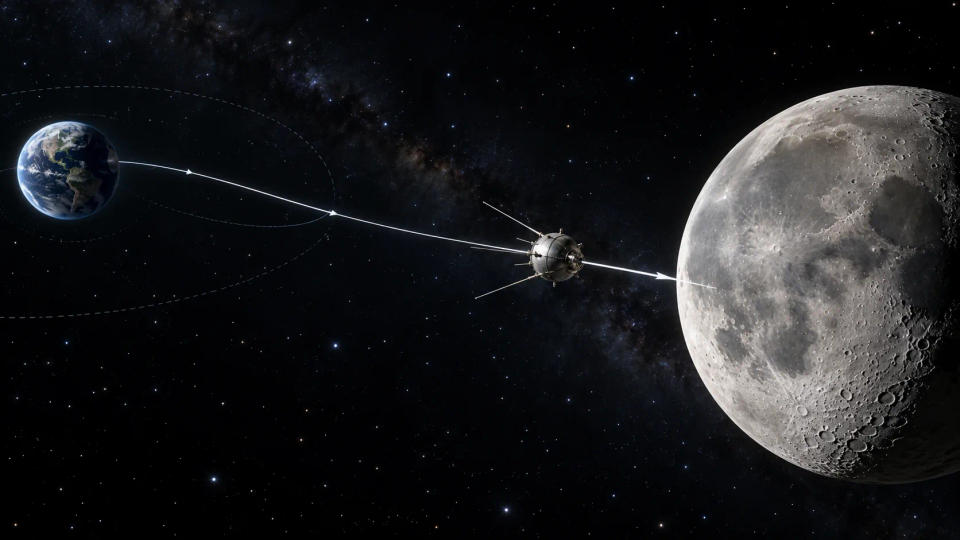
Aiming at the Moon is not like firing at a stationary target. The Moon is moving around Earth, Earth is moving around the Sun, and a probe’s trajectory changes under the gravity of both worlds. Small launch errors can grow into enormous misses after hundreds of thousands of kilometers.
That difficulty explains why the first lunar missions produced so many failures and partial successes. NASA’s Moon mission timeline lists several unsuccessful American Pioneer attempts and several unsuccessful Soviet impact attempts before Luna 2. Even Luna 1, which successfully escaped Earth’s gravity, passed the Moon instead of striking it.
Luna 2 therefore represented more than a dramatic collision. It showed that mission planners could predict where the Moon would be, launch at the right moment, and put a spacecraft on a trajectory accurate enough to intersect it.
During the trip, the mission also released a cloud of sodium gas that could be observed from Earth. The artificial cloud helped with tracking and let scientists study how gas behaved in space. It was a striking reminder of how different early deep-space navigation was: ground observatories were an essential part of following the probe’s path.
What Happened During Luna 2’s Final Approach
On September 13, 1959, Luna 2 closed in on the Moon. NASA records the impact in the region between Mare Imbrium and Mare Serenitatis, on the Moon’s near side. Its radio transmissions suddenly stopped when the spacecraft reached the surface, providing the decisive sign that the flight had ended at the Moon.
The spacecraft also carried metallic spheres containing Soviet emblems. They were a symbolic payload as much as a technical one, reflecting the intense competition of the early Space Race. A few days later, Soviet leader Nikita Khrushchev gave U.S. President Dwight Eisenhower a replica of one of the pennant spheres during a visit to the United States.
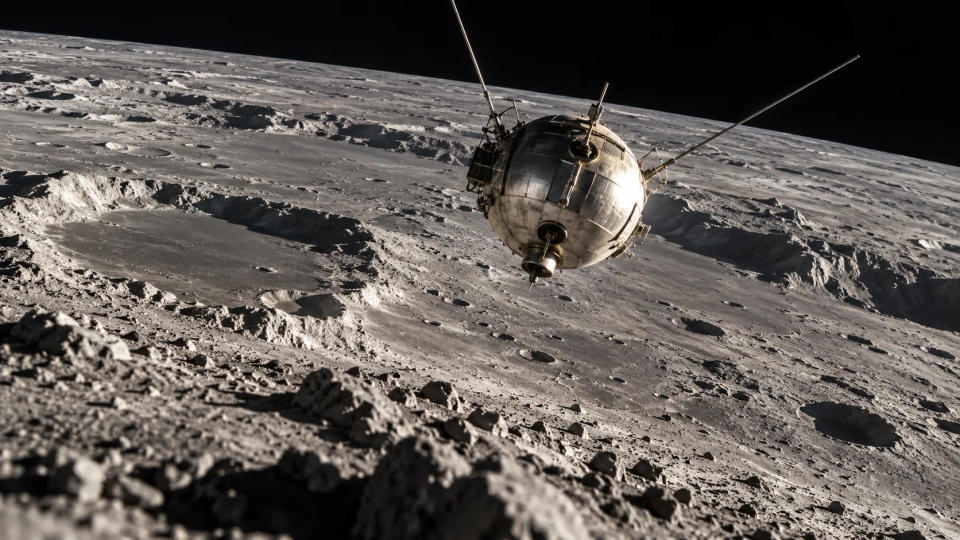
The phrase “crashed into the Moon” can therefore be misleading if it suggests something went wrong. Luna 2 was an impactor: destruction on arrival was the planned final step. The success was reaching the right place at all.
And the mission was doing science right up to the end. Luna 2 carried instruments for studying magnetic fields, radiation, charged particles, and tiny meteoroid impacts. NASA notes that the probe detected no strong global lunar magnetic field and no radiation belts comparable to Earth’s Van Allen belts.
Later missions would reveal localized magnetic regions in the Moon’s crust, but the Moon does not possess a global magnetic field like Earth’s. In 1959, even basic questions about the environment around another world could not be answered with close-range spacecraft data until a probe physically went there.
Luna 2 kept transmitting measurements during its one-way flight. Its destruction ended the mission, but by then the spacecraft had already delivered something more valuable than survival: direct data from a region no spacecraft had previously reached.
Why the First Lunar Crash Mattered
Luna 2’s impact was a milestone in both science and the Space Race. It demonstrated that a spacecraft could leave Earth, cross the Earth-Moon distance, and reach another world. That basic capability became the foundation for far more ambitious missions.
The pace of Soviet lunar firsts continued almost immediately. Luna 3 flew around the Moon weeks later and returned the first photographs of the lunar far side. In 1966, Luna 9 achieved the first survivable soft landing on the Moon, proving that a spacecraft could arrive without being destroyed. Luna 10 then became the first spacecraft to orbit another celestial body.
Hard impacts also remained useful as a scientific technique. A spacecraft does not always need to survive contact with a target to produce useful data. An intentional impact can test navigation, expose material, or create an event that telescopes and other spacecraft can observe.
So the first successful trip to the Moon did not end with landing legs touching gently on dust. It ended with a radio signal cutting off.
Conclusion
The first country to crash a spacecraft into the Moon was the Soviet Union, with Luna 2 in September 1959. The collision was intentional and successful, making Luna 2 the first human-made object to reach another celestial body.
Its brief mission captured the character of early space exploration: simple hardware by modern standards, enormous navigation challenges, real scientific measurements, and a finish that looked like destruction but counted as a historic success.
Sources & Further Reading
- NASA History — 60 Years Ago: Luna 2 Makes Impact in Moon Race
- NASA Science — Moon Missions
- NASA Goddard HEASARC — A Brief History of High-Energy Astronomy: 1900–1959
- ESA — 12 September: Luna 2 Launch
- Lunar and Planetary Institute — Luna Mission
Post a Comment