

The James Webb Space Telescope does not see the universe the way human eyes do. Most of the light it is built to detect lies beyond the red end of the visible spectrum, in infrared wavelengths that can reveal things hidden from ordinary sight.
That infrared vision is the reason Webb can peer through dusty stellar nurseries, measure the warmth of planets and disks, and detect ancient galaxies whose light has been stretched by the expansion of the universe. But Webb does not simply "switch on" an infrared camera. Its mirrors, instruments, orbit, cooling system, detectors, and even the colors in its published images are all designed around the physics of infrared light.
Infrared Is Light Our Eyes Cannot See
Visible light is only a small slice of the electromagnetic spectrum. Infrared begins just beyond the red light our eyes can detect and extends to much longer wavelengths. Webb observes from about 0.6 microns, which includes visible red light, out to roughly 28 microns in the mid-infrared.
Those longer wavelengths are scientifically useful for several reasons. Dust grains that block visible light are less effective at blocking some infrared wavelengths, so Webb can look deeper into dusty clouds where stars and planets are forming. Cooler objects such as warm dust, young planets, and some brown dwarfs also emit strongly in infrared light even when they are faint in visible light.
Infrared is also essential for studying the distant universe. As space expands, light traveling across billions of years is stretched to longer wavelengths. Ultraviolet and visible light emitted by very early galaxies can therefore arrive at Webb as infrared light, a process called cosmological redshift. In that sense, Webb's infrared sensitivity is not just a different way of seeing the same universe; it opens a window onto epochs that are difficult to study at visible wavelengths.
How Webb Collects and Measures Infrared Light
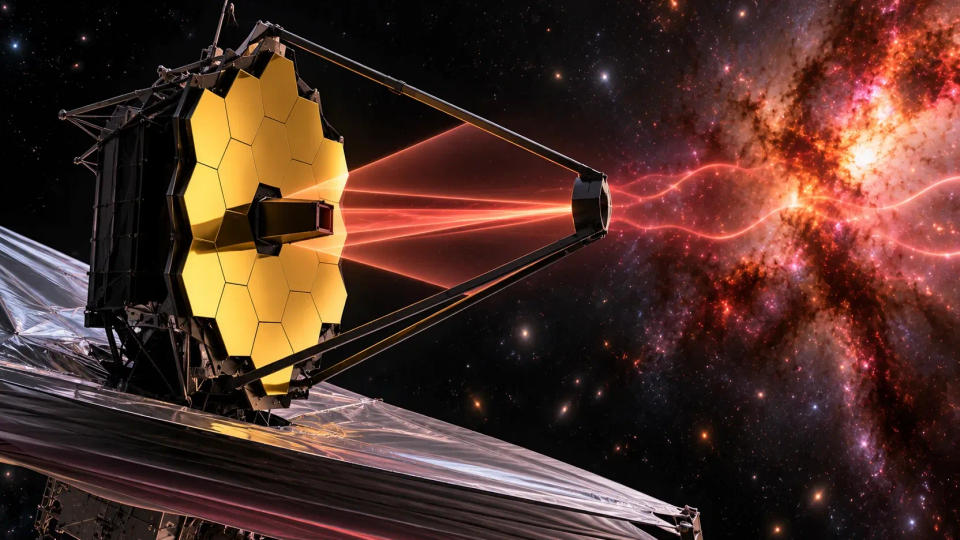
Webb begins with its enormous segmented primary mirror. Eighteen hexagonal beryllium mirror segments work together as one surface about 6.5 meters across. A very thin layer of gold coats the mirrors because gold reflects red and infrared light especially well.
The primary mirror gathers faint incoming light and reflects it to the secondary mirror. From there, the light continues through additional optics and into Webb's scientific instruments. The large collecting area matters because many of the objects Webb studies are extraordinarily faint. More mirror area means more photons can be collected during an observation.
Webb has four main science instruments. NIRCam takes near-infrared images and also supports other observing modes. NIRSpec spreads near-infrared light into spectra, letting astronomers examine how brightness changes with wavelength and identify physical or chemical signatures. NIRISS provides imaging and slitless spectroscopy, while MIRI covers the longer mid-infrared range and can both image and take spectra.
At the end of the optical path are detectors that convert incoming photons into measurable electronic signals. Webb uses mercury-cadmium-telluride detectors for its near-infrared range and arsenic-doped silicon detectors for the mid-infrared. In simple terms, the telescope's mirrors collect and focus the light, filters or spectrographs sort it, and the detectors turn the arriving infrared photons into data.
Why an Infrared Telescope Has to Stay Extremely Cold
Infrared astronomy has a problem that visible-light telescopes do not face in quite the same way: warm objects emit infrared radiation. That includes the telescope itself. If Webb were warm, its own infrared glow could overwhelm the faint signals coming from distant galaxies, planets, and dust clouds.
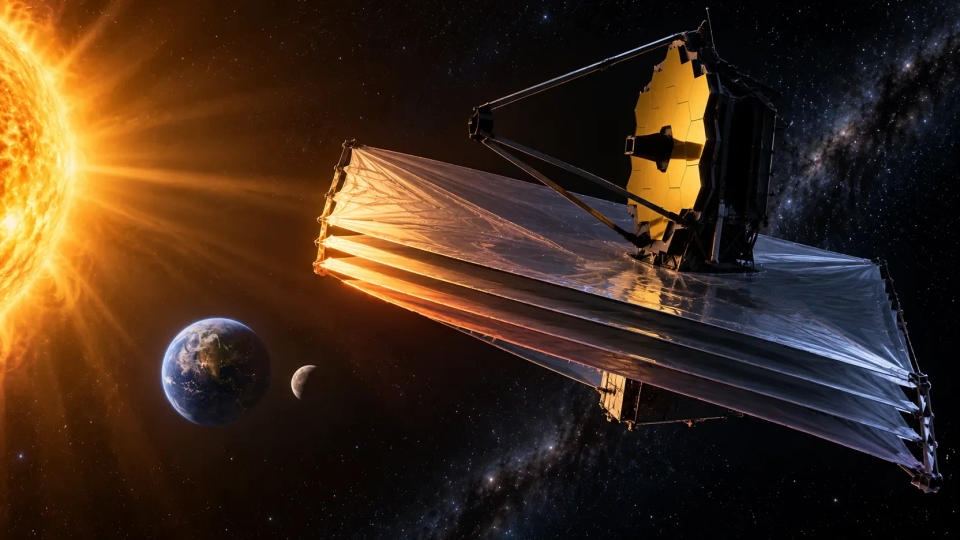
That is why Webb carries a five-layer sunshield roughly the size of a tennis court. The observatory is arranged so the Sun, Earth, and Moon remain on the warm side of the shield while the mirrors and instruments stay shaded on the cold side. Webb operates near the Sun-Earth L2 region, about 1.5 million kilometers from Earth, where this geometry can be maintained as the observatory orbits the Sun with Earth.
The near-infrared instruments operate at temperatures of only a few dozen kelvins. MIRI must be even colder, around 7 kelvins, so it uses a dedicated cryocooler. Keeping the observatory cold reduces its own infrared background and makes it possible to distinguish extremely weak cosmic signals from unwanted thermal noise.
How Invisible Infrared Data Becomes a Color Image
The famous Webb images seen on websites and news pages are not what a human observer would literally see through an eyepiece. Webb records infrared wavelengths that human eyes cannot detect, and the observatory does not have a traditional eyepiece at all.
Instead, astronomers observe a target through different filters that isolate particular ranges of wavelength. Each exposure begins as data representing how much infrared light reached each detector pixel. Image specialists then combine exposures from several filters and assign visible colors to them.
The usual approach preserves wavelength order: shorter infrared wavelengths are mapped toward bluer visible colors, intermediate wavelengths toward greens or yellows, and longer wavelengths toward oranges and reds. The result is a scientifically useful translation of invisible light into a palette our eyes can interpret. The colors can highlight differences in temperature, dust, gas, stars, or molecular emission depending on the filters used.
This does not make the images "fake." The structures, relative positions, brightness patterns, and wavelength-dependent features come from real measurements. Color is a visualization tool, much like using a weather map to represent temperature with colors that make invisible physical differences easier to understand.
Conclusion
Webb sees the infrared universe by combining a large gold-coated mirror, specialized near- and mid-infrared instruments, highly sensitive detectors, and an unusually cold observing environment. That combination lets it collect light our eyes cannot see and turn it into images and spectra that reveal hidden star formation, cooler worlds, dusty structures, and highly redshifted galaxies from the early universe.
Its greatest advantage is not simply that infrared light looks different. Infrared carries information that visible light often cannot deliver, which is why Webb can show us parts of the cosmos that would otherwise remain hidden.
Sources & Further Reading
- NASA Science — Infrared Astronomy
- NASA Science — Telescope Overview
- NASA Science — Infrared Detectors
- NASA Science — How Are Webb's Full-Color Images Made?
- ESA — Webb's Instruments
Post a Comment