

About 1,000 light-years away in the constellation Perseus, a young cluster called IC 348 is still surrounded by the raw material from which stars are made. In September 2026, NASA and ESA released a huge new James Webb Space Telescope view of this region, revealing a crowded nursery of young stars, dusty filaments, protostellar jets, and exceptionally low-mass brown dwarfs.
The most surprising part is not simply that IC 348 is making stars. Webb has helped astronomers identify brown dwarfs in the cluster with estimated masses as low as about twice that of Jupiter. These objects occupy an awkward borderland between stars and planets, and they are forcing researchers to ask how small an object can be and still form through the same basic collapse process that produces a star.
A Nearby Nursery Still Making Stars
IC 348 belongs to the Perseus star-forming complex and is young on astronomical timescales. Earlier Webb work described the cluster as roughly 5 million years old, which means many of its lowest-mass members are still warm from formation and therefore relatively bright in infrared light. That makes the region unusually useful for studying objects that would be much harder to detect once they cool.
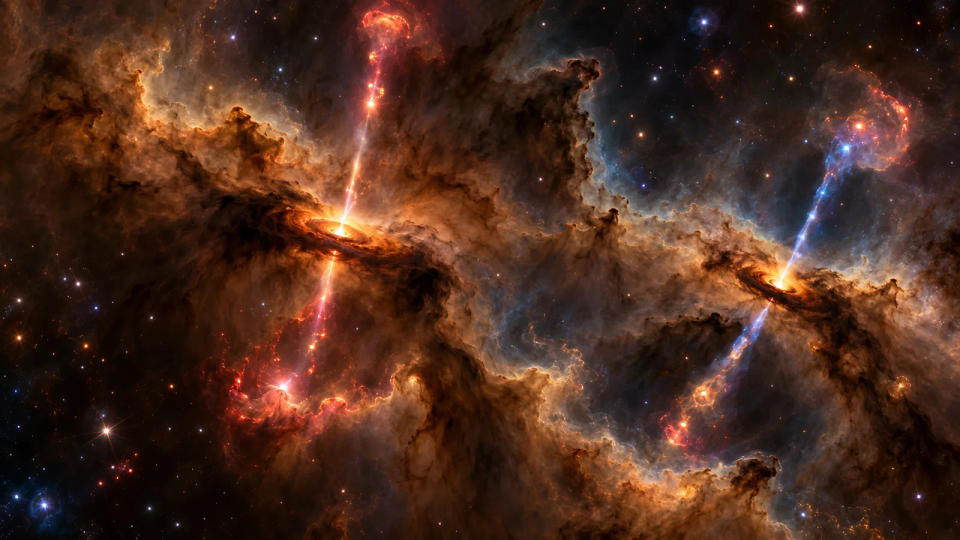
The broad Webb panorama shows why the area is so visually complex. Cold molecular gas and dust surround the cluster in layered clouds, while radiation from young stars illuminates and sculpts the material. Some of the wispy structures are reflection nebulae: dust that becomes visible because it scatters starlight. Infrared observations can also see through portions of the obscuring dust that would hide young objects at visible wavelengths.
That combination of youth, proximity, and infrared visibility makes IC 348 more than a pretty nebula. It is a laboratory where astronomers can examine several stages of stellar birth in the same neighborhood, from embedded protostars to young stars and faint substellar objects.
How Newborn Stars Reveal Themselves
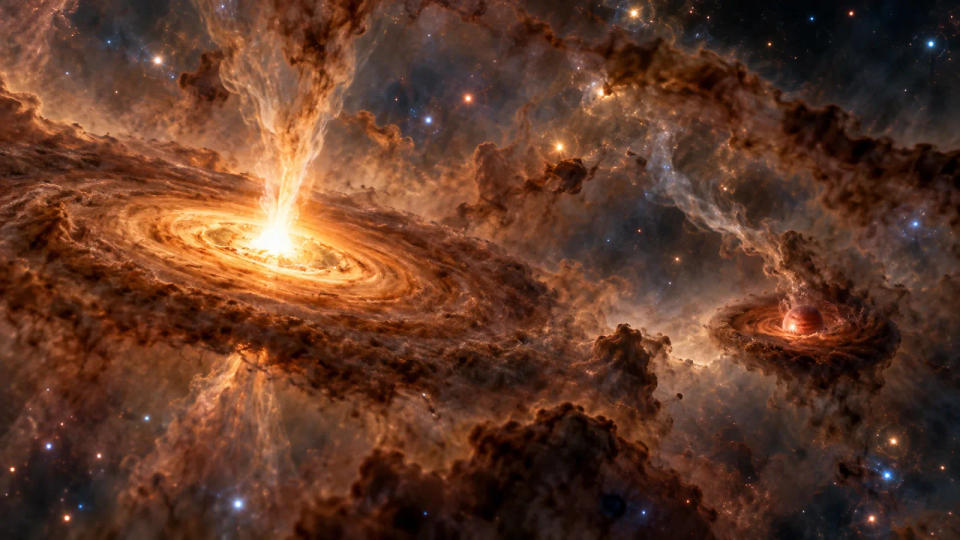
A star begins when part of a cold molecular cloud becomes dense enough for gravity to overcome internal support. The collapsing material gathers into a central protostar, while conservation of angular momentum naturally helps create a rotating disk around it. Gas and dust continue to feed the growing object through that disk.
But not all of the infalling material stays there. Young stars can launch narrow jets along their rotation axes. When those fast outflows collide with surrounding gas, they create bright shock fronts known as Herbig-Haro objects. In the new IC 348 panorama, Webb resolves several examples. NASA highlights HH 797, where the source is actually two protostars with nearly parallel outflows, and nearby HH 211, a striking object with narrow jets and broader outflow structures.
These jets are useful because newborn stars can be deeply buried. The central protostar may be difficult to see directly, but its outflow can extend far beyond the dusty envelope. In effect, the jet becomes a signpost announcing that active star formation is taking place inside an otherwise dark cloud.
Why IC 348’s Brown Dwarfs Are So Important
Brown dwarfs form in a star-like way, but they never become massive enough for sustained fusion of ordinary hydrogen in their cores. The smallest normal stars are roughly 8 percent of the Sun’s mass; below that limit lies the brown-dwarf regime. Many brown dwarfs can briefly fuse deuterium early in life, but they do not settle into the long-lived hydrogen-burning state that defines a true star.
Webb is now pushing this category to remarkably low masses. The team used NIRCam imaging in 2024 to identify faint candidates from their colors and brightness, then followed up with NIRSpec spectroscopy in 2025. The peer-reviewed study behind the results reported 39 candidates in the deeper survey, spectra for 15 of them, and nine newly classified substellar cluster members. The faintest new members had estimated masses of about two Jupiter masses.
That is difficult for theories of star formation. A massive cloud fragment has enough gravity to collapse relatively easily, but as the available mass gets smaller, resisting forces such as thermal pressure become increasingly important. Finding a star-like object at only a few Jupiter masses therefore gives researchers a new observational constraint on the minimum mass that the fragmentation process can produce.
There is another intriguing clue: two of the new members, with estimated masses around 2 and 10 Jupiter masses, showed strong infrared excess associated with circumstellar disks. A disk is not proof that planets are forming, but it provides the same kind of raw material from which planets can potentially emerge around stars.
The Fuzzy Boundary Between Brown Dwarfs and Planets
A two-Jupiter-mass brown dwarf sounds almost contradictory. If an object has a planetary mass, why not simply call it a planet? The key distinction is not mass alone but formation history. A giant planet is generally understood to form in a disk around a star or another central object. A brown dwarf forms more directly from the collapse and fragmentation of a molecular cloud, even if its final mass overlaps the planetary range.
That is why these free-floating IC 348 objects are so valuable. They allow astronomers to study planetary-mass bodies without the glare of a host star, while also testing how far the star-formation process extends toward lower masses. Researchers still have to consider alternatives such as planets that formed in disks and were later ejected, but the youth and population of IC 348 make the star-like formation route a central explanation under investigation.
Their atmospheres are proving unusual as well. Webb spectra show an absorption feature attributed to an unidentified hydrocarbon, with a strong band near 3.4 micrometers in the coolest, faintest objects. The 2025 paper proposed a new spectral class, “H,” defined by this hydrocarbon feature. That classification is a proposal rather than an established replacement for existing brown-dwarf classes, but it shows how observations of very young, very low-mass objects may expose chemistry that older classification schemes were not designed to capture.
Conclusion
IC 348 is valuable because it places several cosmic birth stories in one field of view. Webb can trace dusty clouds collapsing toward stars, jets punching through surrounding gas, young cluster members still glowing with formation heat, and brown dwarfs so light that they overlap the mass range of giant planets.
The latest panorama is visually spectacular, but its deeper importance is scientific: IC 348 lets astronomers test where star formation stops, where planetary-mass objects begin, and whether nature really draws a clean line between the two. So far, the evidence suggests that the boundary is much blurrier than the names “star,” “brown dwarf,” and “planet” make it sound.
Sources & Further Reading
- NASA Science — Webb Reveals Dynamic Panorama of Star Formation
- ESA — Webb Reveals Stunning Panorama of Star Formation
- Penn State — A New Spectral Class of Brown Dwarfs at the Bottom of the IMF in IC 348
- NASA Science — Webb Identifies Tiniest Free-Floating Brown Dwarf
- STScI — JWST General Observer Program 4866
Post a Comment