
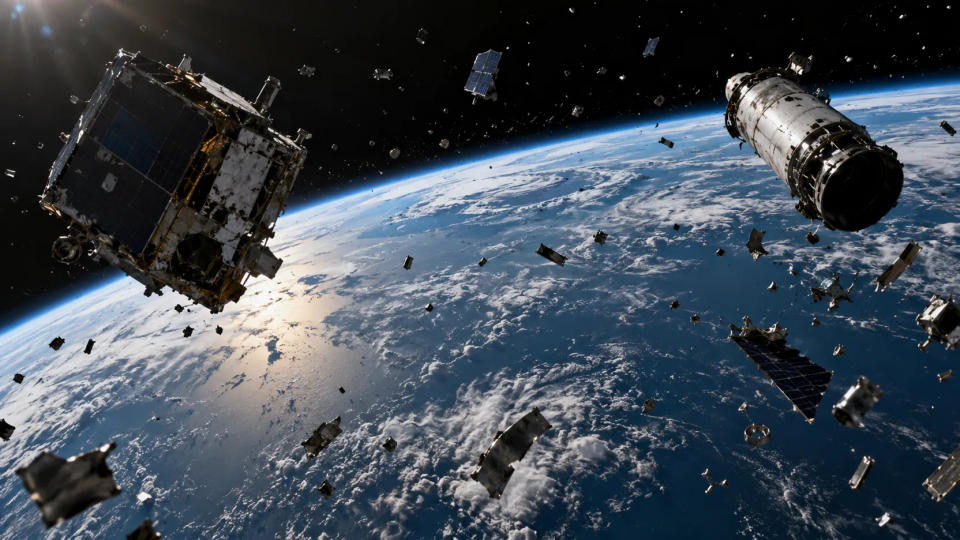
Earth does not have a visible ring of broken spacecraft, but the space around our planet is far busier than the night sky suggests. Thousands of dead satellites and rocket stages share orbit with clouds of fragments too small to track individually, and some of those pieces are moving fast enough to disable a spacecraft on impact.
So how much space junk is actually up there? There is no exact live count, because most small debris cannot be followed one object at a time. The best current picture comes from surveillance catalogues for larger objects and statistical models for the much larger population of smaller fragments.
The short answer: the real number is in the hundreds of millions
ESA’s Space Environment Statistics, last updated on July 31, 2026, lists about 46,930 objects that are regularly tracked by space-surveillance networks. But that catalogue includes working satellites as well as dead spacecraft, rocket bodies, fragments, and objects whose origin is not yet identified.
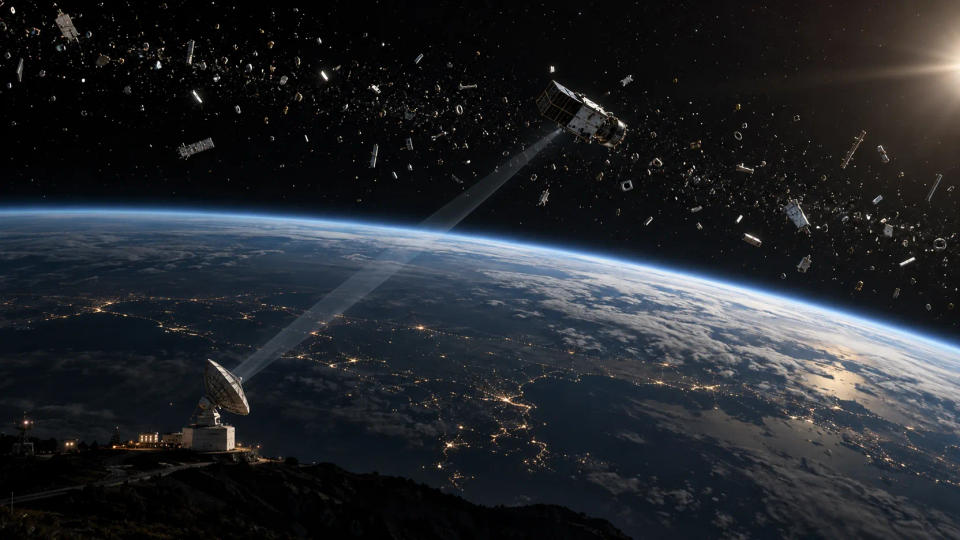
The larger picture is much more crowded. ESA’s MASTER-8 statistical model, using a February 2026 reference population, estimates about 68,450 space objects larger than 10 centimeters, including roughly 11,300 active payloads in that model population. It also estimates around 1.5 million pieces of space debris between 1 and 10 centimeters and about 230 million pieces between 1 millimeter and 1 centimeter.
That means the familiar “number of tracked objects” is only the visible tip of the problem. Once millimeter-scale debris is included, the population rises into the hundreds of millions. ESA also estimates that all human-made objects currently in Earth orbit have a combined mass of more than 17,000 tonnes, although that mass includes functioning spacecraft as well as debris.
Why the tracked count is not the same as the junk count
A radar catalogue is not a complete census of everything in orbit. Ground systems can routinely track many objects roughly 5–10 centimeters across in low Earth orbit, while the practical size limit becomes much larger at geostationary altitude. Small fragments may be detectable during specialized observations without being trackable well enough to maintain a reliable orbit for each one.
ESA says about 18,840 satellites remain in space and about 15,900 are still functioning. Those figures also show why “46,930 tracked objects” should not simply be described as 46,930 pieces of junk: active spacecraft are mixed into the broader catalogue. The debris population has to be separated by object type, status, size, and whether an orbit can be maintained accurately enough for repeated tracking.
For the smallest particles, scientists use a different approach. Radar surveys, impact marks on returned spacecraft hardware, and debris-environment models reveal populations that cannot be followed individually. That is how researchers can estimate hundreds of millions of small objects even though only a tiny fraction have their own catalogue entries.
What actually counts as space junk?
Space junk is not just “old satellites.” The standard definition covers non-functional human-made objects in Earth orbit or re-entering the atmosphere. A dead spacecraft qualifies, but so does a spent rocket body, a discarded mission component, or a fragment created when hardware explodes or collides.
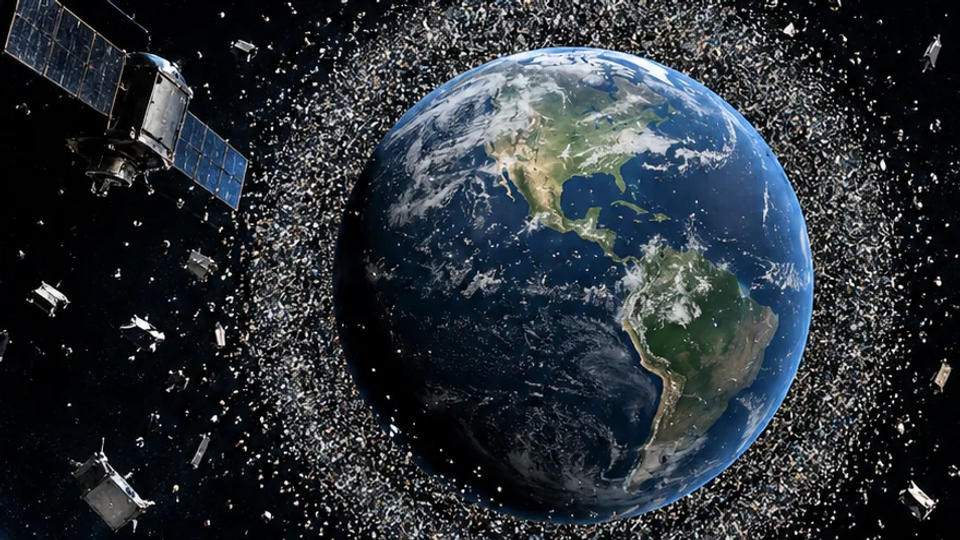
Stylized visualization; debris sizes and density are exaggerated so the fragments remain visible.
Fragmentation is especially important because one event can turn a single large object into a cloud of smaller hazards. ESA’s current statistics record more than 660 break-ups, explosions, collisions, or other anomalous fragmentation events since the beginning of the space age. Some fragments can be linked to a particular satellite or rocket stage; others remain unidentified.
The result is a strange orbital archaeology. Modern satellites fly through regions that still contain hardware and fragments left by decades of earlier missions. New launches add active spacecraft, while old objects may linger long after their useful lives have ended.
Where is space junk most dangerous?
Debris is not spread evenly around Earth. Low Earth orbit, which extends to about 2,000 kilometers in altitude, contains a large share of the tracked population because it is heavily used by Earth-observation satellites, communications constellations, crewed spacecraft, and many older missions.
ESA’s 2026 Space Environment Report highlights a particularly difficult band between roughly 600 and 1,100 kilometers, where large amounts of legacy debris have accumulated. Below about 600 kilometers, atmospheric drag removes objects more quickly, although those lower altitudes are increasingly crowded with maneuverable satellites. Above 1,100 kilometers, natural orbital decay can take centuries, so debris can remain a hazard for a very long time.
Size is only half the story. NASA’s Orbital Debris Program Office notes that objects in low Earth orbit typically travel around 7–8 kilometers per second, while the average collision speed between orbital objects is about 10 kilometers per second. At those velocities, a centimeter-scale fragment can seriously damage or disable a spacecraft, and even millimeter-size impacts can destroy exposed components. Spacecraft shielding helps against the smallest particles, but it cannot make a satellite invulnerable.
Can we stop the debris population from growing?
Some debris leaves orbit naturally. ESA reported in September 2026 that more than three intact satellites or rocket bodies were re-entering the atmosphere each day on average during 2025. Newer guidelines also push operators toward shorter post-mission disposal times; ESA has moved from a 25-year target to a five-year target for relevant low Earth orbit missions.
Prevention matters because avoiding one fragmentation event is far easier than tracking or removing thousands of new pieces afterward. Operators can passivate old spacecraft and rocket stages by removing stored energy, design satellites to leave busy orbital regions after their missions, share trajectory information, and perform collision-avoidance maneuvers when necessary.
But ESA’s latest long-term modeling says prevention alone is no longer enough in the most congested regions. Even with no future launches, collisions between existing objects can create debris faster than some of it naturally re-enters. That is the mechanism behind the Kessler syndrome: collisions produce fragments that increase the chance of more collisions. It does not mean all near-Earth space is about to become unusable, but it is why agencies are also developing active debris-removal missions for large, high-risk objects.
The most useful answer to “How much space junk is orbiting Earth?” is therefore not one neat number. We can track tens of thousands of large objects, models indicate more than a million hazardous centimeter-scale fragments, and the millimeter-scale population reaches roughly 230 million. Keeping orbit usable will depend less on counting every speck than on preventing new debris and removing the large objects most likely to create thousands more.
Post a Comment