
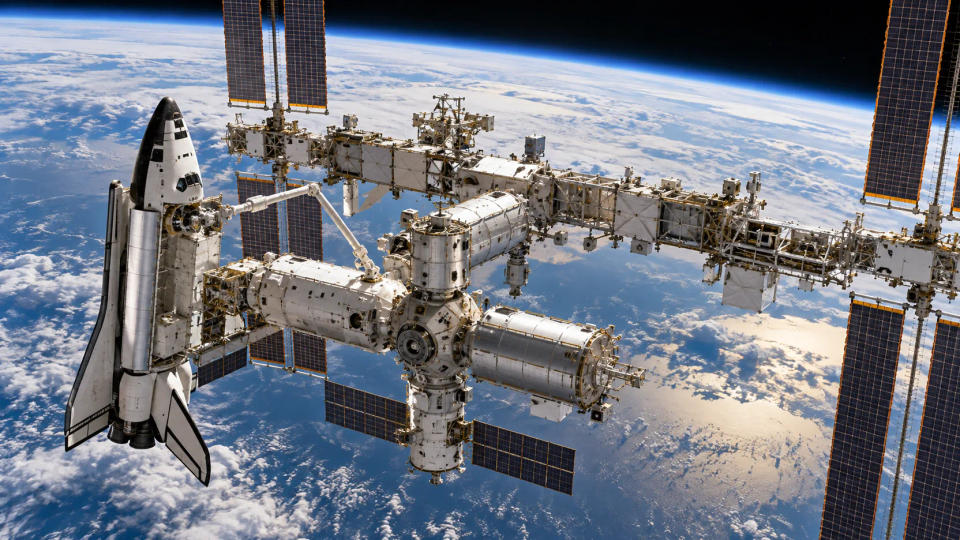
The International Space Station looks as if it must have been launched as one enormous spacecraft. It was not. The ISS was built piece by piece in low Earth orbit, with modules arriving on different rockets and space shuttles, then being joined by docking systems, robotic arms, and astronauts working outside in spacesuits.
That approach was not just convenient; it was necessary. A complete station is far too large and massive for any single launch vehicle. Instead, engineers designed the ISS like a giant orbital construction kit whose pieces could survive launch separately and still fit together hundreds of kilometers above Earth.
Why the ISS Had to Be Built Piece by Piece
The finished station is wider than a football field and has a mass of more than 400,000 kilograms, although its exact mass changes as visiting vehicles, supplies, and equipment come and go. No rocket available when the program began could place anything close to that entire structure into orbit in one launch.
So the partners divided the station into pressure modules, connecting nodes, truss sections, solar-array assemblies, radiators, airlocks, laboratories, docking hardware, and other components. Many of those pieces were designed and manufactured in different countries, tested on Earth, and launched only when the station was ready to receive them.
The key idea was modularity. Each new part had to attach to hardware already in orbit, make mechanical connections, and often receive power, data, cooling, or atmosphere from the rest of the station. That meant the construction plan had to work not only as an engineering blueprint but also as a carefully choreographed sequence of launches.
The First Two Pieces Met in Orbit in 1998
Construction began with Zarya, a Russian-built module launched on a Proton rocket on November 20, 1998. Zarya provided early electrical power, propulsion, communications, and attitude-control capability while the station was still little more than a single spacecraft.
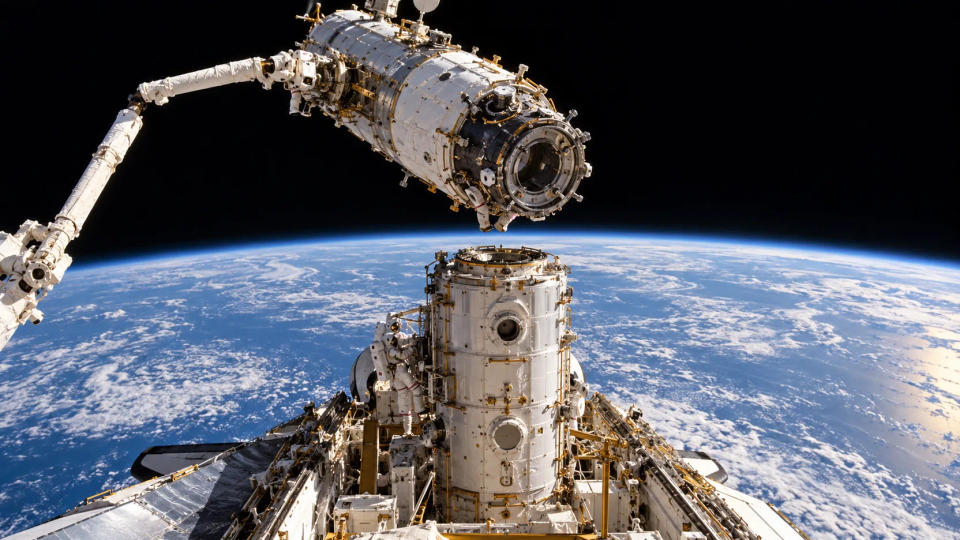
Sixteen days later, Space Shuttle Endeavour arrived carrying Unity, the first U.S.-built ISS module. The two pieces had never been physically joined on Earth. During mission STS-88, the shuttle crew used Endeavour's robotic arm to capture Zarya and bring it to Unity, which was mounted in the shuttle's payload bay. On December 6, the modules were mated together.
That connection created the first recognizable building block of the ISS. Spacewalking astronauts then connected cables, installed hardware, and prepared the small two-module outpost for future additions. It was a preview of the method that would be repeated for years: launch a component, maneuver it into position, lock it to the station, and connect the systems that let it become part of the larger machine.
Shuttles, Spacewalkers, and Robotic Arms Did the Heavy Lifting
The Space Shuttle became the main construction truck for the U.S.-led side of the station. Its large payload bay could carry bulky hardware that would have been difficult to deliver any other way, including laboratory modules, truss segments, solar-array structures, airlocks, and logistics carriers.
Robotic arms handled much of the heavy positioning. Early in assembly, the shuttle's Canadarm lifted payloads from the cargo bay. In 2001, the ISS received Canadarm2, a 17-meter-long robotic arm that could move around the station by gripping power-and-data fixtures with either end. That ability made it especially useful as the station expanded.
But robots could not do every job. Astronauts and cosmonauts performed spacewalks to bolt equipment into place, route electrical lines, connect fluid systems, install antennas, unfold hardware, and make repairs. In microgravity, a large object does not feel heavy in the ordinary sense, but it still has mass. Once a massive truss or module starts moving, it must be controlled gently and precisely so it does not collide with the station.
How the Station Grew Into a Full Laboratory
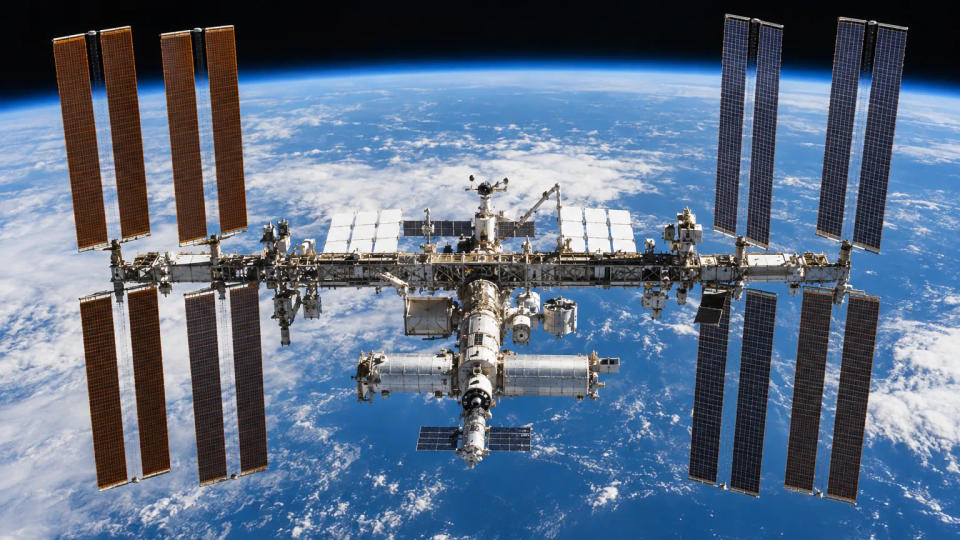
Once the first modules were connected, the pace of construction accelerated. Russia's Zvezda service module arrived in 2000, adding living quarters, life-support functions, and propulsion capability. That same year, the Z1 truss and the first large U.S. solar arrays began turning the tiny outpost into a much more capable station.
NASA's Destiny laboratory was installed in 2001, followed by Canadarm2 and the Quest airlock. Major truss sections were added in 2002, creating the backbone that would eventually support the station's huge power-generating solar arrays and thermal-control radiators.
The loss of Space Shuttle Columbia in 2003 interrupted the assembly schedule, because many large ISS components depended on shuttle launches. Construction later resumed. Harmony arrived in 2007, Europe's Columbus laboratory and the first major pieces of Japan's Kibo laboratory followed in 2008, and additional Kibo hardware arrived in 2009. The final major starboard truss section and its solar arrays were installed in 2009.
By 2010, the Tranquility module and the Cupola had been added. The Cupola's seven windows gave crews an extraordinary view of Earth, but it also served a practical role: astronauts could use it as a robotics workstation while watching operations outside the station. In 2011, the shuttle era of ISS assembly ended after the delivery of hardware including the Permanent Multipurpose Module and the Alpha Magnetic Spectrometer.
Was the ISS Ever Really Finished?
NASA describes the major assembly of the station as completed in 2011, when the Space Shuttle program ended. That is a useful milestone, but it does not mean the ISS stopped changing.
The station was designed to be serviced and upgraded in orbit. New equipment has continued to arrive, including the expandable BEAM module in 2016, Russia's Nauka laboratory in 2021, and newer roll-out solar arrays added to increase available power. Older hardware has also been replaced, moved, or removed as the station's needs changed.
This is one reason the ISS is such an unusual engineering achievement. Most machines are fully assembled before they begin operating. The ISS began working while it was still under construction. Crews lived aboard it, ran experiments, maintained life-support systems, and helped expand the structure around themselves as new pieces arrived.
In that sense, the station was less like launching a finished building and more like constructing a research campus while people were already living inside it.
Conclusion
The International Space Station was built through decades of careful orbital assembly rather than a single giant launch. Rockets and shuttles delivered the pieces, robotic arms moved them into position, docking mechanisms locked them together, and spacewalkers connected the systems that made the structure function as one spacecraft. The result is not simply a large object in orbit, but a machine assembled and repeatedly upgraded in the environment where it was meant to operate.
Sources & Further Reading
- NASA — International Space Station Assembly Elements
- NASA — ISS20th: High-Flying Construction
- NASA — International Space Station Reference
- NASA — International Space Station Final Configuration
- Canadian Space Agency — The History of Canadarm2
- ESA — Building the International Space Station
Post a Comment