

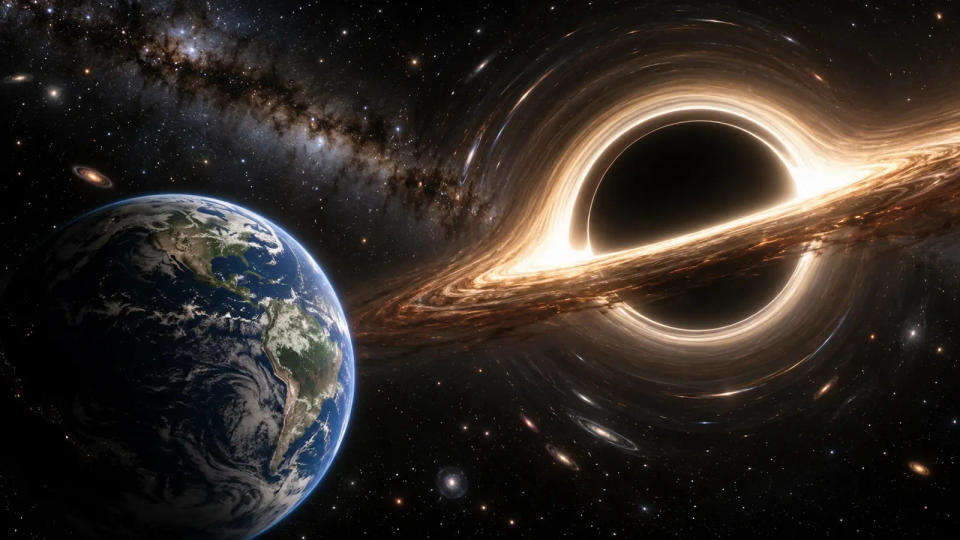
If Earth fell into a black hole, the planet would not simply disappear in one instant. Long before reaching the center, intense tidal gravity would distort Earth, fracture its crust, strip away its atmosphere and oceans, and eventually stretch the planet into a stream of debris. Exactly where that destruction happens depends strongly on the black hole’s mass.
A stellar-mass black hole would tear Earth apart far outside its event horizon. Around a supermassive black hole, the event horizon is much larger and the tidal forces at that boundary can be weaker, so an object can cross the horizon before being completely destroyed. Either way, there is no survivable route back once Earth passes the point of no return.
Would a Black Hole Suddenly Suck Earth In?
Black holes are often imagined as cosmic vacuum cleaners, but gravity does not work that way. From a great distance, a black hole pulls on Earth according to the same basic gravitational rules as any other object with the same mass. If the Sun were somehow replaced by an equally massive black hole without changing Earth’s speed, Earth would continue orbiting almost as before rather than immediately plunging inward.
For Earth to fall into a black hole, its trajectory would have to carry it close enough that it could no longer escape or maintain a stable orbit. That might happen after a complicated gravitational encounter, a collision, or a loss of orbital energy. Once Earth began a deep plunge, the most important effect would not be the overall pull of gravity but the difference in gravity across the planet.
The side of Earth closer to the black hole would be accelerated more strongly than the far side. This difference is called a tidal force. NASA describes the same basic process for stars and other objects that venture too close to black holes: the nearer side is pulled harder, producing extreme stretching and compression.
How Would Earth Be Destroyed?
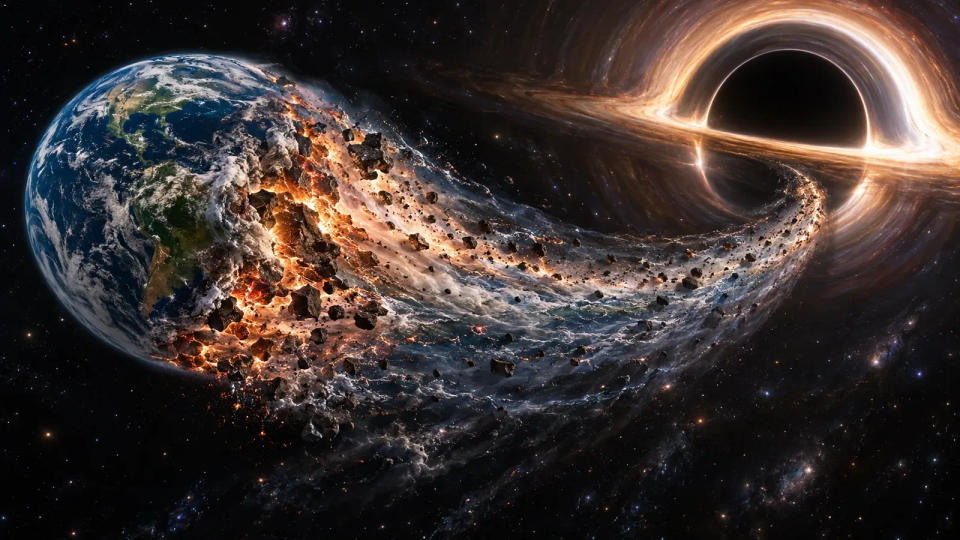
At first, the changes might be subtle on a planetary scale. But as Earth approached the black hole, tidal forces would rise rapidly. The crust would fracture globally, enormous earthquakes would reshape the surface, and the oceans and atmosphere would no longer remain evenly bound to the planet.
Closer still, Earth’s nearly spherical shape would be lost. The planet would stretch along the direction toward the black hole and compress across the other directions. This process is popularly called spaghettification. It is not merely a visual effect: rock, water, air, and eventually individual structures would be pulled into an increasingly narrow stream.
Whether this happens outside or inside the event horizon depends on the black hole. NASA’s black-hole simulations emphasize that smaller, stellar-mass black holes have much stronger tidal gradients near their relatively small horizons. A supermassive black hole can have a horizon millions of kilometers across, so the change in gravity from one side of an object to the other can be gentler at the horizon itself.
For Earth, a simple gravitational estimate shows why the distinction matters. Around a black hole with only a few or a few tens of solar masses, Earth would be disrupted enormously far outside the event horizon. Around a black hole with millions of solar masses, Earth could approach much closer before total disruption. For extremely massive black holes, the horizon can even be reached before tidal gravity becomes strong enough to tear a self-gravitating planet completely apart.
What Would We See Near the Event Horizon?
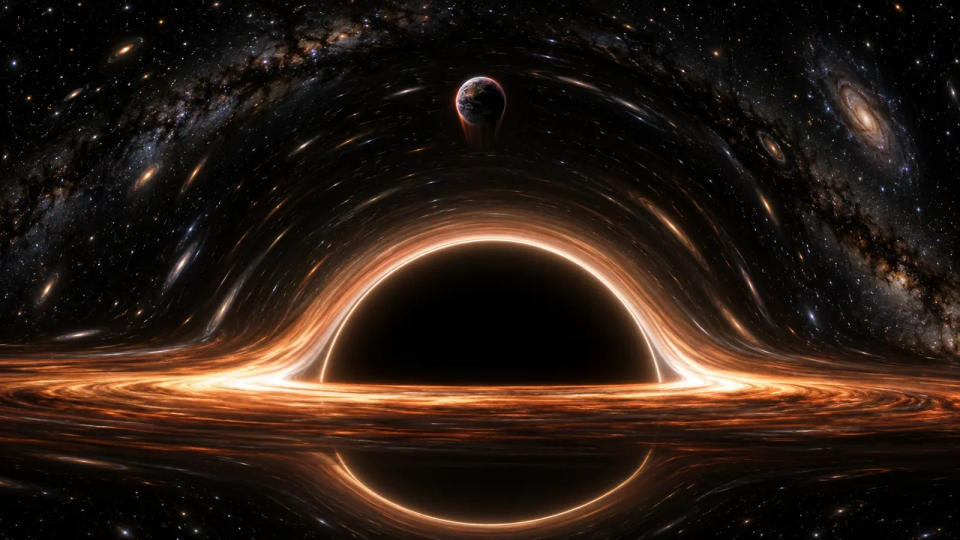
The view would be stranger than simply seeing a dark sphere. A black hole bends the paths of light, so the background sky would appear warped and duplicated. If the black hole were actively feeding, a hot accretion disk could glow around it while gravitational lensing bent light from the far side into arcs above and below the black hole’s shadow.
Time would also appear to behave differently depending on the observer. From far away, signals from the falling Earth would become increasingly delayed, stretched to longer wavelengths, and dimmer as the planet approached the event horizon. The planet would appear to slow dramatically and fade rather than visibly cross the horizon in an ordinary way.
But this does not mean Earth physically stops at the event horizon. In the local frame of an object falling with the planet, crossing the horizon of a sufficiently large black hole would occur in a finite amount of time. The horizon is not a solid surface. It is a boundary in spacetime beyond which all future-directed paths remain trapped inside.
For a stellar-mass black hole, there would be no intact Earth left by this stage. For a supermassive black hole, some material might cross the horizon before the strongest tidal destruction occurs, although the planet would still be doomed as it continued inward.
What Happens After Earth Crosses the Event Horizon?
Once any part of Earth passes the event horizon, it cannot send a signal back to the outside universe. Under general relativity, continuing inward is not simply a choice of direction; the geometry of spacetime makes deeper regions of the black hole part of the object’s future.
Classical general relativity predicts that infalling matter ultimately reaches a singularity, a region where the theory itself produces infinite curvature and stops giving a complete physical description. That is a warning sign that our current physics is incomplete, not proof that we fully understand what exists at the center.
Quantum gravity may change the story, but scientists do not yet have a confirmed theory that describes black-hole interiors all the way to the deepest region. So the scientifically secure answer ends at a limit: Earth would be destroyed and trapped, but the final microscopic fate of its matter cannot yet be described with confidence.
Conclusion: If Earth fell into a black hole, tidal gravity would eventually tear the planet apart, while gravitational time dilation and light bending would make the fall look very different to distant observers. Smaller black holes would destroy Earth before it crossed the event horizon; very massive black holes could let the planet cross first. The event horizon marks the irreversible boundary, while what ultimately happens near the central singularity remains one of the major unsolved problems in fundamental physics.
Post a Comment