

What would happen if we stopped thinking of space stations as compact laboratories and tried to build something closer to a giant building in Earth orbit? In principle, we could. But it would not look or behave like a skyscraper on Earth: it would be a sprawling network of pressure vessels, trusses, radiators, solar arrays, docking ports and perhaps rotating habitats, all continuously falling around the planet.
The surprising part is that gravity would not be the main structural problem. In orbit, the building would not need columns to hold up hundreds of floors. Instead, engineers would have to solve a different set of problems: launching enormous amounts of material, assembling it in space, keeping thousands of cubic meters of air contained, dumping waste heat, avoiding debris and maintaining a stable orbit for years or decades.
What Would an Orbital Building Actually Look Like?
A conventional tower makes sense on Earth because gravity defines “down.” Floors stack vertically, walls carry loads and the foundation transfers the building’s weight into the ground. In orbit, there is no ground and no useful architectural reason to stack rooms in a tall vertical column.
The International Space Station shows why. NASA lists the ISS at roughly 420,000 kilograms, with a truss about 94 meters long, yet the station and everything inside it are in continuous free fall around Earth. Astronauts float not because gravity has disappeared, but because they, the station and loose objects are falling together along the same orbit.
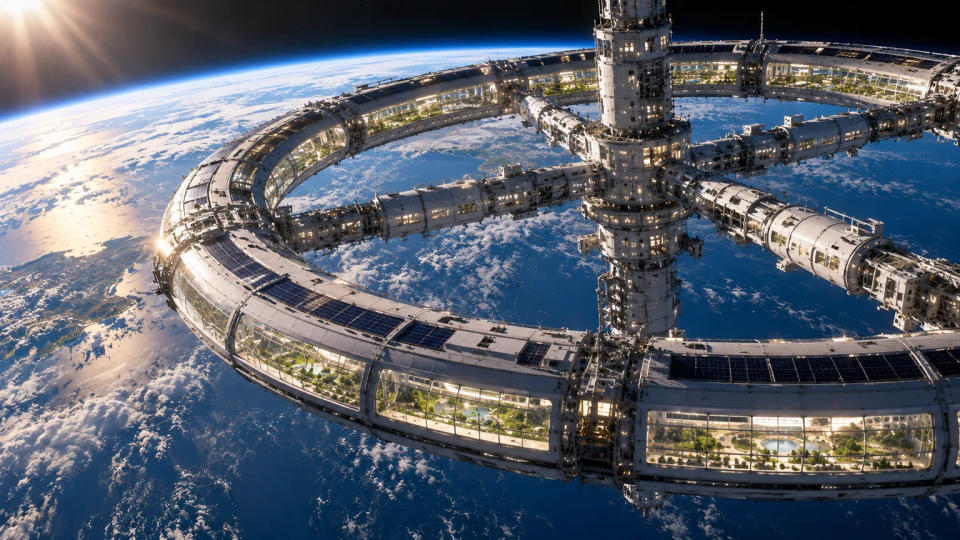
A much larger orbital building could therefore spread outward in almost any direction. Long trusses could connect laboratories, storage areas, greenhouses, docking hubs and crew neighborhoods. Pressurized modules might be arranged like branches around a central spine. Solar arrays and radiators would extend away from inhabited sections where they could see sunlight or radiate heat efficiently.
If the structure included a rotating ring, part of it could even create artificial gravity. That would make the overall complex look less like a skyscraper and more like a mechanical city floating over Earth.
How Could We Build Something This Large?
The first rule would be simple: do not try to launch the whole thing at once. Rocket fairings limit the size of hardware that can leave Earth, and the mass of a truly gigantic station would require many launches. The ISS was built the same basic way, with separate components delivered and connected in orbit over many missions.
A future orbital megastructure would push that method much further. Standardized modules could arrive already pressurized, while truss sections, tanks, cables, solar panels and shielding could be delivered as compact packages. Some elements might unfold after launch. Others could be assembled robotically from smaller pieces.
NASA’s work on in-space servicing, assembly and manufacturing is aimed at exactly this kind of constraint. The agency notes that assembling components in space can overcome rocket-fairing volume limits and enable structures that would be impractical to launch as one piece. In a giant orbital building, robots would probably do much of the repetitive external construction because every human spacewalk consumes time, life-support resources and carries risk.
The station would also need to grow in stages. Early modules could provide power, guidance, communications and safe shelter. Later sections could add living space, science facilities, workshops and larger power systems. That approach would make the project more like building a city district by district than launching a single spacecraft.
Could It Have Artificial Gravity?
Microgravity is useful for research, but living in it permanently changes the body. A very large orbital habitat could address that by rotating part of the structure. Inside a spinning ring, the floor would push inward on people and objects, producing an effect that feels like gravity.
The basic physics is straightforward: the apparent gravity depends on how fast the habitat spins and how large the ring is. A larger radius can produce the same artificial-gravity level at a slower rotation rate, which is generally more comfortable than spinning a small room rapidly.
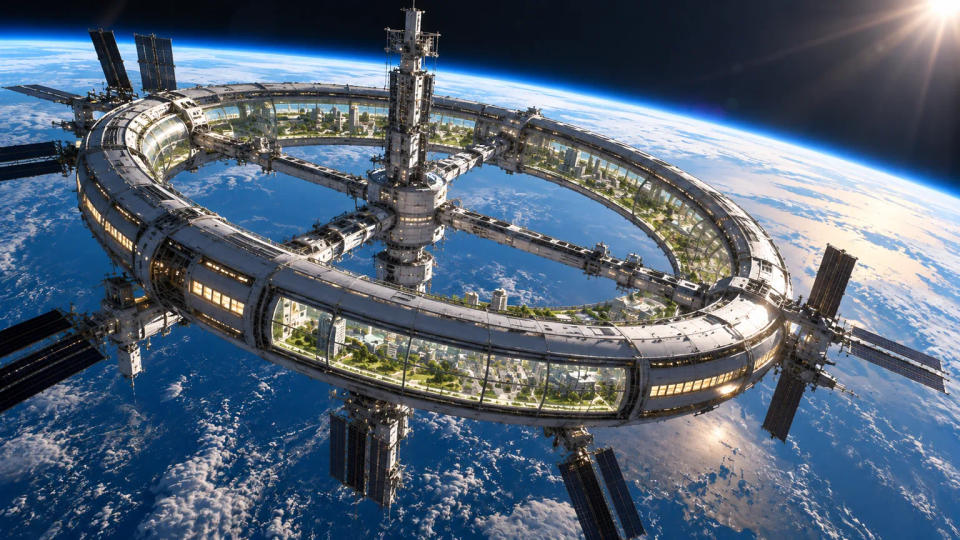
That sounds ideal, but it creates a new architectural problem. A rotating neighborhood and a non-rotating docking hub would have to coexist in the same complex. Bearings, seals, power connections, fluid lines and structural joints would need to transfer loads while allowing continuous rotation. Vehicles would probably prefer to dock with the non-rotating section, while residents might travel through a hub into the spinning ring.
In other words, artificial gravity could make a giant orbital building feel more familiar inside, but it would make the engineering outside much more complicated.
The Problems That Get Harder as the Structure Grows
Size would create challenges that ordinary buildings never face. The first is pressure. A large inhabited volume is essentially a giant pressure vessel. The air inside pushes outward on every wall, hatch, window and joint, so the structure must remain airtight while repeatedly heating and cooling as it moves between sunlight and Earth’s shadow.
Heat is another major issue. Space is cold in the everyday sense, but a spacecraft cannot cool itself with outside air. Electronics, people, lights and machinery produce heat that must be moved through coolant loops and released by radiators. The ISS already relies on large external thermal-control hardware. A much larger inhabited complex would need even more heat-rejection area and extensive plumbing to move energy away from busy sections.
Then there is orbital debris. Tiny objects can strike spacecraft at several kilometers per second, and NASA treats micrometeoroids and orbital debris as a serious hazard. A larger station presents more surface area that could be hit, so shielding, compartmentalization and the ability to isolate damaged sections would become essential.
Radiation would also matter, especially for long-term residents. Low Earth orbit benefits from some protection provided by Earth’s magnetic environment, but crews are still exposed to more radiation than people on the ground. A permanent orbital building would likely concentrate water, supplies and other mass around sleeping areas or storm shelters to improve shielding.
Finally, the entire structure would still be a spacecraft. In low Earth orbit, traces of atmosphere create drag, so even the ISS needs periodic boosts to maintain altitude. A giant building would need propulsion, attitude control and careful management of docking forces and vibrations. The larger and more flexible the structure becomes, the more difficult it is to move without bending or oscillating.
Conclusion
A giant building in Earth orbit is not forbidden by physics. The real barrier is scale. We already know how to assemble large structures in orbit, keep people alive in pressurized modules, generate power and operate complex stations for decades. Turning those capabilities into an orbital “building” would require vastly more launches, automation, shielding, thermal control and maintenance.
If it ever happens, the result probably will not resemble a tower with a roof and basement. It may look more like a floating city made of connected modules and rotating neighborhoods. In space, architecture would finally be free from the need to build upward — but it would become completely dependent on the engineering of staying alive in orbit.
Sources & Further Reading
- NASA — International Space Station Facts and Figures
- NASA — What Is Microgravity?
- NASA — In-Space Servicing, Assembly, and Manufacturing (ISAM)
- NASA — Micrometeoroids and Orbital Debris
- NASA — Space Radiation
- NASA NTRS — ISS Radiator Face Sheet Anomaly Investigation and Return to Function
Post a Comment