
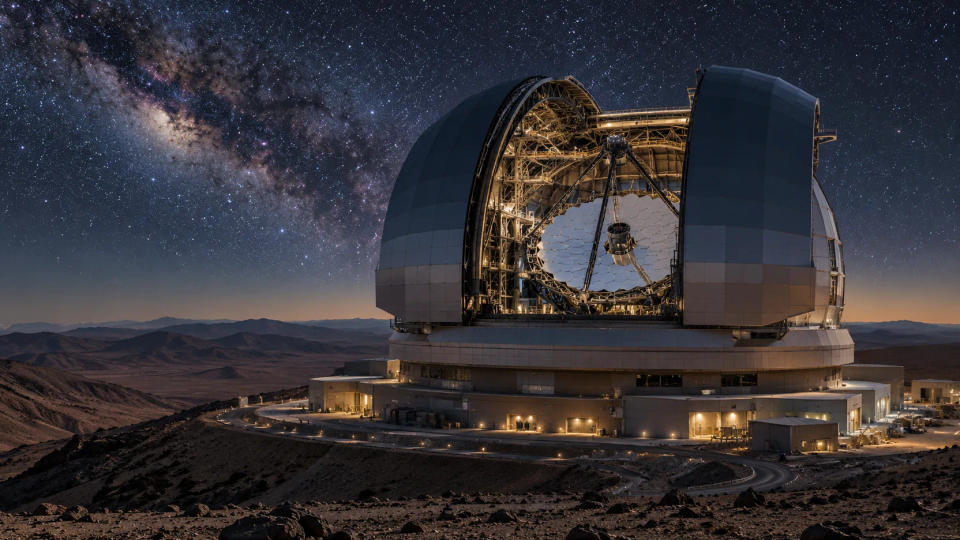
Imagine a telescope so large that its main mirror would nearly span the width of a baseball infield, yet every part of that mirror must behave as if it were one perfectly smooth piece of glass. That is the challenge behind the European Southern Observatory’s Extremely Large Telescope, or ELT, now rising on Cerro Armazones in Chile’s Atacama Desert.
The ELT is not operating yet. ESO currently plans telescope first light for March 2029, followed by scientific first light in December 2030. When it is ready, its 39-meter primary mirror will make it the world’s largest optical and near-infrared telescope, built to study everything from nearby exoplanets to galaxies formed in the young Universe.
Why Build a 39-Meter Telescope?
In astronomy, a larger mirror does two valuable things at once: it gathers more light and, at a given wavelength, can resolve finer detail. The ELT’s primary mirror, called M1, will have a diameter of 39 meters and a light-collecting area of about 978 square meters. That huge collecting surface matters because many of the most interesting targets in the Universe are extraordinarily faint.
A rocky planet orbiting another star, for example, can be billions of times fainter than the star beside it. A galaxy from the early Universe may arrive at Earth as only a trickle of photons after traveling for more than 12 billion years. A telescope cannot create photons that never reach us; it can only catch as many as possible. The ELT is designed to catch an enormous number of them.
Its location helps too. Cerro Armazones stands 3,046 meters above sea level in the Atacama Desert, about 20 kilometers from ESO’s Very Large Telescope at Paranal. The site is high, dry, dark and exceptionally clear, with more than 320 clear nights per year according to ESO. Those conditions reduce interference from clouds, water vapor and artificial light.
How 798 Mirror Segments Become One Giant Eye
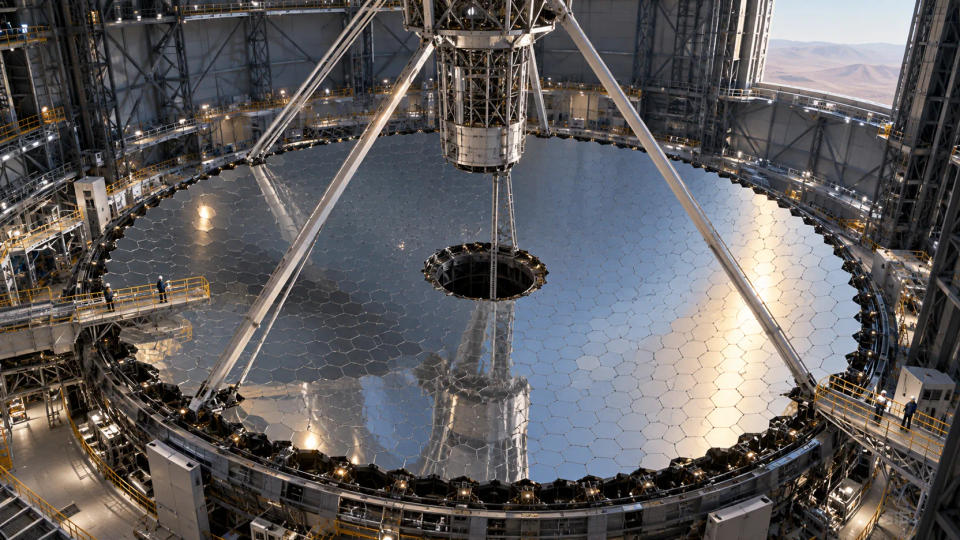
A 39-meter mirror cannot be manufactured, transported and supported as one giant slab. Instead, M1 will be assembled from 798 hexagonal glass-ceramic segments, each roughly 1.4 meters across. Together they form the enormous curved surface that gathers incoming starlight.
The difficult part is not simply arranging hundreds of mirrors in a honeycomb. They must act like a single optical surface. Tiny changes in temperature, gravity, wind or the telescope’s pointing angle can shift the segments. If neighboring pieces are even slightly out of position, the combined image becomes distorted.
To prevent that, the ELT uses sensors and actuators to continuously monitor and adjust the segments. ESO says the mirror must maintain alignment to within tens of nanometers across its full diameter. That is an almost absurdly small tolerance for a structure tens of meters wide. Each segment can be moved in height and tilt, allowing the control system to keep the whole surface synchronized while the telescope tracks objects across the sky.
The ELT actually needs more than 798 segments over its lifetime. ESO is producing a spare seventh sector so segments can be removed for cleaning and recoating without leaving holes in the working mirror. The result is less like one mirror and more like a precisely choreographed optical machine.
How the ELT Beats the Blur of Earth’s Atmosphere
A giant mirror alone is not enough. Starlight passing through turbulent air is constantly bent by moving layers of the atmosphere. That is why stars twinkle to our eyes, and it is also why ground-based telescopes naturally produce blurred images.
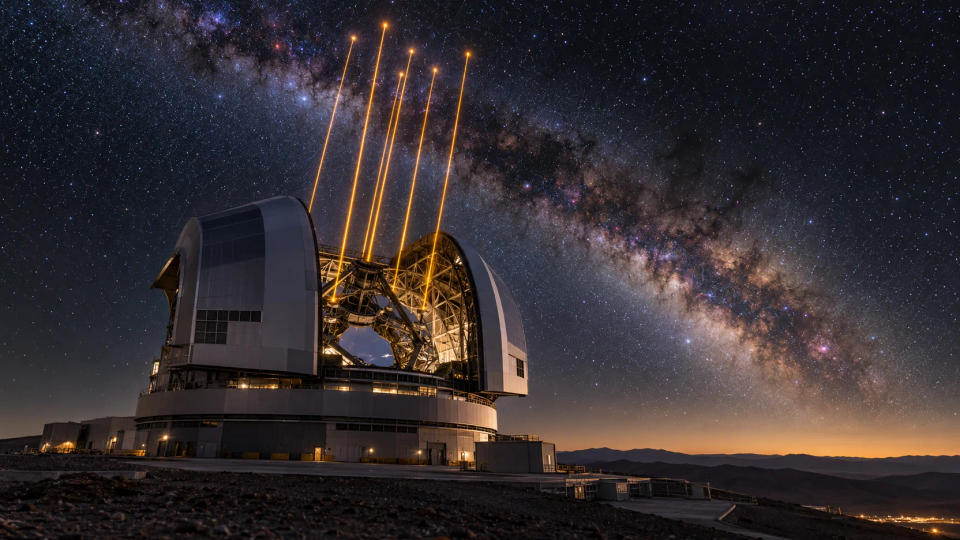
The ELT is designed with adaptive optics built into the telescope itself. Its fourth mirror, M4, is a 2.4-meter deformable mirror whose shape can be adjusted about a thousand times per second. It responds to measurements of atmospheric distortion and reshapes the light path before the image reaches the science instruments. A fifth mirror, M5, makes rapid tip-and-tilt corrections to stabilize the image.
Some observing modes will also use artificial guide stars created by lasers shining into the upper atmosphere. Systems such as MORFEO will combine laser guide stars with natural stars to measure turbulence at different heights. Computers then calculate the corrections almost in real time.
This is why the ELT is not simply “a bigger telescope.” Its performance depends on the mirror, sensors, lasers, control software and instruments working together as one system. ESO says the MICADO near-infrared camera, when paired with adaptive optics, is designed to deliver extremely fine angular resolution and to resolve details far beyond what current ground-based observatories can routinely achieve.
What Will the ELT Study—and When Does It Start?
One of the ELT’s most exciting goals is the study of exoplanets. Its instruments are being designed to separate faint planetary light from the glare of nearby stars and to analyze that light spectroscopically. That could reveal temperatures, atmospheric chemistry and other clues about distant worlds. For some rocky planets in habitable zones, astronomers hope to search for combinations of gases that might be interesting from an astrobiology perspective, although any possible biosignature would require careful confirmation.
The telescope will also examine the center of the Milky Way, where stars orbit the supermassive black hole Sagittarius A*. With sharper infrared observations, astronomers can track stellar motions closer to the black hole and test gravity in an extreme environment.
Farther away, the ELT will study how the first generations of galaxies assembled stars, gas and heavy elements. Instruments such as HARMONI will obtain spectra across tiny regions of distant galaxies, while MICADO will provide high-resolution near-infrared imaging. METIS will extend the view into the mid-infrared. Later instruments including ANDES and MOSAIC are planned to add high-resolution spectroscopy and observations of many objects at once.
As of September 2026, the project remains under construction. The ELT dome reached its highest structural point in 2025, and ESO described construction in 2026 as approaching its final stages. The current schedule targets telescope first light in March 2029. That milestone will be a technical test of the telescope itself, not the beginning of normal science operations. ESO expects the first scientific observations with instruments in December 2030.
Conclusion: The ELT is impressive because of its size, but size is only the beginning. Its real achievement is the attempt to control nearly eight hundred mirror segments, atmospheric turbulence and massive precision machinery well enough to examine objects that are unimaginably faint and distant. If the system performs as designed, the ELT will give astronomers a new way to study planets, black holes and the early Universe from the ground.
Sources & Further Reading
- ESO — Facts about the ELT
- ESO — ELT Mirrors and Optical Design
- ESO — ELT Location: Cerro Armazones
- ESO — ELT Instruments Overview
- ESO — ELT Timeline
- ESO — 2026 Update as Andreas Kaufer Begins as Director General
Post a Comment