
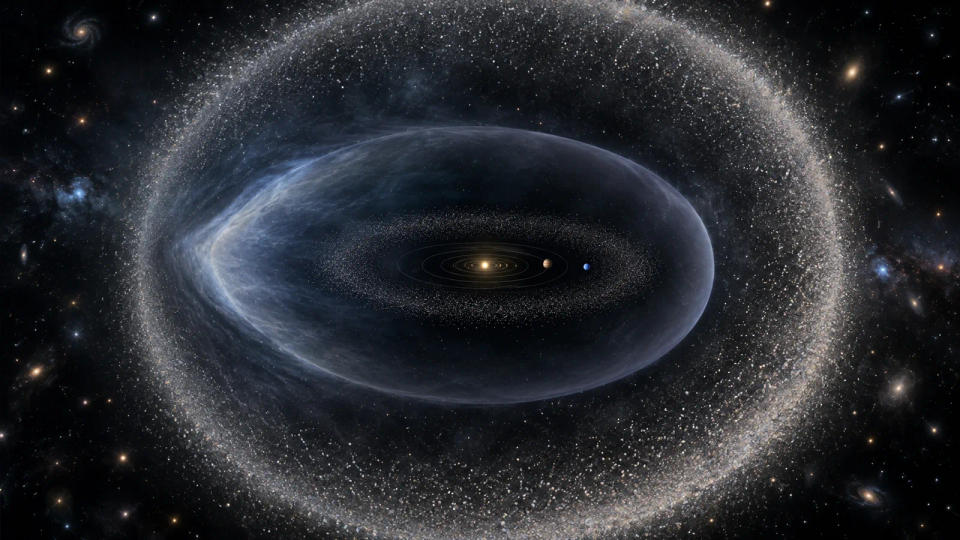
Ask where the Solar System ends, and the surprising answer is that there is no single finish line. One boundary marks where the Sun’s flowing plasma gives way to interstellar space, while another lies vastly farther out, where objects can still remain gravitationally tied to the Sun.
That is why Voyager 1 can already be in interstellar space without having truly left the Solar System. To understand what is really at the edge, you have to decide which kind of “edge” you mean.
There Is No Single Edge of the Solar System
Most diagrams make the Solar System look tidy: Sun in the middle, eight planets, Pluto beyond Neptune, and then empty space. Reality is much less compact. Neptune orbits at about 30 astronomical units, or AU, from the Sun, with 1 AU equal to the average Earth-Sun distance. Beyond Neptune lies the Kuiper Belt, a broad population of icy worlds that includes Pluto and many smaller bodies.
But even the Kuiper Belt is nowhere near the farthest reach of the Sun. Solar particles continue streaming much farther outward, and the Sun’s gravity extends farther still. NASA describes the Solar System as extending well beyond the planets, with the distant Oort Cloud forming its most remote region.
This gives us at least two useful boundaries. The heliopause is the outer boundary of the heliosphere, the bubble made by the solar wind and the Sun’s magnetic influence. The Oort Cloud, meanwhile, represents a much more distant gravitational frontier populated by icy bodies that are still thought to orbit the Sun.
The Heliopause Is the Edge of the Sun’s Plasma Bubble
The Sun is constantly releasing a stream of charged particles known as the solar wind. Close to the Sun, that wind races outward at enormous speed. Far from the planets, however, it begins to encounter the gas, plasma, and magnetic field of the local interstellar medium.
The solar wind first slows dramatically at a region called the termination shock. Beyond that lies the heliosheath, where the solar wind is slower, compressed, and increasingly shaped by the surrounding interstellar environment. The outer boundary of this whole structure is the heliopause.
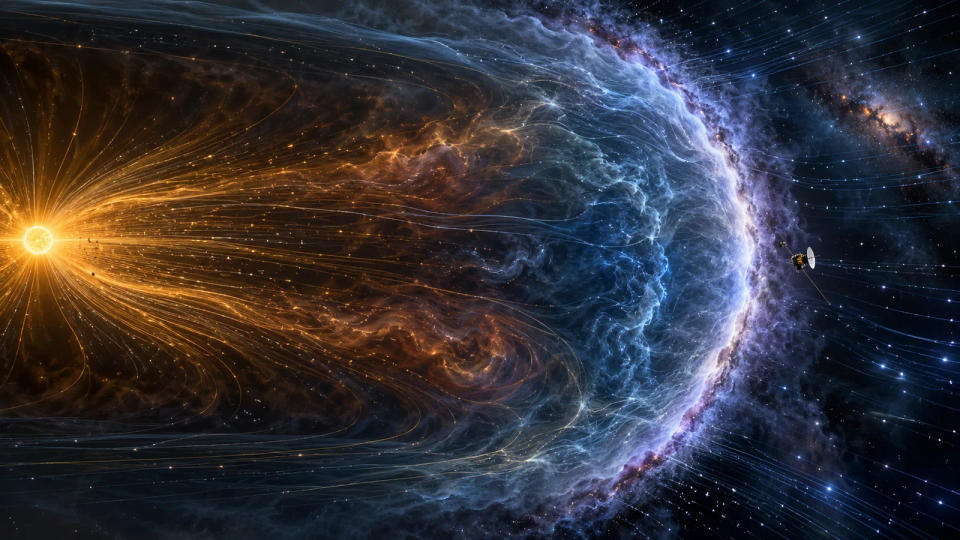
Crossing the heliopause means crossing out of the Sun-dominated plasma environment and into interstellar space. It does not mean the Sun suddenly stops exerting gravity, and it does not mean you have passed every object that belongs to the Solar System.
The heliopause is also not a perfectly rigid spherical shell. Its shape and distance depend on the pressure of the solar wind and the interstellar material around the Sun. In other words, this “edge” behaves more like a dynamic boundary between two competing space environments than like a wall.
Voyager Is in Interstellar Space—but Still in the Solar System
NASA’s Voyager probes gave humanity its first direct crossings of the heliopause. Voyager 1 entered interstellar space in 2012, and Voyager 2 followed in 2018. They remain the only spacecraft to have operated beyond the heliosphere.
That achievement sometimes leads to the shorthand claim that the Voyagers have “left the Solar System.” That is true only if the Solar System is being defined by the heliosphere. Under the broader gravitational definition, the spacecraft still have an astonishing distance to travel.
NASA notes that a spacecraft moving at Voyager-like speeds would need roughly 300 years just to reach the inner region of the Oort Cloud, and perhaps around 30,000 years to pass beyond its outer edge. The Voyagers themselves will stop transmitting long before then.
This is one of the strangest scale comparisons in astronomy. Voyager 1 is already so distant that radio signals take many hours to cross the gap between Earth and the spacecraft, yet on the scale of the full Solar System it is still relatively close to home.
The Oort Cloud Marks a Much Farther Frontier
The Oort Cloud is a hypothesized, enormous shell of icy bodies surrounding the Solar System. Unlike the Kuiper Belt, which is concentrated relatively near the plane of the planets, the Oort Cloud is expected to form a far more spherical swarm around the Sun.
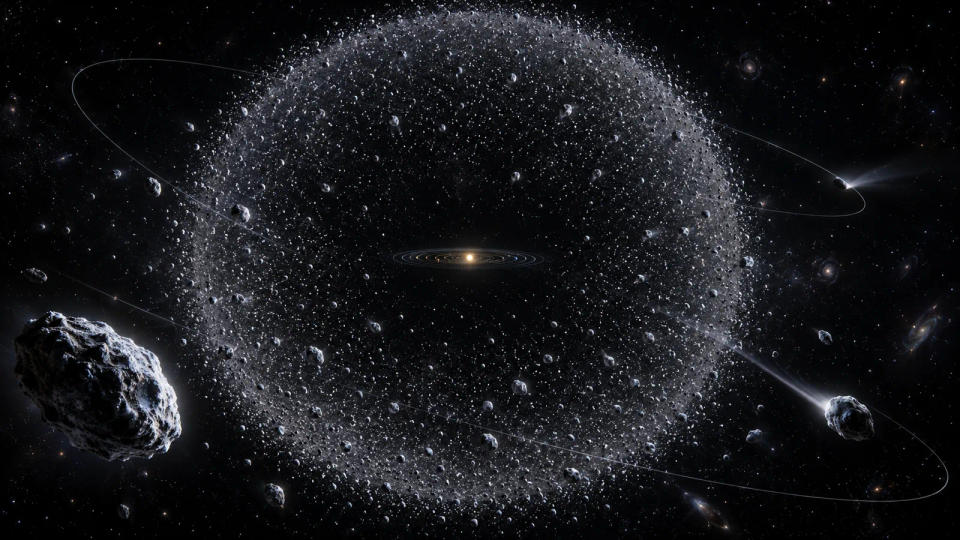
Its exact size is uncertain because the Oort Cloud has never been directly imaged as a complete structure. Astronomers infer its existence from the orbits of long-period comets and from models of how the young Solar System evolved. NASA places its inner reaches at thousands of AU from the Sun, with estimates for the outer edge extending to tens of thousands of AU and possibly about 100,000 AU.
At those distances, the Sun would look like an unusually bright star rather than a blazing disk. A faintly bound comet could take an immense amount of time to complete one orbit. Passing stars and the Milky Way’s gravitational field can also disturb these distant bodies, occasionally nudging some of them inward toward the planetary region.
This is why the Oort Cloud is often treated as the Solar System’s true outer frontier. Beyond its far edge, the gravitational influence of neighboring stars and the Galaxy increasingly competes with the Sun’s ability to hold objects in long-term orbit.
Conclusion: The Edge Depends on What You Mean
If by “edge” you mean the boundary of the Sun’s plasma bubble, the answer is the heliopause, a little beyond 100 AU in the directions crossed by the Voyagers. Beyond it lies interstellar space.
If by “edge” you mean the farthest region still considered part of the Sun’s gravitational family, the answer is much farther away: the Oort Cloud, potentially reaching toward 100,000 AU. So the edge of our Solar System is not a single place. It is a transition from planets, to icy debris, to the fading reach of the solar wind, and finally to the point where the Sun’s gravitational claim on distant objects becomes uncertain.
Sources & Further Reading
- NASA Science — Solar System Facts
- NASA Science — Components of the Heliosphere
- NASA Science — Oort Cloud Facts
- NASA Science — Where Are Voyager 1 and Voyager 2 Now?
- NASA JPL — Voyager Interstellar Trajectory
Post a Comment