

If Earth’s magnetic field vanished instantly, the planet would not become a lifeless wasteland overnight. The first serious effects would appear in space: satellites and astronauts would lose an important layer of protection, compasses would stop working, and the solar wind would interact far more directly with the upper atmosphere.
People on the ground would still have a powerful shield—the atmosphere itself. That means there would be no sudden burst of deadly radiation at sea level. The bigger story would unfold above us and over much longer timescales, as Earth settled into a very different relationship with the Sun.
The First Change Would Happen Above Our Heads
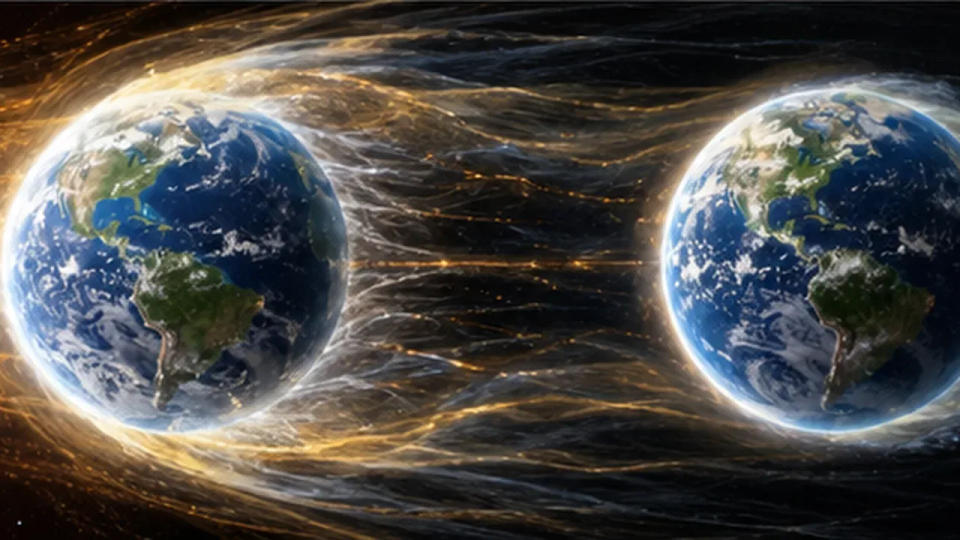
Earth’s magnetic field is generated by moving electrically conducting material in the planet’s liquid outer core. In space, that field forms the magnetosphere, a huge magnetic cavity that diverts much of the solar wind around Earth.
If the internal field suddenly disappeared, the familiar magnetosphere would collapse. But Earth would not become completely magnetically naked. The solar wind carries its own magnetic field, and when it meets an electrically conducting ionosphere it can create an induced magnetic environment. Venus works this way today: it has no strong internally generated global field, yet interactions between the solar wind and its ionosphere still create a weak induced magnetosphere.
The difference is scale and protection. Instead of the solar wind being pushed away far from Earth by a large intrinsic magnetic bubble, the interaction region would move much closer to the upper atmosphere. Charged particles and solar magnetic fields would have a more direct path to Earth’s near-space environment.
Auroras would also change dramatically. Today, Earth’s magnetic field guides many charged particles toward the polar regions, creating the familiar northern and southern auroral ovals. Without that organized global field, those patterns would no longer behave the same way. Atmospheric glows could still occur where energetic particles interact with gases, but they would be shaped by a much more complicated solar-wind and ionosphere interaction.
Satellites and Astronauts Would Face a Harsher Environment
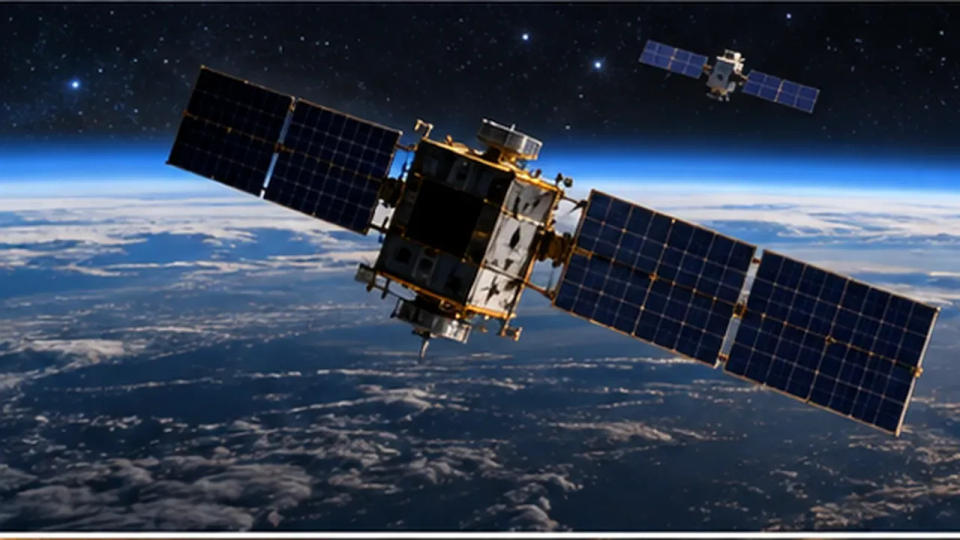
The most immediate practical problem would be for technology and people above most of the atmosphere. Earth’s magnetosphere currently deflects many charged solar particles, while the atmosphere absorbs much of what gets through. Remove the magnetic part of that protection, and spacecraft would operate in a more exposed radiation environment.
Solar energetic particles can damage electronics, degrade solar panels, produce false signals in detectors, and disrupt spacecraft operations. Satellites would need more radiation-hard components, more shielding, and better safe-mode procedures. Some existing spacecraft might experience shorter operating lives, especially during major solar storms.
Astronauts would face the same basic issue. NASA treats space radiation as one of the major hazards of human exploration beyond Earth’s magnetic protection. People aboard spacecraft would not instantly receive lethal doses, but their exposure to solar energetic particles and other charged radiation could rise substantially depending on orbit, shielding, and solar activity.
Navigation would change too. Magnetic compasses would no longer point toward magnetic north. Animals that use Earth’s field as one source of orientation—such as some sea turtles, fish, and birds—would lose that cue and would have to rely on other sensory information. That would be an ecological disruption, but not an automatic collapse of animal migration worldwide.
Life at the Surface Would Not Be Instantly Exposed
This is the part that is often exaggerated. Earth’s magnetic field matters, but it is not the only shield protecting life. The atmosphere is extremely effective at absorbing and slowing incoming particles before they reach the ground.
NASA and USGS both note that the atmosphere remains a major barrier against space radiation. Even during real magnetic reversals, when the global field can weaken greatly and become more complex, the field does not disappear, and the geological record does not show a pattern of mass extinctions tied to those reversals.
In the imaginary case of a complete field loss, radiation levels would increase most strongly at high altitudes and in space. The surface would still be protected by many kilometers of air. There would be no reason to expect Earth’s oceans to boil, the atmosphere to vanish in days, or people at ground level to be instantly irradiated.
Ultraviolet sunlight would also not suddenly pour through to the surface simply because the magnetic field vanished. Ozone and other atmospheric gases, rather than the magnetic field, provide the main protection from solar ultraviolet radiation.
Over Time, Earth’s Atmosphere Could Change
The long-term effects are harder to calculate because they would depend on solar activity, atmospheric chemistry, gravity, and how the new induced magnetic environment developed. A weaker magnetic barrier would allow the solar wind to interact more directly with the upper atmosphere, potentially increasing some forms of atmospheric escape.
Mars is often used as the cautionary example. It lost its global magnetic field billions of years ago, and NASA’s MAVEN mission has shown that the solar wind and solar radiation help remove particles from the Martian atmosphere. But Mars is not a perfect model for Earth: it is smaller, has weaker gravity, and followed a very different atmospheric and geological history.
Venus provides an equally important warning against simple conclusions. Venus has no strong intrinsic global magnetic field, yet it retains an atmosphere far denser than Earth’s. Its ionosphere creates an induced magnetic obstacle to the solar wind. That does not mean a magnetic field is unimportant; it means atmospheric survival depends on more than one factor.
So Earth would probably lose atmospheric particles differently—and likely more directly—to space, especially during periods of strong solar activity. But turning modern Earth into something like present-day Mars would be a process measured on geological timescales, not in weeks, years, or even necessarily thousands of years.
A Sudden Disappearance Is Not How Earth’s Field Behaves
Fortunately, there is no known mechanism that would make Earth’s magnetic field switch off in an instant. The geodynamo in the liquid outer core changes gradually, and the planet has experienced many magnetic reversals in the geological past.
During a reversal, magnetic north and south trade places over hundreds to thousands of years. The field can weaken substantially and become more complicated, with multiple magnetic poles, but it does not simply vanish everywhere at once. NASA and the U.S. Geological Survey also emphasize that reversals are not associated with known mass extinctions.
That distinction matters. A real magnetic reversal is a natural geophysical process. The sudden total loss imagined here is a thought experiment designed to reveal what the magnetic field actually does for us.
Conclusion
If Earth suddenly lost its magnetic field, the first crisis would be technological and orbital rather than an instant disaster on the ground. Satellites, astronauts, navigation systems, and magnetically guided animals would face the fastest changes, while the atmosphere would continue shielding surface life from most space radiation.
Over much longer periods, the solar wind would interact more directly with Earth’s upper atmosphere and could alter the rate at which atmospheric particles escape to space. The magnetic field is therefore not a magical force field that keeps every danger away, but it is a major part of the layered system that has helped make Earth’s near-space environment—and ultimately the planet itself—far more hospitable.
Sources & Further Reading
- NASA Science — Earth’s Magnetosphere
- NASA Science — Earth’s Magnetosphere: Protecting Our Planet from Harmful Space Energy
- U.S. Geological Survey — Geomagnetism FAQs
- NASA Science — Venus: Facts
- NASA — MAVEN and Solar-Wind Stripping of the Martian Atmosphere
Post a Comment