
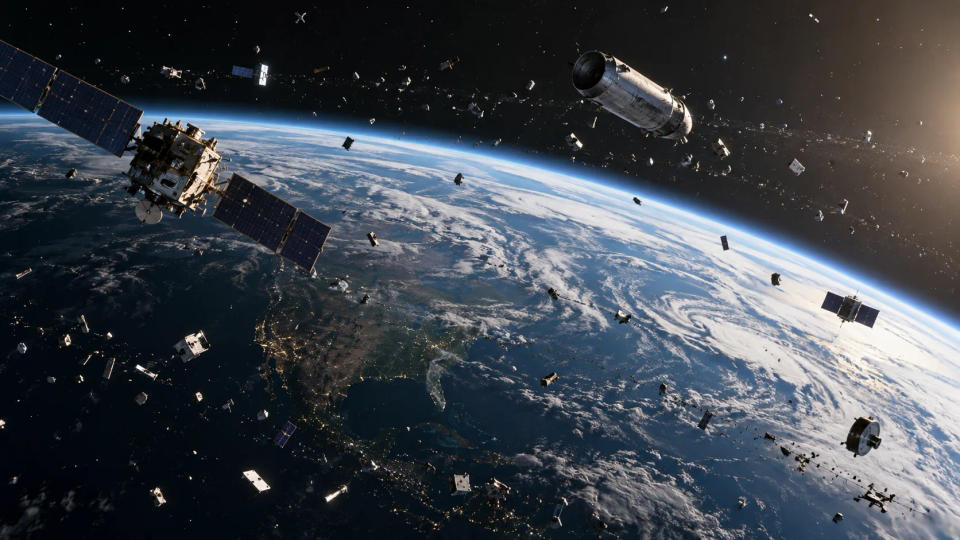
Space junk does not need to blanket the space above Earth to cause a serious problem. If enough dead satellites, rocket bodies, and fragments accumulate in the same orbital bands, collisions can create fresh debris faster than the atmosphere can remove it.
That means the answer is yes, some parts of Earth orbit could eventually become too risky for routine use—but not in the sudden, all-or-nothing way science fiction often imagines. The real danger is a gradual loss of usable orbital “lanes,” especially in parts of low Earth orbit where objects remain for decades or centuries.
How a Collision Cascade Can Feed Itself
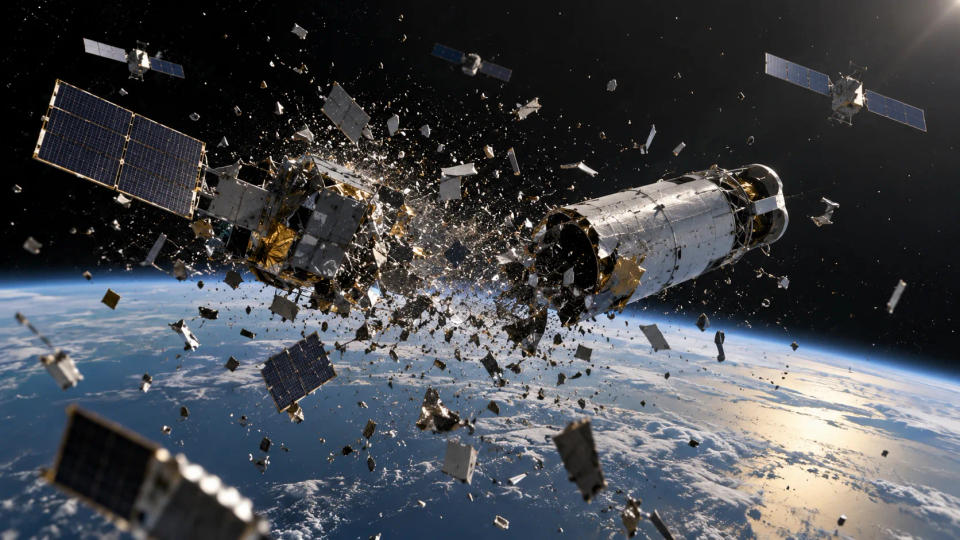
A single collision in orbit can turn two large objects into thousands of smaller hazards. The fragments do not disappear after the crash. They keep circling Earth at orbital speed, crossing the paths of other spacecraft again and again.
NASA says debris in low Earth orbit typically travels around 7–8 kilometers per second, while the average collision speed between objects is about 10 kilometers per second. At those velocities, even a small fragment can carry enough energy to disable a satellite. A larger impact can completely break a spacecraft apart.
The dangerous feedback loop is known as Kessler syndrome, or a collisional cascade. The idea is not that one crash instantly triggers a chain of explosions around the planet. Instead, every major breakup adds more fragments, which raise the probability of later collisions. Those later collisions create still more fragments.
Once collisions generate debris faster than natural orbital decay removes it, the debris population can keep growing even without new launches. NASA modeling has warned about this possibility for years, and ESA’s 2026 Space Environment Report says the same self-sustaining effect remains the central long-term threat.
Why Some Altitudes Are Much More Vulnerable
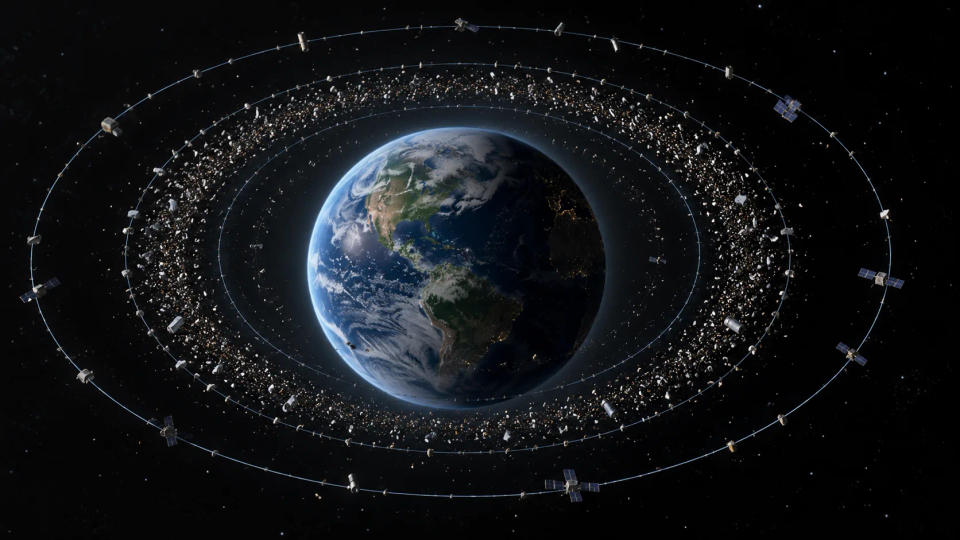
“Earth orbit” is not one uniform shell around the planet. A satellite a few hundred kilometers above Earth lives in a very different environment from one at 900 kilometers or 36,000 kilometers.
At lower altitudes, traces of Earth’s atmosphere create drag. That drag slowly removes dead spacecraft and fragments by pulling them downward until they reenter. The higher an object goes, the weaker that cleaning effect becomes. In some high low-Earth orbits, debris can remain for many decades or longer.
ESA’s latest assessment highlights that difference. Below roughly 600 kilometers, traffic is becoming busier, but many active satellites can maneuver. Between about 600 and 1,100 kilometers, operators face a more difficult environment containing large amounts of legacy debris. Above 1,100 kilometers, natural orbital decay can take centuries, making long-lived debris especially troublesome.
This is why a debris crisis would probably not make every altitude unusable at once. It would develop unevenly, with certain crowded and long-lived orbital bands becoming increasingly costly or hazardous to operate in.
What Would “Too Dangerous to Use” Actually Look Like?
An orbit does not need to become physically impassable before satellite operators begin avoiding it. The practical limit can arrive much earlier, when the risk and cost of operating there become unacceptable.
Satellites already perform collision-avoidance maneuvers when tracking systems predict dangerous close approaches. As congestion rises, operators may need to maneuver more often, reserve more fuel for avoidance, process more warnings, and accept more interruptions. Spacecraft may also need heavier shielding or more redundant systems, increasing cost and reducing the mass available for instruments or communications hardware.
Small debris makes the problem harder. According to ESA’s statistics updated July 31, 2026, surveillance networks regularly track about 46,950 cataloged objects, but models estimate around 1.5 million debris objects between 1 and 10 centimeters and about 230 million between 1 millimeter and 1 centimeter. Many pieces in those size ranges are too small to track continuously yet still capable of damaging spacecraft.
So an “unusable” orbit would probably look less like a solid wall of junk and more like an increasingly hostile operating environment: too many conjunction warnings, too much untrackable debris, too much fuel spent dodging, and too high a chance that one failure creates another cloud of fragments.
How Close Are We to a Runaway Debris Problem?
We are not at a point where low Earth orbit as a whole is unusable. Thousands of satellites operate there today, new spacecraft are launched every day, and collision avoidance works most of the time. But the long-term trend is moving in the wrong direction.
ESA’s 2026 report, based mainly on activity through the end of 2025, says more than 4,000 payloads were placed into orbit during 2025. It also concludes that current behavior is producing a net increase in debris and that future projections show collision-driven growth appearing sooner than in previous assessments.
The key warning is that even a complete halt in new launches would not automatically reset the environment. Large dead satellites and rocket stages already in orbit can collide with one another. A breakup of one massive object can create a cloud of fragments that remains dangerous for years.
That does not mean a catastrophic global cascade is inevitable. It means the risk depends heavily on what space operators do now—and on whether the most dangerous existing objects are dealt with before they collide.
Keeping Orbit Usable Is Still Possible
The most effective strategy combines prevention with cleanup. New spacecraft can be designed to leave busy orbits quickly after their missions, release as little debris as possible, and “passivate” batteries and fuel systems so they are less likely to explode after retirement. Better tracking and coordination can also prevent avoidable collisions between active spacecraft.
But prevention alone cannot remove the large derelict objects already circling Earth. NASA’s Orbital Debris Program Office has found that long-term stabilization may require active debris remediation, especially targeting massive rocket bodies and dead satellites that could generate thousands of fragments if struck.
Possible approaches include robotic removal missions, controlled deorbiting, servicing that extends a satellite’s useful life, and techniques that nudge high-risk objects away from predicted collisions. The engineering is difficult, and legal questions about ownership and responsibility still matter, but the physics is straightforward: fewer large collision sources mean fewer opportunities for the debris population to multiply.
Space junk is therefore unlikely to “close” all of near-Earth space. The more realistic danger is that humans gradually make some of the most useful orbital regions harder, more expensive, and eventually impractical to use. Orbit is enormous, but the safest and most useful parts of it are a limited resource—and keeping them usable is easier than trying to repair them after a collision cascade has taken hold.
Post a Comment