
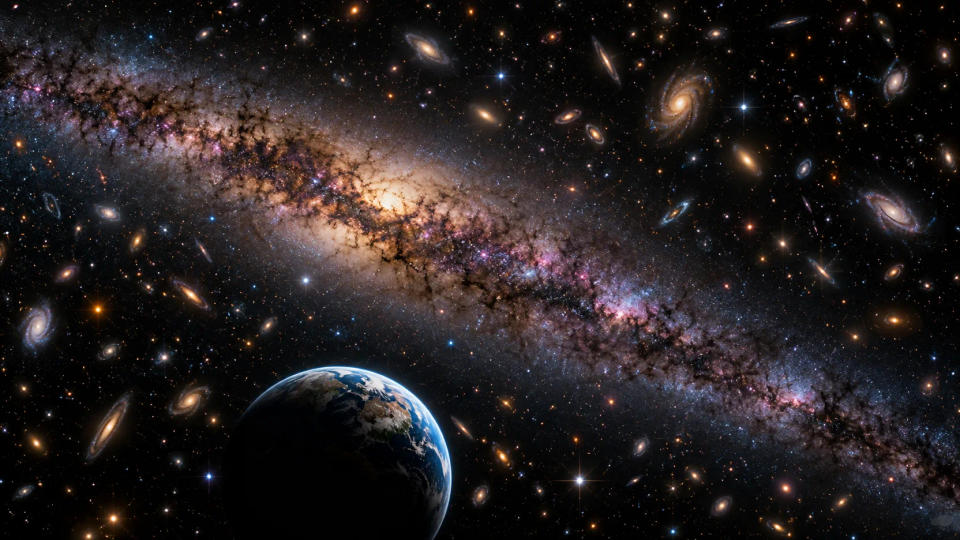
Stand under a dark sky for long enough and the universe can feel almost familiar: stars overhead, a bright planet near the horizon, perhaps the pale stripe of the Milky Way. But that view is deceptive. The cosmos is so much larger, older, and stranger than our senses evolved to handle that learning its real scale can permanently change what “here” and “now” mean.
The shift begins with a simple fact: astronomy is not just about objects in space. It is also about distance, time, origin, and our place inside a universe whose most important ingredients are largely invisible.
The universe is far larger than intuition can handle
A light-year sounds like a measure of time, but it is a measure of distance: about 9.5 trillion kilometers, the distance light travels in one year. The Milky Way is more than 100,000 light-years across. Even at light speed, crossing our home galaxy would take longer than recorded human history has existed by an almost absurd margin.
A scale model makes the problem easier to feel. If the Sun were shrunk to a sphere only 1 millimeter wide, Earth would orbit roughly 11 centimeters away. On that same scale, Proxima Centauri, the nearest star beyond the Sun, would still be almost 29 kilometers away. Space is not packed with stars like glitter. It is mostly distance.
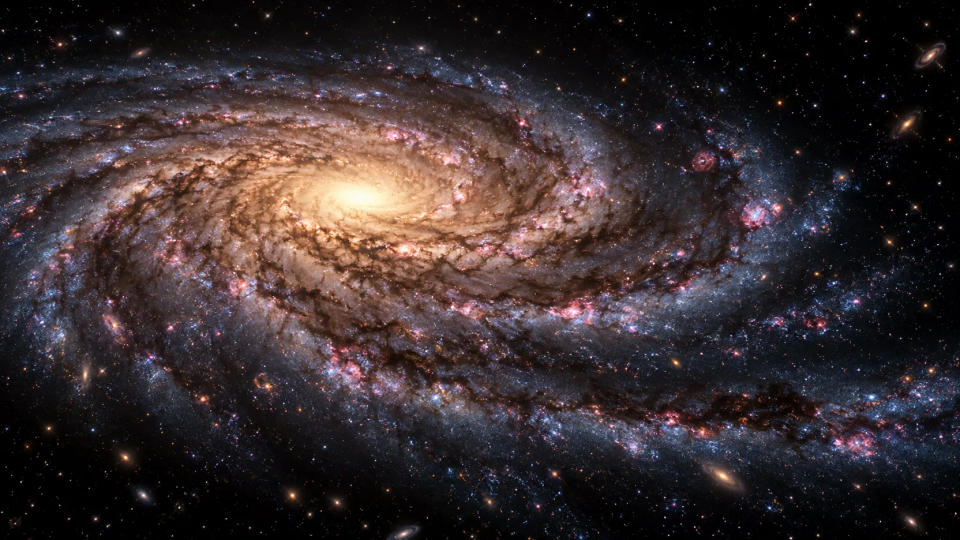
And the Milky Way is only one galaxy. NASA describes the observable universe as containing at least 100 billion galaxies, arranged on scales so large that even a galaxy becomes a small building block. Once that sinks in, familiar words such as “nearby” begin to stretch. In astronomy, a galaxy millions of light-years away can count as a neighbor.
This is one reason the cosmos changes perspective so quickly: the universe is not merely a larger version of our everyday world. It operates across ranges of size that ordinary experience never prepared us to imagine.
Looking farther away also means looking backward in time
Distance in astronomy has a second meaning because light does not arrive instantly. Sunlight takes about eight minutes to reach Earth. Light from the nearest stars takes years. The Andromeda galaxy is about 2.5 million light-years away, so the Andromeda we see tonight is not the galaxy as it is “now.” We see it as it was roughly 2.5 million years ago.
That makes every telescope a kind of time machine. The deeper astronomers look, the earlier the chapter of cosmic history they can study. In January 2026, NASA reported that the James Webb Space Telescope had confirmed the galaxy MoM-z14 as it appeared only about 280 million years after the big bang. The observation did not transport Webb into the past; ancient light simply spent billions of years crossing an expanding universe before reaching the telescope.
This changes the meaning of a night sky. It is not a single frozen moment. It is a layered archive. Nearby objects are shown to us with relatively little delay, while extremely distant galaxies are seen at much earlier stages in cosmic history.
Once you understand that, “seeing far away” and “seeing long ago” become inseparable ideas.
The cosmos is a web, and most of its structure is invisible
From Earth, galaxies can look like isolated islands scattered through black space. On the largest scales, however, they are organized into groups, clusters, filaments, walls, and enormous voids. Together these structures form what astronomers call the cosmic web.
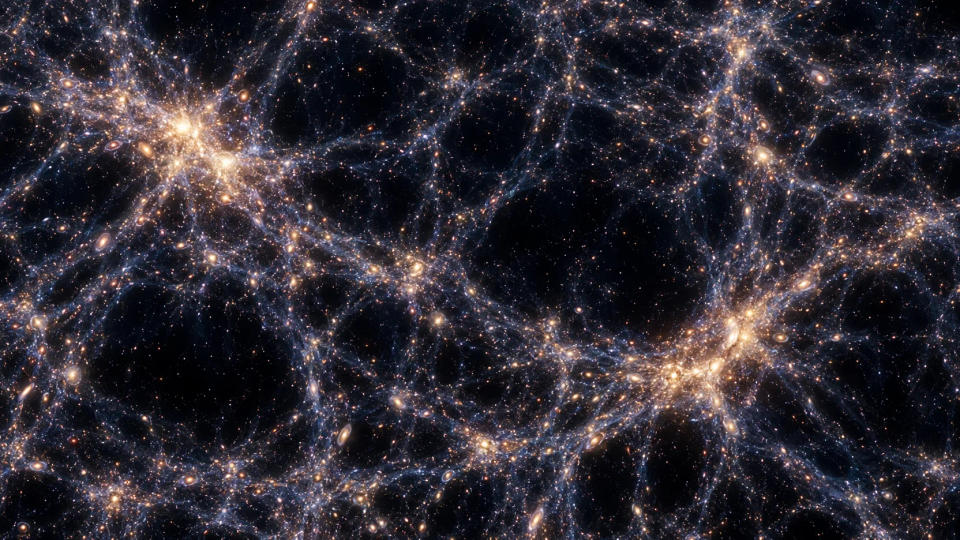
Gravity built that web over billions of years by amplifying small differences in the early distribution of matter. Dark matter, which does not emit or reflect light, plays a major role in this architecture. Astronomers infer its presence from gravitational effects, including the motions of galaxies and the way mass bends light. Galaxies tend to gather where this unseen matter is concentrated.
The surprise becomes even larger when the universe is viewed as an inventory. Results from ESA’s Planck mission indicate that ordinary matter—the material in stars, planets, gas, people, and everything made of atoms—accounts for only about 4.9% of the universe’s mass-energy content. Dark matter accounts for about 26.8%, while dark energy, the name given to whatever is associated with the universe’s accelerating expansion, accounts for about 68.3%.
Those labels can sound like answers, but they are really names for major unsolved problems. Scientists have strong evidence for the effects attributed to dark matter and dark energy, yet their fundamental nature remains unknown. The visible universe is therefore not the whole story. In a very literal sense, most of the cosmic story is written in ingredients we cannot see directly.
Your own body carries a history of stars
The cosmic perspective is not only about feeling small. It also reveals a surprisingly direct connection between people and the wider universe.
Hydrogen and much of the helium in the cosmos trace back to the early universe. Many heavier elements were built later through nuclear reactions inside stars and then dispersed through stellar winds, dying stars, and explosive events. Carbon is essential to life. Oxygen is in the air and water around us. Calcium helps form bones. Iron is part of hemoglobin. The atoms are ordinary on Earth, but their deeper history is astronomical.
NASA describes this “star stuff” connection as literal, not merely poetic. Generations of stars formed, changed, and returned enriched material to space long before the Sun and planets existed. That recycled material became part of later stars, planetary systems, asteroids, Earth, and eventually living organisms.
So the lesson of the cosmos is not that humans are separate from an overwhelmingly large universe. It is almost the opposite. We are physically part of the same long chain of cosmic evolution that produced galaxies, stars, rocky planets, and the chemistry life uses.
Conclusion
The universe changes our perspective because it challenges several instincts at once. Distance becomes almost unimaginable, looking outward becomes looking into the past, visible galaxies turn out to sit inside a mostly invisible cosmic framework, and the atoms in our bodies acquire a history far older than Earth.
That does not make everyday life less important. It simply places it inside a much larger story—one that began billions of years before us and that we are only beginning to understand.
Sources & Further Reading
- NASA Science — Universe Overview
- NASA Science — How Does Webb See Back in Time?
- NASA Science — Webb Pushes Boundaries of the Observable Universe Closer to the Big Bang
- NASA Science — Large Scale Structures
- NASA — How Are We Made of Star Stuff?
- ESA — Planck Science Highlights
Post a Comment