
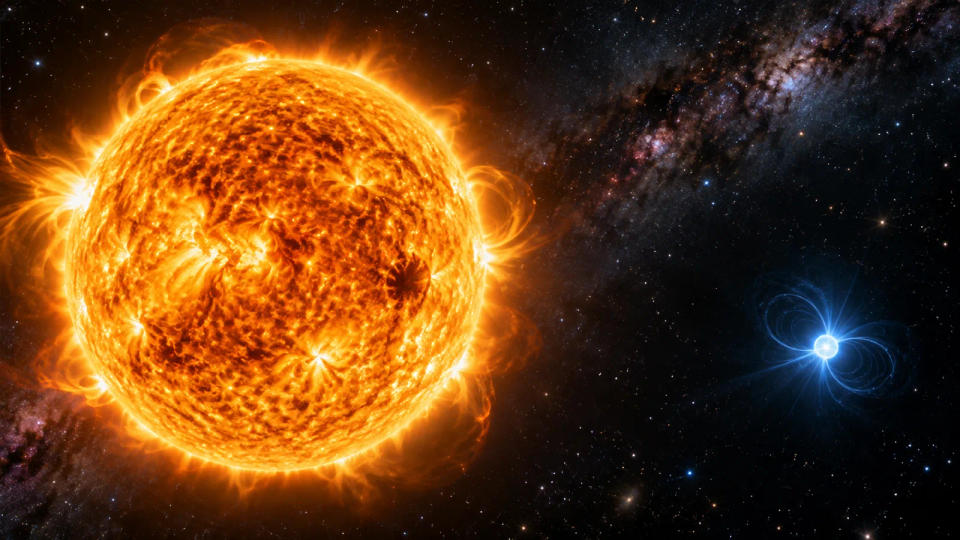
Suppose you could squeeze a star harder and harder without losing any mass. How small could it become before nature simply refused to compress it any further?
For a Sun-mass object, the answer changes depending on what you mean by “star.” Ordinary stellar matter can be crushed into a compact remnant only tens of kilometers across. If the same mass is forced inside a radius of about 3 kilometers, however, it is no longer a material star at all—it becomes a black hole. Beyond that point, the familiar idea of a surface disappears.
That is an extraordinary change in scale. The Sun is about 1.4 million kilometers wide today, according to NASA. A neutron-star-sized version would be roughly 20 to 25 kilometers across, while the event-horizon diameter of a nonrotating black hole with one solar mass would be about 6 kilometers.
How far can a star shrink before physics changes the answer?
A normal star avoids collapse because gravity is balanced by pressure. In the Sun, nuclear fusion heats the gas in the core, and that hot plasma pushes outward while gravity pulls inward. As long as those effects remain in balance, the star keeps roughly the same size.
When fusion can no longer support a stellar core, gravity gets another chance to squeeze it. But collapse does not always continue all the way to a black hole. Quantum physics provides new forms of pressure that can temporarily stop gravity at much smaller scales.
This is why stellar remnants come in distinct classes rather than forming one smooth sequence of ever-smaller glowing balls. White dwarfs, neutron stars, and black holes represent fundamentally different outcomes.
White dwarfs and neutron stars are gravity’s stopping points
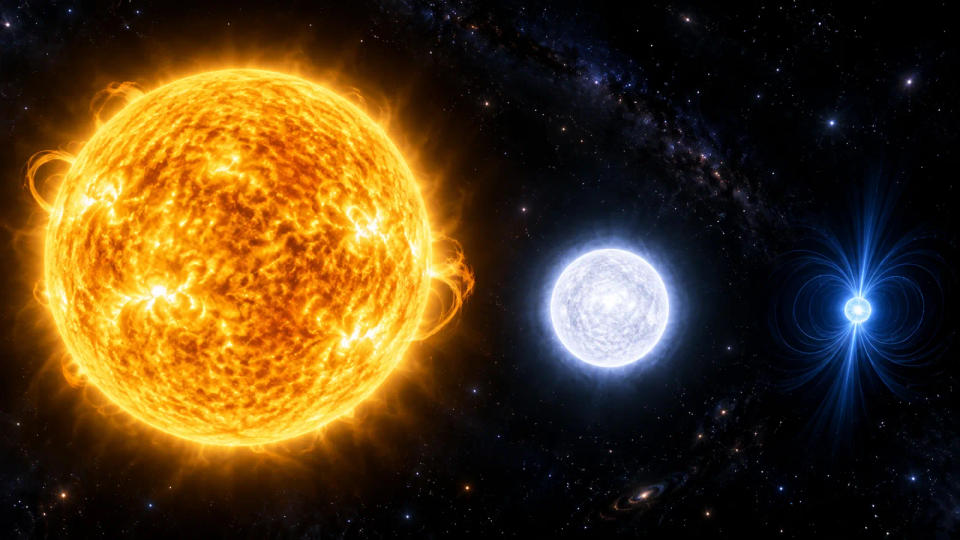
For a star like the Sun, the natural end state is a white dwarf. After the outer layers are lost, the remaining core becomes roughly Earth-sized. It is no longer supported by ordinary fusion. Instead, electron degeneracy pressure—a quantum-mechanical effect—keeps the matter from being squeezed indefinitely.
That support has a limit. NASA lists the Chandrasekhar limit at about 1.4 times the Sun’s mass. Above that scale, electron degeneracy pressure cannot provide a stable white-dwarf configuration. In real stellar evolution, what happens next depends on the star’s history and composition, but massive collapsing cores can move into an even denser state.
In a neutron star, matter is compressed so strongly that protons and electrons are driven into a neutron-rich state. NASA commonly describes neutron stars as objects with more than the Sun’s mass packed into a sphere only about 20 kilometers across.
Modern measurements show why there is no single exact neutron-star diameter. The size depends on the mass and on the still-uncertain behavior of matter at densities beyond ordinary atomic nuclei. A 2025 analysis highlighted by NASA’s NICER team inferred a radius of about 12.2 ± 0.5 kilometers for a 1.4-solar-mass neutron star. That corresponds to a diameter near 24 kilometers.
So if the question is “How small can matter remain in something we would still reasonably call a star?” a neutron star is the clearest answer: roughly city-sized.
Push farther and the star becomes a black hole
There is still another step. If gravity overwhelms every known form of pressure in a sufficiently massive compact object, collapse continues. Once all of the mass lies inside its Schwarzschild radius, an event horizon forms.
For a nonrotating object with the Sun’s mass, that radius is about 3 kilometers. In other words, a one-solar-mass black hole would have an event horizon about 6 kilometers across. NASA notes that the Schwarzschild radius scales with mass, so a nonrotating black hole with ten times the Sun’s mass would have a radius of roughly 30 kilometers.
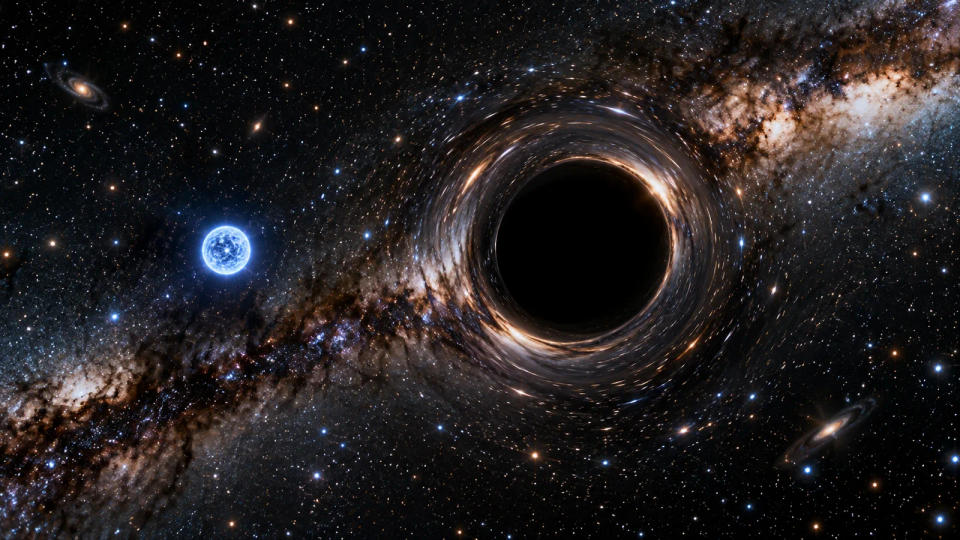
This does not mean a star turns into a hard black sphere with a six-kilometer surface. The event horizon is not a material shell. It is a boundary in spacetime beyond which light cannot escape to the outside universe.
That distinction matters. A neutron star has a physical surface that radiation and infalling matter can strike. A black hole does not have an observable material surface at its horizon. Once that boundary appears, talking about the “size of the compressed star” becomes less useful, because the star as a stable material object has ceased to exist.
Is there an absolute smallest possible size?
Classical general relativity predicts that continued collapse inside a black hole leads toward a singularity, where density becomes formally infinite and the size can be described as zero. But that is not a measured object that astronomers can point to. It is a sign that the equations are being pushed into a regime where quantum gravity is expected to matter.
Physicists do not yet have a complete, experimentally confirmed theory that unifies gravity with quantum mechanics under those extreme conditions. So science can describe the event horizon very well, but it cannot confidently tell us the true physical structure—or minimum size—of whatever lies deepest inside a black hole.
There is also an important real-world caveat: the Sun itself will not naturally become either a neutron star or a black hole. It does not have enough mass. Its expected final compact remnant is a white dwarf. Compressing one solar mass to neutron-star density or to a black-hole radius is therefore best treated as a thought experiment for comparing the strength of different forms of pressure and gravity.
The scale change is still useful. Starting from the Sun’s present diameter of about 1.4 million kilometers, a roughly 24-kilometer neutron star would be around 58,000 times smaller in diameter. A six-kilometer black-hole horizon would be more than 230,000 times smaller in diameter than the Sun.
Conclusion
If you compress stellar matter as far as it can remain a stable, directly observable star-like object, you end up in neutron-star territory: only a few tens of kilometers across. Squeeze a comparable mass farther until it lies inside its Schwarzschild radius, and the result is a black hole instead of a smaller ordinary star.
The deepest part of the question—whether nature permits a true zero-size endpoint—remains unanswered. General relativity points toward a singularity, while quantum physics tells us that the final description is probably more complicated. What we can say with confidence is that gravity can shrink a stellar mass from about 1.4 million kilometers across to something no wider than a city, and then erase the idea of a visible surface altogether.
Sources & Further Reading
- NASA Science — Sun: Facts
- NASA Science — Universe Glossary: Neutron Star
- NASA Science — Universe Glossary: Chandrasekhar Limit
- NASA Imagine the Universe — Neutron Stars
- NASA HEASARC/NICER — Neutron Star Matter and Mass-Radius Constraints
- NASA Imagine the Universe — Black Holes
Post a Comment