
Astronomers have identified a previously overlooked class of extraordinarily soft X-ray sources in nearby galaxies, and the discovery may connect two major puzzles in astrophysics: how energetic radiation ionizes gas between stars and what kinds of stellar systems can eventually produce Type Ia supernovae.
The new objects are called hypersoft X-ray sources, or HSSs. A team led by Mustafa Muhibullah of the University of Alabama reported 84 of them in six galaxies using archival observations from NASA’s Chandra X-ray Observatory. The peer-reviewed study was published in Nature Astronomy on September 9, 2026.
What makes these objects unusual is not that they are weak. Some may be extremely luminous. The surprise is where most of their energy appears: at the very lowest X-ray energies Chandra can detect and, according to spectral models, probably in the extreme-ultraviolet part of the spectrum that is notoriously difficult for astronomers to observe.
That combination may explain why such bright cosmic objects remained hidden for so long. Astronomers have been looking across the electromagnetic spectrum for decades, yet there is still a difficult observational gap between ultraviolet light and conventional X-ray astronomy. Hypersoft X-ray sources appear to live almost directly inside that gap.
What Are Hypersoft X-Ray Sources, and Why Did Astronomers Miss Them?
Hypersoft X-ray sources are luminous, point-like objects outside galactic nuclei that emit primarily at extremely low X-ray energies. In the new study, the defining signal appeared mainly or exclusively below about 0.3 kiloelectronvolts, or keV. That is much softer than the emission astronomers normally associate with bright X-ray binaries.
An X-ray binary is a system in which a compact stellar remnant—such as a white dwarf, neutron star, or black hole—pulls material from a companion star. As that material falls inward, gravity can heat it enough to produce X-rays. These systems are among the brightest persistent or repeating X-ray sources in galaxies.
But the newly identified objects do not behave like the familiar population. Their detectable X-rays are unusually low in energy, while models indicate that much of their total output may emerge as extreme-ultraviolet, or EUV, radiation. The most luminous examples reach roughly 1038 ergs per second even within the narrow observed X-ray band, according to the study, while their total energy output could be higher.
A hidden window between ultraviolet and X-rays
The extreme-ultraviolet region is one of astronomy’s awkward blind spots. EUV photons are energetic enough to be absorbed efficiently by neutral hydrogen and helium. That is useful for changing the physical state of gas, but frustrating for astronomers because the same gas can block the radiation before it reaches our telescopes.
This is especially important inside the Milky Way. When we look through our own galactic disk, the line of sight often crosses substantial amounts of interstellar gas. If hypersoft sources radiate most strongly in EUV light, many could be concealed behind that material. Looking at carefully selected external galaxies can sometimes provide a cleaner way to identify the population through the faint low-energy X-rays that escape.
There is another complication. Chandra’s sensitivity at its very lowest energies has declined over the mission as contamination accumulated on its detectors. Finding these objects therefore required careful analysis of archival observations and, in many cases, long exposures.
How were the 84 mysterious sources found?
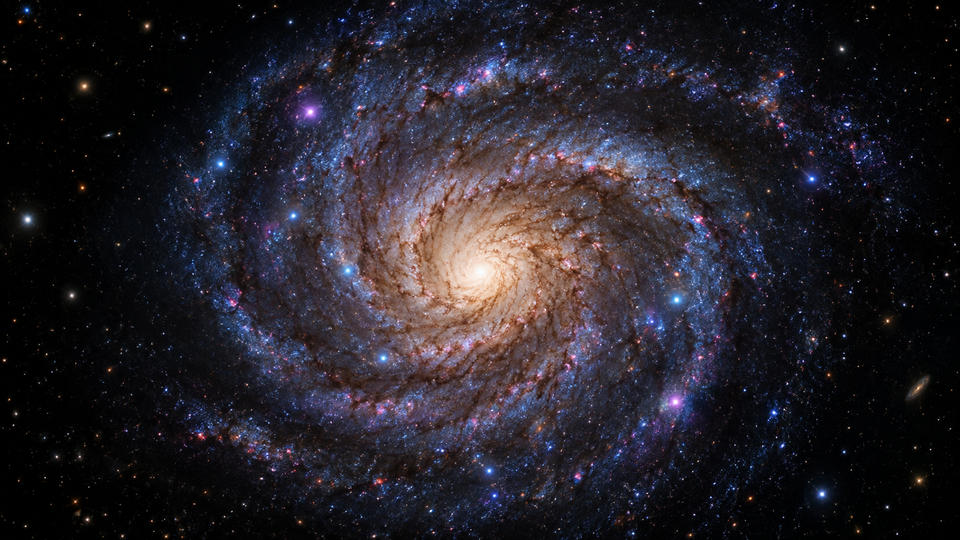
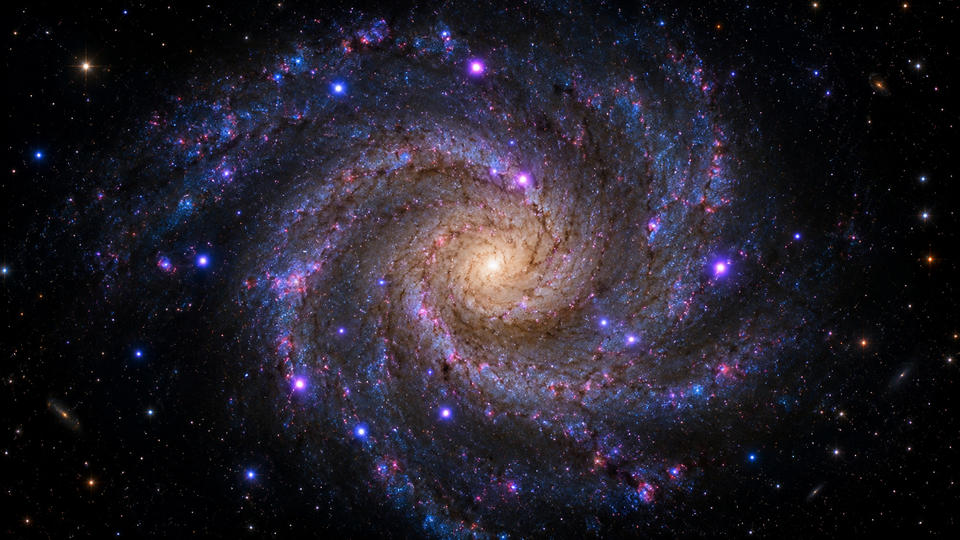
The researchers searched Chandra data from six nearby galaxies. Two are spiral galaxies: M31, better known as the Andromeda Galaxy, and M101, the Pinwheel Galaxy. Four others are elliptical galaxies. The sample was deliberately useful because it included very different stellar environments, from regions with active star formation to populations dominated by older stars.
The team looked for sources that appeared at Chandra’s lowest X-ray energies but became faint or disappeared when the data were examined at higher energies. That spectral behavior is the key clue. A normal bright X-ray binary usually emits a substantial amount of harder radiation. These sources were dramatically softer.
In total, 84 candidates met the researchers’ criteria. Seven were identified in M101 alone. NASA’s Chandra team emphasized that the sources are visually unremarkable in ordinary images: they look like tiny points among countless other stars and compact systems. Their strange nature becomes apparent only when astronomers separate the incoming radiation by energy.
The discovery is therefore a good example of how old observations can still produce new astronomy. The objects were not found because a telescope suddenly saw a new galaxy. They emerged because researchers asked a different question of data that already existed.
What could be producing so much soft radiation?
The answer is not yet settled, and the study does not claim that all hypersoft X-ray sources are the same kind of object. Instead, the researchers propose that the new observational class may contain several types of accreting binary systems.
One possibility involves white dwarfs. A white dwarf can pull gas from a companion star, heating material on or near its surface. Some white-dwarf systems can become extremely hot and luminous at soft X-ray and EUV wavelengths. Post-nova systems may also temporarily occupy this regime after an eruption.
That possibility is particularly interesting because some accreting white dwarfs are candidates for the progenitors of Type Ia supernovae. These explosions are extraordinarily important in astronomy. Because their brightness can be calibrated, Type Ia supernovae are used to measure cosmic distances and helped reveal that the expansion of the universe is accelerating.
Yet astronomers still debate the exact evolutionary paths that lead to all Type Ia explosions. If a meaningful fraction of hypersoft sources are white dwarfs steadily gaining material, the new population could help researchers test some of those pathways.
Other HSSs may contain black holes. Matter spiraling toward a black hole forms an accretion disk, and under some conditions the disk can produce a spectrum dominated by relatively low-energy radiation. Neutron-star systems are another possibility. The important point is that “hypersoft X-ray source” describes what astronomers observe, not a single confirmed physical object.
Could these sources change the gas inside galaxies?
This may be the discovery’s broadest implication. Extreme-ultraviolet photons are easily absorbed by atoms, which means they are very effective at ionizing gas. Ionization occurs when energetic radiation knocks electrons away from atoms. Large populations of hidden EUV sources could therefore influence the temperature, chemistry, and ionization state of gas across a galaxy.
Astronomers have long tried to account for all the radiation needed to explain ionized gas in different galactic environments. Hypersoft sources could supply part of that missing energy budget, especially if the 84 detected objects represent only the visible edge of a much larger population.
The study’s authors argue that the sources may be among the most energetic non-nuclear emitters in galaxies while remaining difficult to recognize. That sounds contradictory, but it makes sense once absorption is considered. A lighthouse can be powerful and still be invisible if the light is emitted at wavelengths that cannot pass through the material between the source and observer.
This is why the discovery matters beyond simply adding a new name to an astronomy catalog. If hypersoft sources are common, models of galactic ionization may need to include them. If some are accreting white dwarfs, they may also provide new evidence about the systems that eventually explode as Type Ia supernovae.
What happens next?
The immediate challenge is identification. Astronomers need to determine which HSSs contain white dwarfs, which contain black holes or neutron stars, and whether other types of systems are hiding in the sample. Repeated observations can reveal whether individual sources brighten, fade, recur, or remain stable over time.
Multiwavelength observations will also be essential. Optical and ultraviolet data can help identify companion stars and surrounding environments, while X-ray spectra and variability can constrain the temperature and size of the emitting region. The problem is that the wavelengths carrying much of the energy are exactly the ones most strongly absorbed by intervening gas.
That makes the population both scientifically valuable and technically difficult. The researchers may be seeing a class of objects that has always been present in nearby galaxies but sits at the edge of what existing observatories can detect.
For now, the strongest conclusion is also the simplest: astronomers have uncovered a substantial population of luminous sources with spectral behavior unlike the standard X-ray classes used to describe compact binaries. Their exact identities remain uncertain, but their numbers and energy output are large enough that they cannot easily be dismissed as rare curiosities.
Sometimes a major discovery is a new object appearing in the sky. In this case, the surprise came from realizing that dozens of powerful objects had been hiding in a part of the spectrum we rarely see clearly.
Sources and verification
This article is based primarily on the peer-reviewed paper by Mustafa Muhibullah, Jimmy A. Irwin, and Rosanne Di Stefano, “Hypersoft X-ray sources as a low-energy class of luminous cosmic emitter,” published in Nature Astronomy on September 9, 2026, together with NASA/Chandra’s official release describing the discovery.
Nature Astronomy research paper
NASA Science: Chandra discovery release
Post a Comment