

Space junk sounds like the kind of problem that should have a simple solution: send up a spacecraft, collect the trash, and bring it down. In reality, a cleanup spacecraft has to match orbits with objects moving around Earth at several kilometers per second, often at very different altitudes and inclinations.
So can we actually clean up space junk? Yes—but not by removing everything. The realistic goal is to identify the objects most likely to cause future collisions, safely capture or redirect some of them, deal with smaller debris where practical, and stop adding new junk faster than we can remove the old.
Why Space Junk Is Much Harder to Clean Up Than Trash on Earth
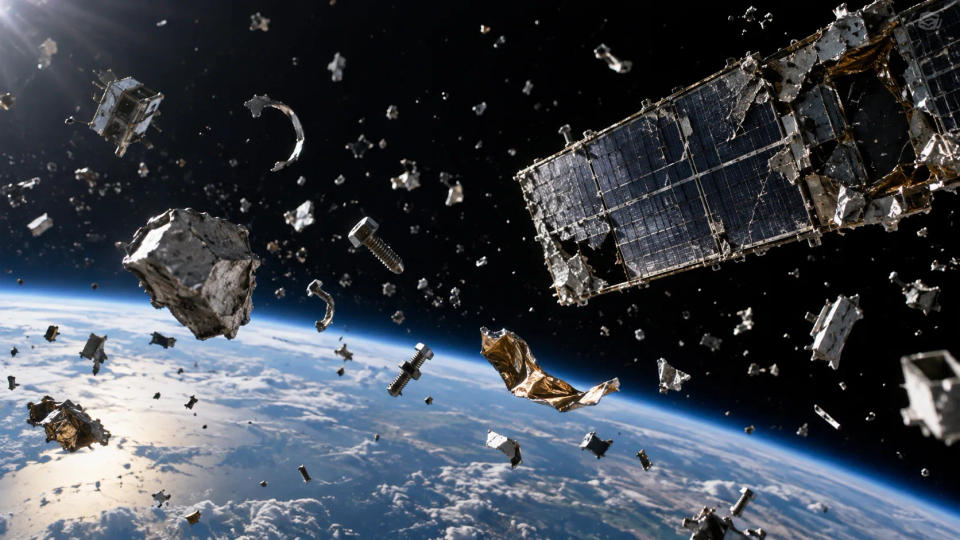
The first problem is scale. According to the European Space Agency's Space Debris Office, about 46,950 objects are regularly tracked in orbit as of July 31, 2026. Models estimate roughly 1.5 million debris objects between 1 and 10 centimeters across, plus around 230 million between 1 millimeter and 1 centimeter.
Most of those smaller fragments cannot simply be collected one by one. They are too numerous, many are too small to track continuously, and each follows its own orbit. A cleanup vehicle would need fuel to change its speed and orbital plane, and even a modest change in orbital inclination can require a large amount of propulsion.
There is also no single ring of garbage circling Earth. Debris is spread through many orbital regions. Some objects are in relatively low orbits where atmospheric drag will eventually pull them down. Others can remain aloft for decades or centuries.
This is why space agencies do not talk about making Earth orbit spotless. The practical question is how to reduce collision risk enough to keep the busiest orbital regions usable.
The Best Targets Are Often Large, Dead Objects
A tiny fragment can destroy or disable a spacecraft, but removing millions of tiny fragments individually is extraordinarily difficult. Large dead satellites and abandoned rocket bodies offer a different opportunity.
They are comparatively easy to track, and some have enough mass and cross-sectional area to create a serious long-term hazard. If two large objects collide, the result can be thousands of additional fragments. Removing one high-risk object can therefore do more than eliminate a single piece of junk: it can reduce the chance of a future fragmentation event that would make the environment worse.
That is why long-term debris-control studies often focus on selected large objects in crowded regions of low-Earth orbit. ESA's latest 2026 Space Environment Report says active debris removal is needed alongside better end-of-life disposal because collisions among existing objects can create new debris even if launch behavior improves.
NASA has taken a broader view of remediation. Its cost-benefit studies have considered not only complete removal, but also moving large objects away from potential collisions and concepts for dealing with smaller debris. In other words, “cleanup” can mean preventing a collision before it happens, not necessarily hauling every object out of orbit.
How Would a Spacecraft Remove a Dead Satellite?
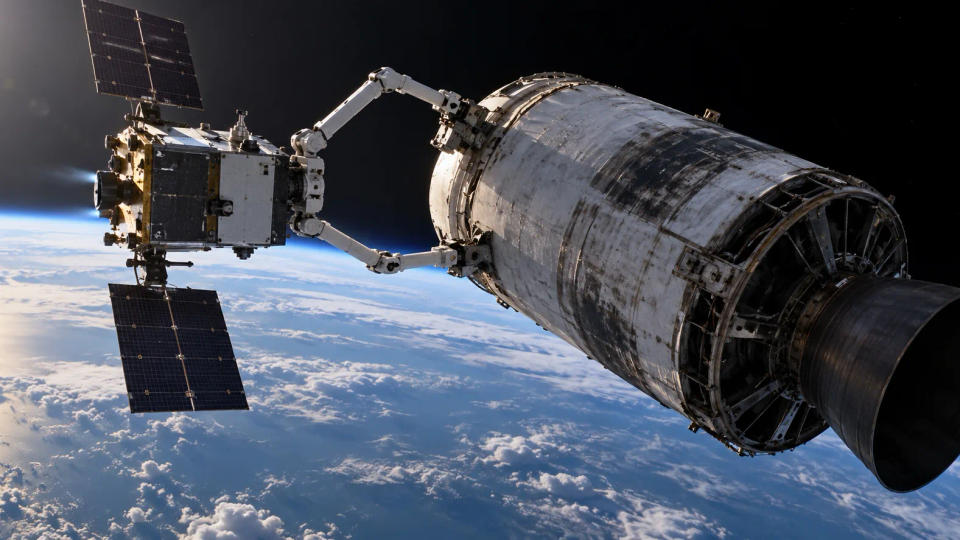
The basic sequence sounds simple. A servicing spacecraft enters a similar orbit, approaches the target gradually, matches its motion, inspects it, captures it, and then changes the combined object's orbit so it can reenter safely or move to a disposal orbit.
The capture step is the difficult part. Old spacecraft were usually never designed to be grabbed after retirement. They may have no docking port, no navigation beacon, and no way to cooperate with the approaching vehicle. Some may also be slowly tumbling.
A remover therefore needs precise cameras, navigation sensors, autonomous collision avoidance, and a capture system such as robotic arms or another mechanical gripping device. Once attached, the combined spacecraft becomes heavier and awkward to control. The tug must then lower the orbit without losing its grip or creating new fragments—the exact opposite of what the mission is supposed to achieve.
Other cleanup concepts have included nets, tethers, drag devices and laser-based techniques for altering the orbits of smaller debris. Some of these ideas are promising in simulations or demonstrations, but there is no universal tool that works for every object. A dead satellite, a spent rocket stage and a one-centimeter fragment are three very different engineering problems.
Real Debris-Removal Missions Are Moving From Theory Toward Flight
The most important progress is that engineers are now practicing the hardest part: getting close to an uncooperative object without hitting it.
Japan's JAXA-backed ADRAS-J mission, built by Astroscale, approached and inspected a roughly 11-meter-long, 3-ton abandoned rocket upper stage. During the mission it performed fly-around observations and came within 15 meters of the target. Astroscale announced in March 2026 that ADRAS-J had completed its main operations and begun lowering its own orbit for eventual atmospheric reentry.
The follow-on ADRAS-J2 mission is being developed to return to the same rocket body, capture it with robotic-arm technology and deorbit it. Astroscale says the mission is targeted for launch in Japan's fiscal year 2027, which runs from April 2027 through March 2028.
Europe is pursuing a similar goal. ESA's ClearSpace-1 mission is being developed to rendezvous with, capture and remove the agency's approximately 95-kilogram PROBA-1 satellite, an object that was not designed with a removal interface. The mission developer, ClearSpace, currently lists a 2028 launch date.
These missions will not clean up Earth orbit by themselves. What they can do is prove the navigation, inspection, capture and controlled-disposal techniques needed to turn debris removal from a one-off experiment into a repeatable service.
Why Cleanup Alone Will Never Be Enough
Even a successful removal industry faces economics, law and simple arithmetic. A dedicated spacecraft is expensive, while the number of debris objects is enormous. There is also the question of permission: under Article VIII of the Outer Space Treaty, ownership of a space object is not erased simply because the object is no longer useful. A company cannot treat another country's dead satellite like abandoned roadside scrap and take it without authorization.
That makes prevention just as important as removal. New spacecraft can be designed to lower themselves after their missions, vent stored energy that might cause explosions, use standardized servicing or capture interfaces, and avoid crowded orbital regions when possible. Better tracking and coordination can prevent collisions between maneuverable spacecraft before they happen.
ESA's 2026 report makes the central point clearly: prevention is cheaper, but prevention by itself is no longer enough. The orbital population already contains enough long-lived hardware and fragments that active removal will have to be part of the solution.
The most realistic future is not a perfectly clean sky. It is an orbital environment managed more like critical infrastructure: new satellites designed not to become hazards, operators sharing better tracking data, dangerous encounters avoided when possible, and specialized spacecraft sent after the few objects whose removal can make the biggest difference.
Space junk can be cleaned up. The challenge is choosing the right pieces to remove—and making sure we stop replacing them with new ones.
Post a Comment