
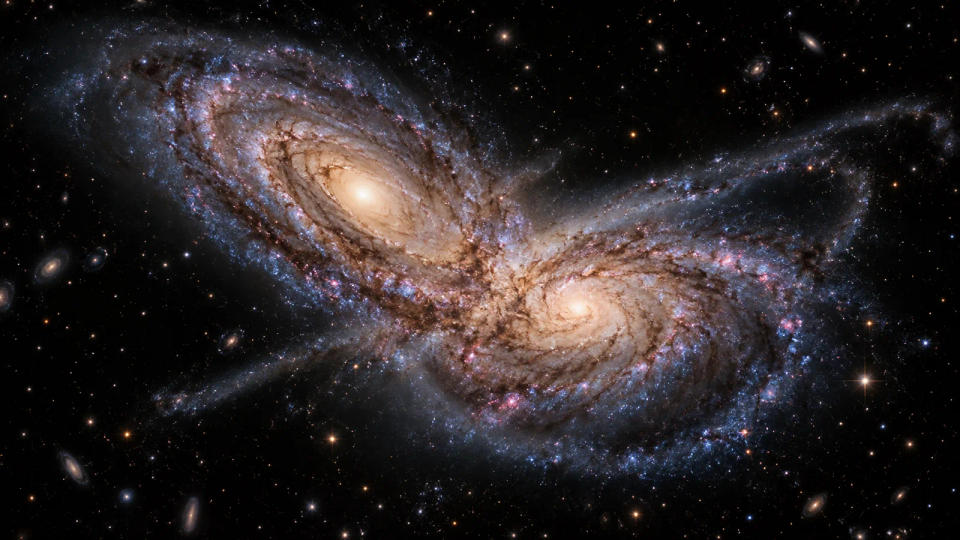
Imagine two galaxies, each containing billions of stars, heading straight into one another. It sounds like the setup for the biggest pileup in the universe. Yet the surprising answer is yes: two galaxies can overlap and pass through each other while almost every star avoids a direct collision.
That does not mean the encounter is gentle. Gravity can stretch both galaxies out of shape, gas clouds can slam together, new stars can form in bursts, and the galaxies may later return for another encounter and merge. The strange part is that the stars themselves are usually not what hits.
Why Don’t the Stars Collide When Galaxies Do?
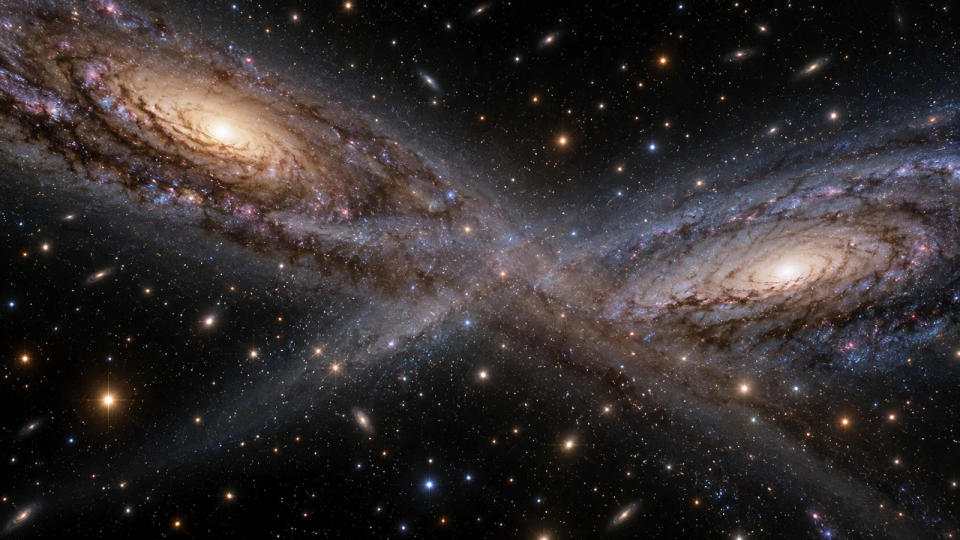
A galaxy can look densely packed in a photograph because all its light is compressed into a flat image. In three-dimensional space, however, the stars are separated by enormous distances.
The Sun is about 1.4 million kilometers across, but the nearest star system beyond the Sun is more than four light-years away. That gap is tens of millions of times wider than the Sun itself. Most stars in a typical galaxy occupy similarly vast stretches of space.
Imagine two swarms of tiny grains, with each grain made extremely small and the grains spread kilometers apart. If the swarms moved through each other, almost all of the grains would miss. That is much closer to what happens when the stellar populations of two galaxies overlap.
NASA’s Hubble team notes that direct stellar collisions are very rare because stars occupy only a tiny fraction of a galaxy’s volume. In the interacting system NGC 6052, for example, stars were sent onto new paths by the changing gravitational field even though actual star-to-star impacts were expected to be uncommon.
This does not mean stellar collisions can never happen. In exceptionally dense environments, such as compact star clusters and regions near galactic centers, the odds can be higher. But a normal galaxy encounter does not turn billions of stars into a cosmic pinball machine.
What Actually Collides During a Galaxy Encounter?
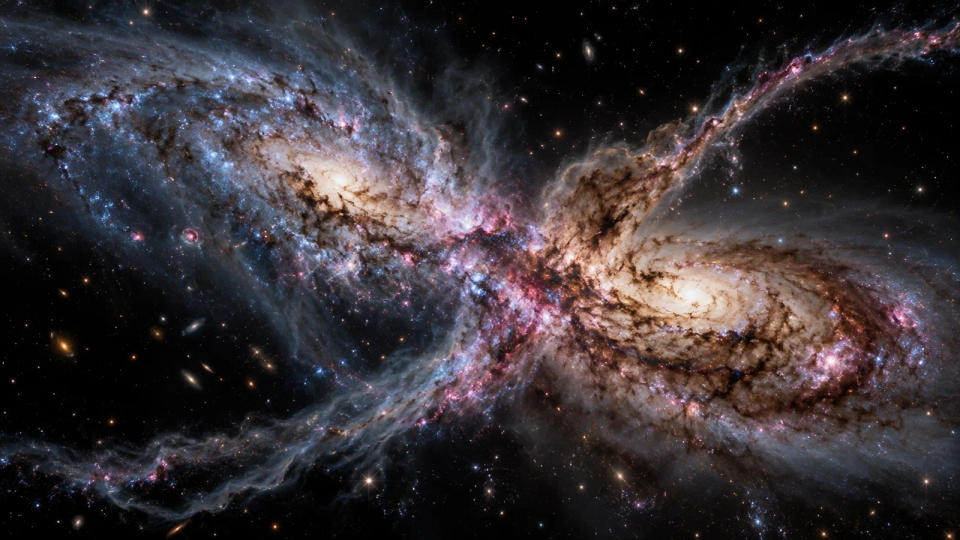
Stars are tiny targets, but a galaxy also contains gas and dust spread across enormous regions. Those materials behave very differently.
When the gas-rich disks of two galaxies overlap, giant clouds can run into other clouds. The gas can be compressed, shocked, heated, and redirected. In some regions, that compression helps dense clouds collapse under their own gravity, producing bursts of new star formation. This is why interacting galaxies often contain bright knots of young blue stars and glowing nebulae.
Dust and magnetic fields are disturbed as well. The encounter can draw out long bridges and tails of material far beyond the original disks. In famous systems such as the Antennae Galaxies, those tidal structures are among the clearest signs that a major gravitational interaction is under way.
So the phrase “galaxy collision” is not wrong, but it can create the wrong mental picture. It is not like two solid plates crashing together. It is more like two immense, mostly transparent systems interpenetrating while their diffuse material interacts and their gravity rearranges almost everything.
The galaxies’ dark-matter halos can overlap too. Dark matter is thought to be effectively collisionless on these scales, so it does not behave like colliding gas. But the halos still matter gravitationally. As a galaxy moves through the surrounding halo, its gravity creates a wake in the matter behind it. The pull of that wake can drain orbital energy, a process called dynamical friction.
Gravity Can Wreck a Galaxy Without Stars Touching
The most dramatic damage in a galaxy collision comes from gravity acting across tens or hundreds of thousands of light-years.
As two galaxies approach, the near side of each galaxy feels a somewhat stronger pull than the far side. Those differences create tidal forces. Spiral arms can be stretched, disks can warp, and streams of stars can be pulled into long tails. A galaxy can look torn apart even though almost none of its stars physically touched a star from the other system.
The stars are not destroyed; their orbits are rewritten. Some move toward the center of the interacting system. Others are thrown outward into extended halos or tidal streams. If the galaxies eventually merge, their original orderly disks may be transformed into a very different structure.
The supermassive black holes in the galactic centers also do not normally smash together on the first pass. If the galaxies become bound and merge, the black holes can sink toward the new center over a much longer period. They may eventually form a binary and, under the right conditions, merge themselves.
This is why astronomers can learn so much from oddly shaped galaxies. A stretched tail, warped disk, double nucleus, or bridge of stars can preserve evidence of an encounter that has been unfolding for hundreds of millions of years.
Can Galaxies Pass Through Each Other and Keep Going?
Sometimes, yes. Whether two galaxies merge or separate again depends on their speed, direction, mass, and how much orbital energy the encounter removes.
Hubble observations of IRAS 06076-2139 provide a useful example. The system contains two galaxies passing one another at roughly 2 million kilometers per hour. NASA and ESA noted that the speed is probably too high for the pair to settle into a single merged galaxy, even though their gravity strongly distorts both of them.
Other encounters are slower or more tightly bound. In those cases, the galaxies may pass through each other once, move apart, then fall back together. Repeated passages transfer energy into the motions of stars and dark matter, while gravitational interactions gradually shrink the orbit. Eventually the galaxies can merge.
Our own Milky Way and Andromeda show why the outcome is not always simple. For years, a future merger was widely presented as essentially inevitable. A 2025 study in Nature Astronomy used Hubble and Gaia measurements while also accounting for the Large Magellanic Cloud and the Triangulum Galaxy. In the full four-galaxy simulations, the probability of a Milky Way–Andromeda merger within the next 10 billion years was only slightly above 50 percent.
That result does not change the basic physics of galaxy collisions. It highlights it. Galaxies are not solid objects on predetermined crash courses. They are vast gravitational systems whose stars, gas, dark matter, and companion galaxies all influence the final path.
Two galaxies can therefore pass through one another without their stars colliding, and they can even emerge as two separate galaxies afterward. But “nothing collided” would be the wrong conclusion. Their gas may crash, their shapes may be transformed, new stars may form, and billions of stellar orbits may change. In a galaxy collision, the empty space between stars prevents the obvious catastrophe—and gravity is what makes the encounter spectacular anyway.
Post a Comment