
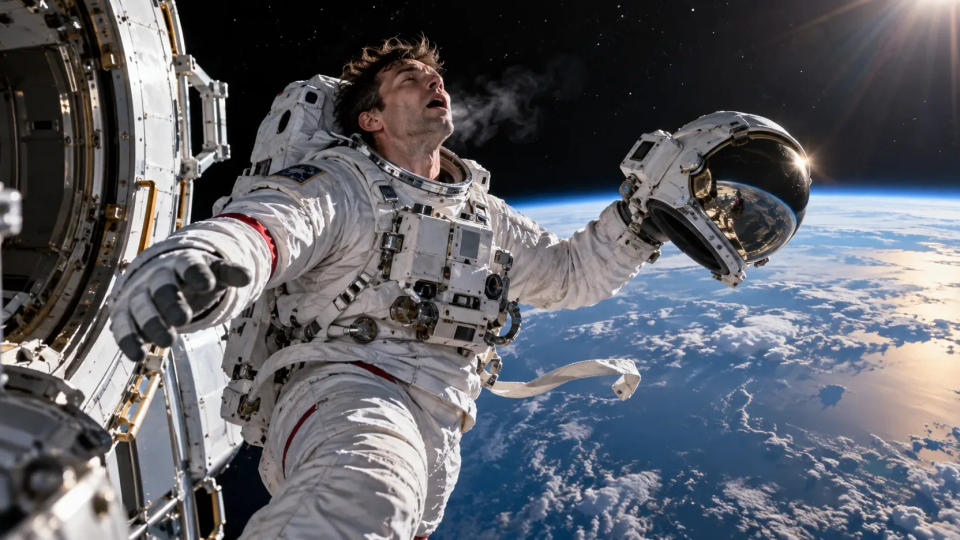
Taking off a spacesuit in space would not make an astronaut explode, freeze solid, or instantly turn into an ice-covered statue. The real danger is more straightforward and much faster: without pressure and breathable oxygen, the body would begin to suffer from hypoxia and vacuum exposure within seconds.
The suit is not just warm clothing. It is a small life-support system that keeps enough pressure around the body for human tissues to function, supplies oxygen, removes carbon dioxide, and controls temperature. Remove that protective environment in open space, and several things start happening almost at once.
The First 15 Seconds Would Be the Most Critical
The first problem is not cold. It is the sudden loss of pressure and oxygen.
If an astronaut removed a helmet or opened a suit to vacuum, air in the lungs would rush outward. The safest instinct would be to exhale rather than hold the breath. Trapped gas expands as pressure falls, so holding a full breath during rapid decompression could injure delicate lung tissue.
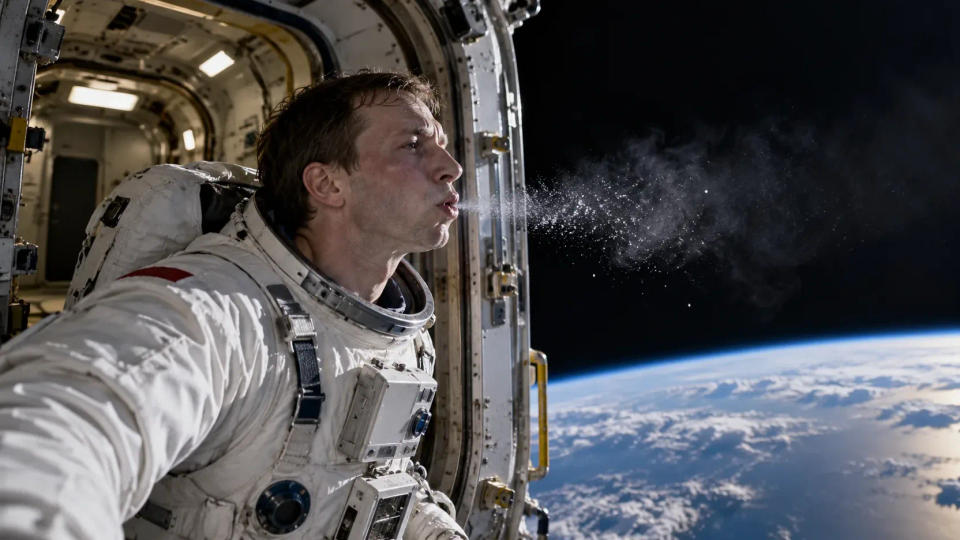
For a few seconds, the astronaut could remain conscious because the blood and brain still contain some oxygen. But that reserve disappears quickly. NASA has documented a 1965 vacuum-chamber accident in which test subject Jim LeBlanc remained conscious for roughly 14 seconds after his suit lost pressure. He later recalled feeling moisture on his tongue begin to boil before he blacked out.
That detail sounds extreme, but it illustrates what very low pressure does. In a vacuum, exposed moisture can begin to vaporize at body temperature. Saliva and moisture on the eyes or airways are far less protected by internal pressure than circulating blood.
The body would not have much useful time to react. Once oxygen-poor blood reaches the brain, consciousness is lost. At that point, self-rescue becomes impossible unless another astronaut or an automatic system can restore pressure.
Why the Body Would Swell but Not Explode
Science fiction often shows people bursting in vacuum. Human skin is tougher than that.
At sufficiently low pressure, water in exposed or poorly confined tissues can begin to form vapor bubbles, a process called ebullism. NASA medical references place the threshold near 47 mmHg of ambient pressure, corresponding to the so-called Armstrong limit at about 63,000 feet above Earth.
In open space, the pressure is far below that level. Soft tissues could swell as water vapor and dissolved gases expand. The face and limbs might become noticeably puffy, and gas in the digestive system would also expand.
But the body would not pop like a balloon. Skin, connective tissue, blood vessels, and the pressure inside the circulatory system provide mechanical restraint. Blood circulating inside vessels is also under pressure, so the popular claim that all of a person's blood would instantly boil is misleading.
The lungs are a special case. They contain gas, so a rapid pressure drop creates a strong pressure difference between air inside the lungs and the surrounding vacuum. That is why exhaling during decompression matters. A closed airway can turn expanding lung gas into a serious injury before oxygen deprivation becomes the only problem.
Why You Would Not Instantly Freeze
Space can be extremely cold, but “cold” in a vacuum does not work the way it does in winter air.
On Earth, your body loses heat through contact with air, moving air, evaporation, and radiation. In a vacuum, there is essentially no surrounding air to carry heat away by convection. That means an exposed astronaut would not instantly freeze simply because the environment is space.
Heat would still leave the body through thermal radiation, and exposed moisture could cool rapidly as it evaporates. At the same time, direct sunlight could deliver intense solar energy to surfaces facing the Sun. NASA notes that temperatures experienced during spacewalks can range dramatically between sunlit and shaded conditions.
So the immediate crisis would still be lack of oxygen and pressure, not freezing. Thermal damage and ultraviolet exposure matter, but they operate on a different timescale from the rapid loss of consciousness caused by hypoxia.
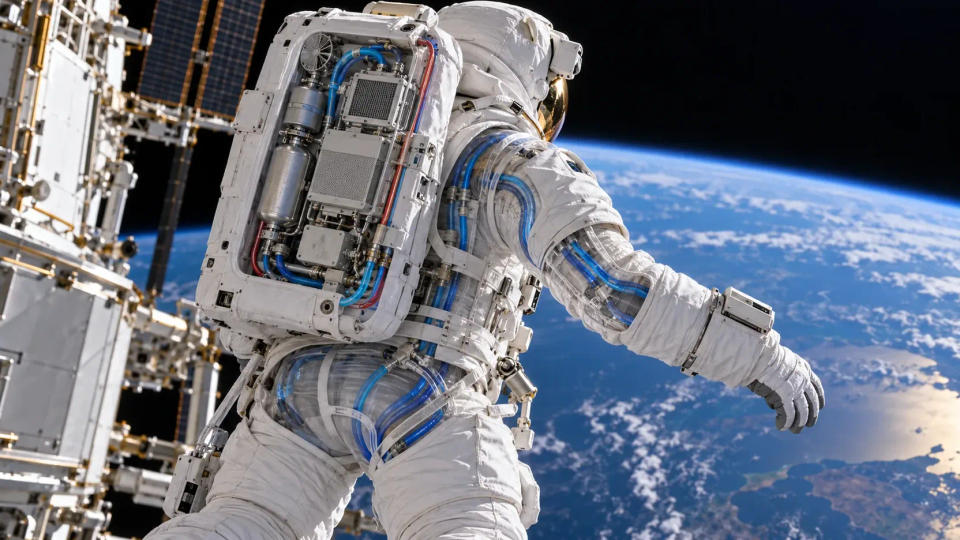
This is also why spacesuits need active thermal control rather than just thick insulation. Astronauts produce metabolic heat while working, and in vacuum that heat cannot simply be carried away by a breeze. Modern EVA suits circulate chilled water through tubes in a garment worn close to the skin.
Why a Spacesuit Is Really a Tiny Personal Spacecraft
A spacesuit solves several problems at once. NASA describes the spacewalk suit as a pressure garment connected to a portable life-support system. The backpack supplies oxygen, maintains suit pressure, circulates gas, removes exhaled carbon dioxide, and pumps cooling water.
That pressure is crucial. Humans do not need Earth sea-level pressure everywhere around the body, but they do need enough total pressure and oxygen partial pressure for the lungs and tissues to work safely. Spacewalk suits therefore use a carefully controlled internal atmosphere rather than simply filling the suit with ordinary air at sea-level pressure.
The suit also protects against temperature extremes, solar radiation, and tiny particles or debris. Its outer layers are part of the survival system, but pressure and oxygen are what turn the vacuum outside into a habitable bubble around the astronaut.
Could a person survive a very brief accidental vacuum exposure? Limited evidence says that survival is possible if repressurization happens quickly. NASA’s historical guidance notes that an exposure of roughly half a minute may not necessarily cause permanent injury if the person does not hold their breath, while exposures approaching one or two minutes become increasingly life-threatening. Those numbers are not a safe countdown; real outcomes depend on pressure, oxygen level, decompression rate, injuries, and how rapidly rescue occurs.
The 1965 chamber accident is important for exactly this reason. LeBlanc survived because the chamber was repressurized almost immediately. It does not show that vacuum exposure is safe. It shows that the body does not fail in the explosive, instantaneous way movies often suggest—and that rescue must happen extremely fast.
Conclusion
If an astronaut took off a spacesuit in open space, the body would not explode and would not instantly freeze. Air would rush from the lungs, exposed moisture could begin to vaporize, tissues could swell, and oxygen deprivation would likely cause unconsciousness in roughly a dozen seconds.
A spacesuit prevents that chain of events by doing something deceptively simple: it carries a small, controlled piece of Earth around the astronaut. In space, that bubble of pressure, oxygen, cooling, and protection is the difference between working outside a spacecraft and facing an immediate medical emergency.
Sources & Further Reading
- NASA Goddard — How would the unprotected human body react to the vacuum of outer space?
- NASA Technical Reports Server — Improving Survival After Tissue Vaporization (Ebullism)
- NASA Johnson Space Center — Spacewalk Spacesuit Basics
- NASA — Risk of Decompression Sickness
- NASA Human Integration Design Handbook — Spacesuits
Post a Comment